Why do we have so many different transcripts?
Laurence D. Hurst

TL;DR
The paper discusses how transcript diversity in large-bodied species like mammals is largely due to random errors rather than functional necessity.
Contribution
It highlights a recent study showing that transcript diversity in mammals arises from accidental processes rather than adaptive evolution.
Findings
Transcript diversity in large-bodied species is attributed to accidental processes.
Alternative transcription and splicing contribute to transcript diversity without clear functional purpose.
Abstract
While it is tempting to suppose that everything that happens inside our cells has a function, a recent study in PLOS Biology adds to the growing consensus that, for large-bodied species, the high diversity of transcripts is down to the fact that accidents happen. The evolutionary significance of extensive transcript diversity generated by alternative transcription initiation, splicing and polyadenylation in eukaryotes remains controversial. This Primer explores a recent study in PLOS Biology showing that the high diversity of transcripts in mammals is down to the fact that accidents happen.
Click any figure to enlarge with its caption.
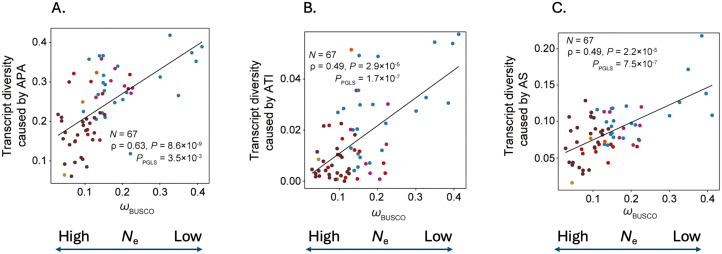 Figure 1
Peer Reviews
No public reviews on file for this paper yet. If you reviewed it on a platform where reviews are public (OpenReview, ICLR, NeurIPS, ICML), you can paste yours below so the community can read it here.
Videos
No videos yet. Explain this paper in a talk, walkthrough, or lecture? Add one.
Taxonomy
TopicsOrigins and Evolution of Life · RNA and protein synthesis mechanisms · Genomics and Chromatin Dynamics