What should be included in a digital mental health intervention, based on solution-focused therapy, for young people who self-harm? A qualitative exploration of young people and clinicians’ views
Lauren Jerome, Katherine Adams, Victoria Bird, Dennis Ougrin

TL;DR
This study explores what young people and clinicians think should be included in a digital mental health intervention based on solution-focused therapy for young people who self-harm.
Contribution
The study is the first to explore the acceptability of a solution-focused therapy-based digital mental health intervention for young people who self-harm.
Findings
Participants emphasized the importance of clear, straightforward, and personalized content in a digital mental health intervention.
Stakeholders wanted the intervention to challenge users with novel ways of thinking and ensure confidentiality.
Chatbots that lack understanding or only refer users elsewhere were seen as discouraging.
Abstract
Digital mental health interventions (DMHIs) are an important resource for individuals who find it difficult to access in-person services, such as young people who self-harm. Most DMHIs currently are based on Cognitive-Behavioural Therapy. Solution-Focused Therapy (SFT) could provide different skills and learning but is not currently delivered digitally. Involving key stakeholders in the development of a novel DMHI is important for ensuring acceptability. The aims of this study are to explore stakeholder perceptions of a novel DMHI based in SFT, to determine what would promote or hinder engagement, and identify important content to include. We conducted focus groups and individual interviews with young people with lived experience of self-harm (n = 12) and clinicians experienced in SFT and working with young people who self-harm (n = 16). We captured a range of views through collective…
Genes, proteins, chemicals, diseases, species, mutations and cell lines named across the full text — each resolved to its canonical identifier and authoritative record.
Click any figure to enlarge with its caption.
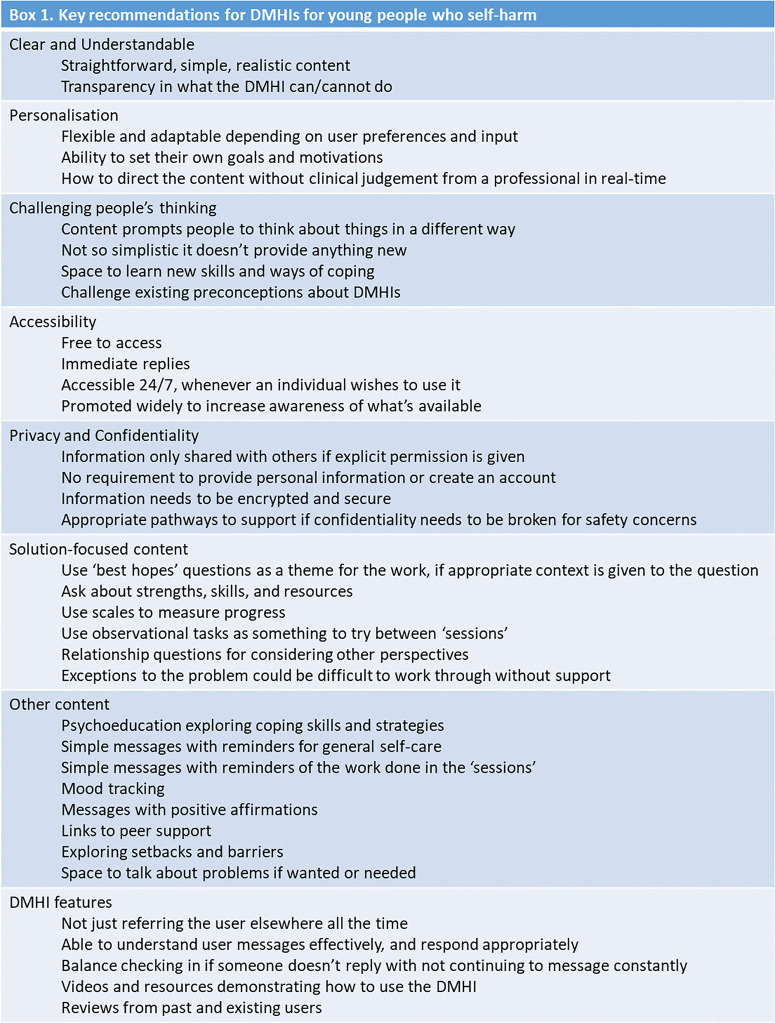 Figure 1
 Figure 2
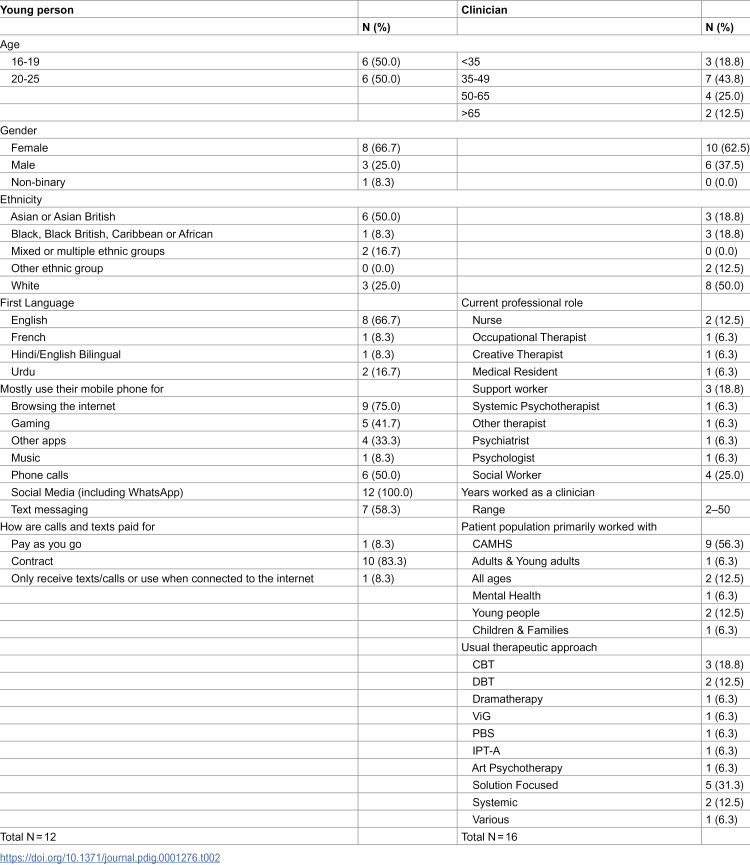 Figure 3
Peer Reviews
No public reviews on file for this paper yet. If you reviewed it on a platform where reviews are public (OpenReview, ICLR, NeurIPS, ICML), you can paste yours below so the community can read it here.
Videos
No videos yet. Explain this paper in a talk, walkthrough, or lecture? Add one.
Taxonomy
TopicsCounseling, Therapy, and Family Dynamics · Digital Mental Health Interventions · Mental Health and Patient Involvement