Characterizing patients who benefit from mature medical AI models in real-world clinical applications
Zhiyi Chen, Wei Li, Zhicheng Lin

TL;DR
Medical AI performs well in wealthy countries and for well-represented groups but fails to show benefits in diverse or underrepresented populations, highlighting a digital divide.
Contribution
Systematic analysis of real-world AI deployment reveals performance disparities and demographic biases in medical AI effectiveness.
Findings
AI models outperformed human practitioners in in-distribution settings but not in out-of-distribution deployments.
95.1% of AI patient cohorts were from high- or upper-middle-income countries, with no low-income country representation.
Performance advantages of AI disappeared in underrepresented populations and cross-demographic contexts.
Abstract
Medical artificial intelligence (AI) is being rapidly deployed in clinical practice, yet its real-world effectiveness across diverse patient populations remains poorly characterized. We conducted a systematic review combining automated screening (fine-tuned BERT-PubMed classifiers) with manual validation to identify studies of mature medical AI models deployed in healthcare facilities worldwide. We included 171 studies at the “device-into-practice” stage with sufficient demographic and performance data, representing 209,772 patients. Patient access to these models showed marked demographic disparities: geographic concentration was extreme (Dagum–Gini coefficient 0.97, P < .001), with 95.1% of patient cohorts (studies) from high-income (62.2%) or upper-middle-income (32.9%) countries—primarily China (28.7%) and the United States (18.9%)—and no studies from low-income countries. Racial…
Genes, proteins, chemicals, diseases, species, mutations and cell lines named across the full text — each resolved to its canonical identifier and authoritative record.
Click any figure to enlarge with its caption.
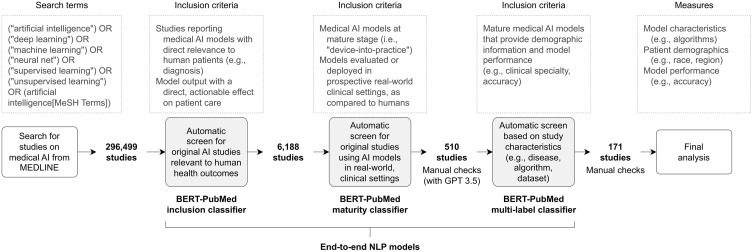 Figure 1
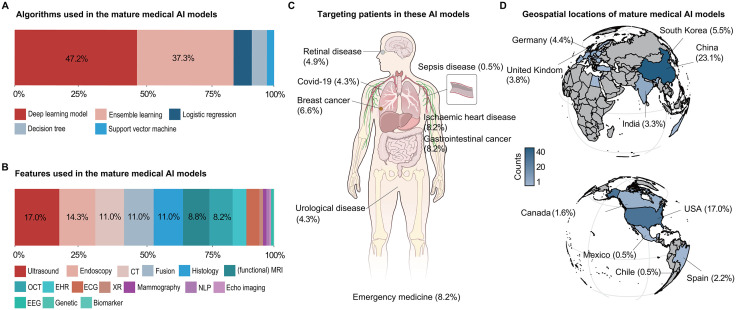 Figure 2
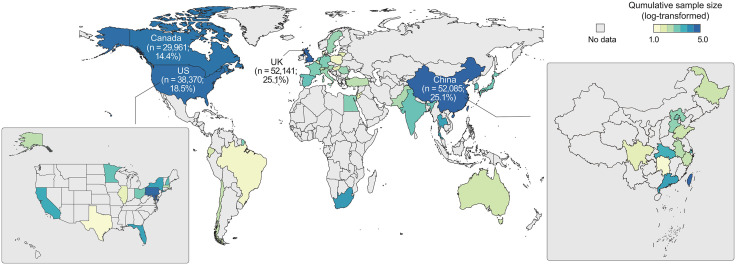 Figure 3
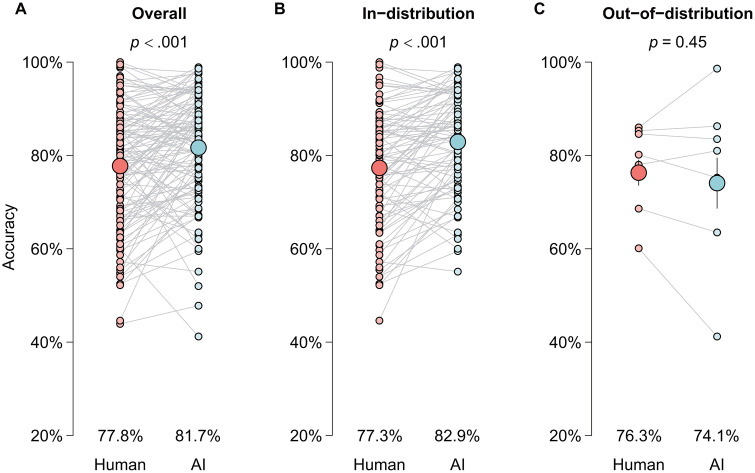 Figure 4
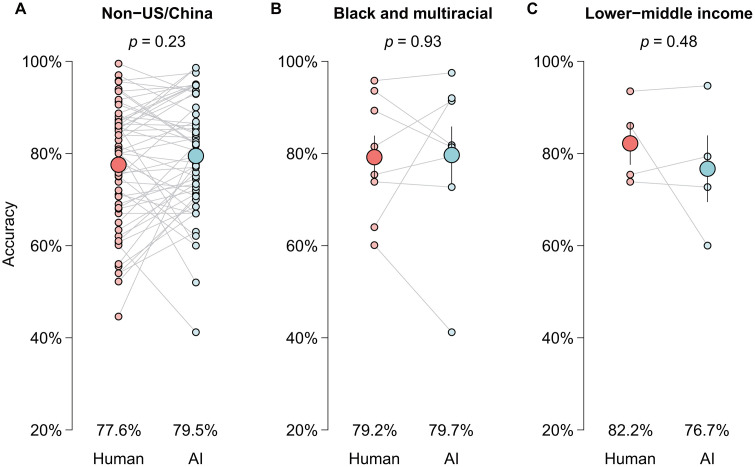 Figure 5
Peer Reviews
No public reviews on file for this paper yet. If you reviewed it on a platform where reviews are public (OpenReview, ICLR, NeurIPS, ICML), you can paste yours below so the community can read it here.
Videos
No videos yet. Explain this paper in a talk, walkthrough, or lecture? Add one.
Taxonomy
TopicsArtificial Intelligence in Healthcare and Education · Machine Learning in Healthcare · Electronic Health Records Systems