HfO2-based memristive synapses with asymmetrically extended p-n heterointerfaces for highly energy-efficient neuromorphic hardware
Babak Bakhit, Xiao Xie, Simon M. Fairclough, Atif Jan, Ingemar Persson, Giuliana Di Martino, Bonan Zhu, Caterina Ducati, Quanxi Jia, Bilge Yildiz, Andrew J. Flewitt, Judith L. MacManus-Driscoll

TL;DR
This paper introduces a new type of energy-efficient artificial synapse using HfO2-based materials for neuromorphic computing.
Contribution
A novel p-n heterointerface design in memristive devices enables ultralow energy consumption and high stability for neuromorphic hardware.
Findings
Memristors show ultralow switching currents (≤~10−8 A) and high retention (>105 s).
Devices exhibit hundreds of low conductance levels with a modulation range of >50.
The p-n heterointerface design reduces energy consumption and variability in memristors.
Abstract
The escalating energy consumption of existing artificial intelligence hardware has become a serious global issue that demands immediate action. Neuromorphic computing offers promises to drastically reduce this footprint. Here, we introduce multicomponent p-type Hf(Sr,Ti)O2 thin films for energy-efficient, resistive switching–based neuromorphic devices. We demonstrate interfacial memristors with ultralow switching currents (≤~10−8 A), exceptional cycle-to-cycle and device-to-device uniformities, and retention >105 s. They reveal hundreds of ultralow conductance levels with a modulation range of >50 (without reaching any saturation) and reproducibly satisfy unsupervised learning rules. This performance originates from incorporating a self-assembled p-n heterointerface between p-type Hf(Sr,Ti)O2 and n-type TiOxNy, resulting in a fully depleted space-charge layer asymmetrically extended…
Genes, proteins, chemicals, diseases, species, mutations and cell lines named across the full text — each resolved to its canonical identifier and authoritative record.
Click any figure to enlarge with its caption.
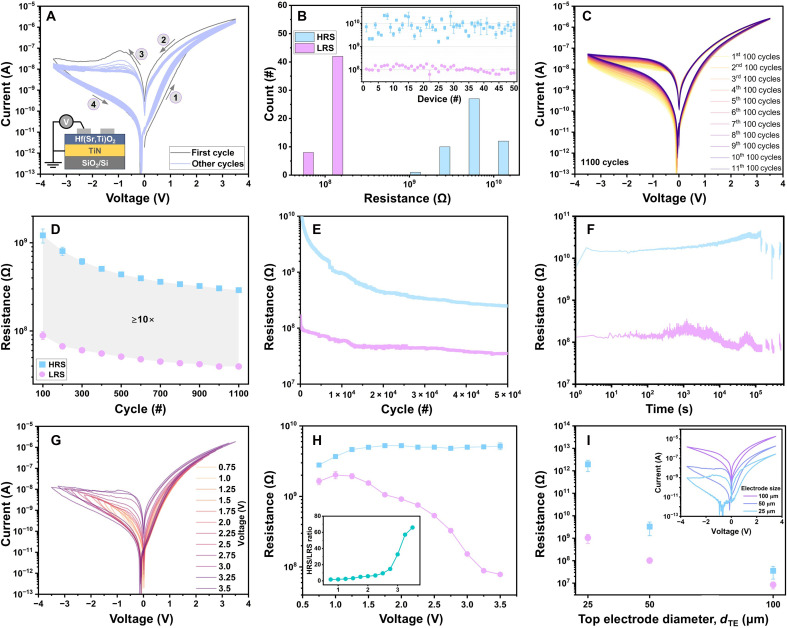 Figure 1
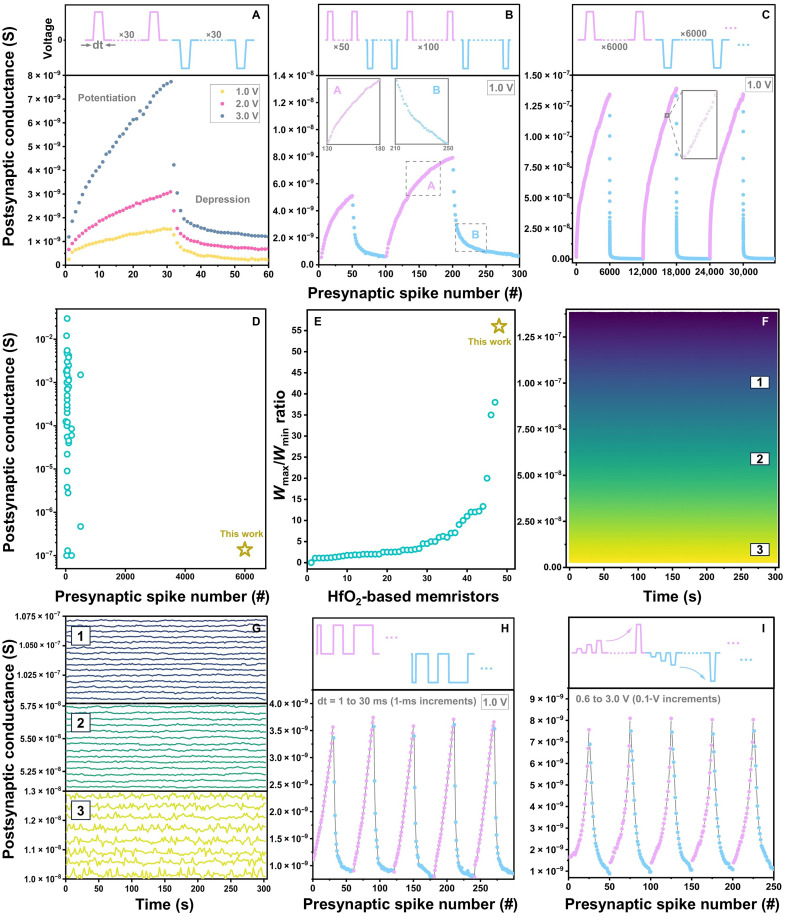 Figure 2
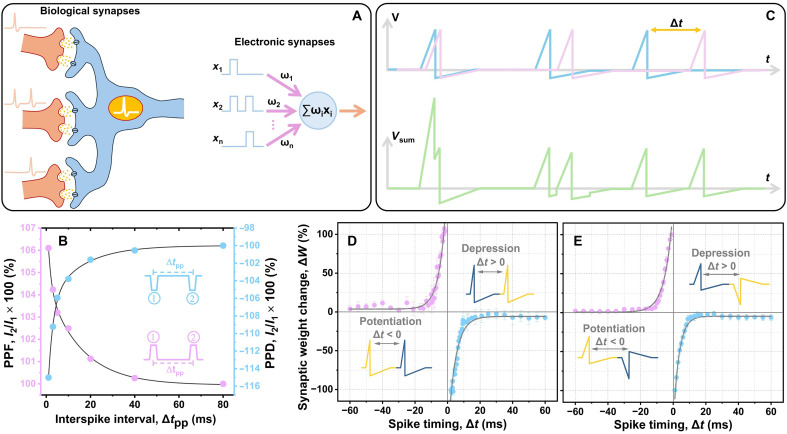 Figure 3
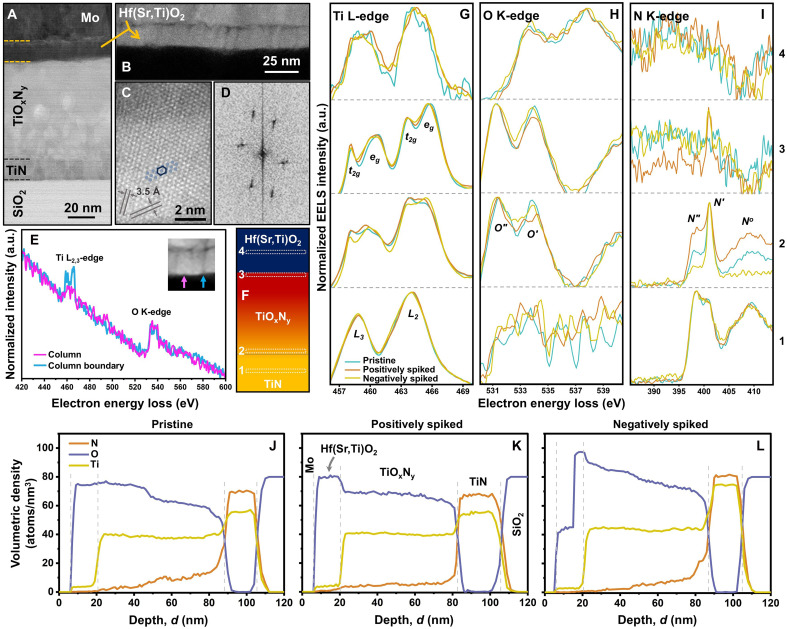 Figure 4
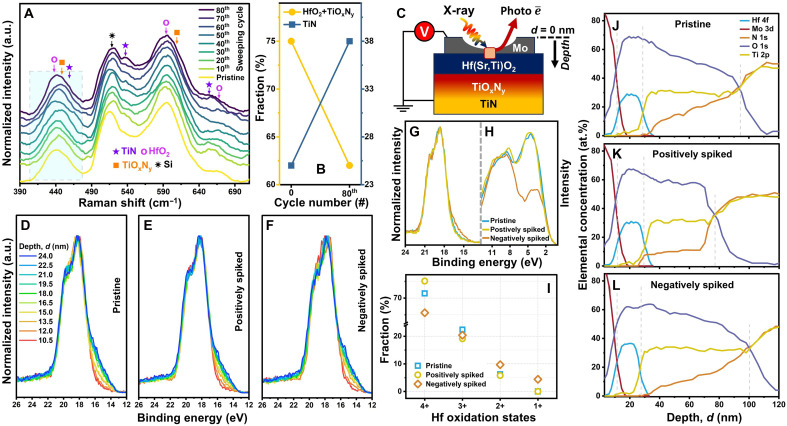 Figure 5
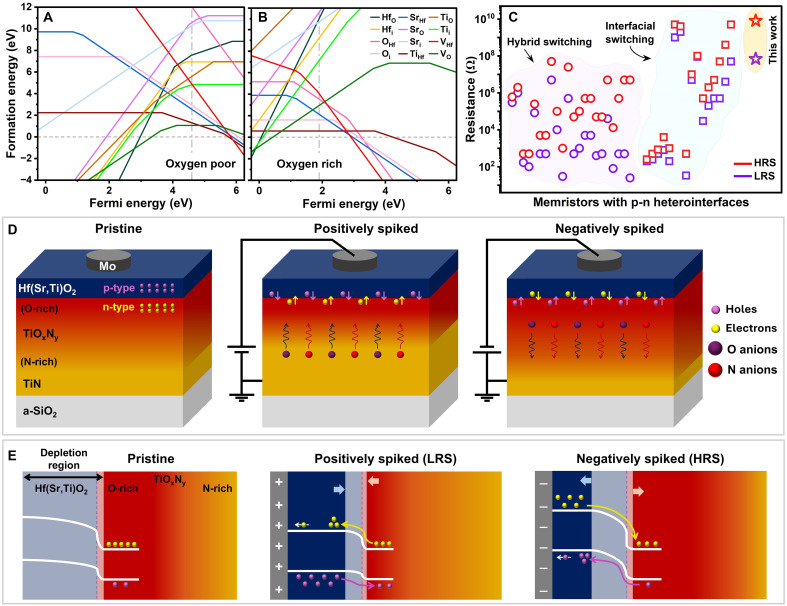 Figure 6
Peer Reviews
No public reviews on file for this paper yet. If you reviewed it on a platform where reviews are public (OpenReview, ICLR, NeurIPS, ICML), you can paste yours below so the community can read it here.
Videos
No videos yet. Explain this paper in a talk, walkthrough, or lecture? Add one.
Taxonomy
TopicsAdvanced Memory and Neural Computing · Ferroelectric and Negative Capacitance Devices · Transition Metal Oxide Nanomaterials