High‐Density Topological Defect Array by Two‐Step Interference Photoalignment
Sunqian Liu, Inge Nys, Kristiaan Neyts

TL;DR
A new method creates high-density topological defect arrays in liquid crystals using two-step interference photoalignment, enabling advanced optical applications.
Contribution
A scalable two-step interference photoalignment method is introduced to achieve high-density topological defect arrays in nematic liquid crystals.
Findings
Defect spacing as low as 1.25 micrometers is achieved using the two-step interference method.
Disclination lines connecting defects on opposing substrates are successfully created and analyzed.
The method enables optical components with large-angle diffraction and bridges LC topological optics with metasurfaces.
Abstract
With nematic liquid crystal (LC) topological defects can be created that are important for the generation of laser beams with orbital angular momentum. Arrays of defects have been realized through photoalignment, by projecting images of a spatial light modulator or digital mirror device. However, such pixel‐based approaches seriously limit the achievable density of defects. Here, we propose a scalable method based on two‐step interference illumination to achieve a much higher density. In the first step, a rotating director pattern is generated by the interference of two circularly polarized beams. In the second step, amplitude modulation by two‐beam interference is used to rewrite the pattern and introduce the defects. By adjusting the illumination doses and angles of incidence in both steps, 2D defect patterns are obtained, with spacing down to 1.25 micrometer. The resulting…
Genes, proteins, chemicals, diseases, species, mutations and cell lines named across the full text — each resolved to its canonical identifier and authoritative record.
Click any figure to enlarge with its caption.
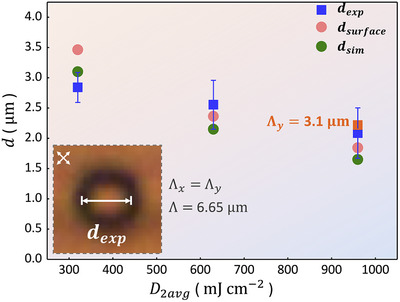 Figure 1
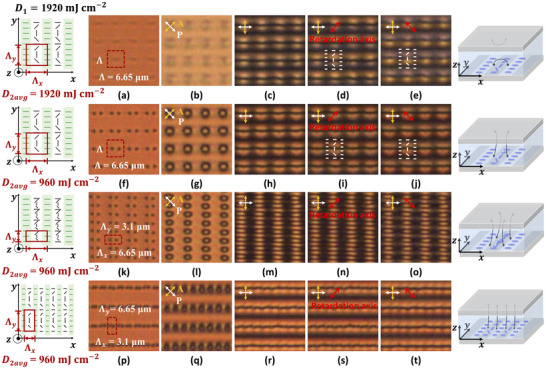 Figure 2
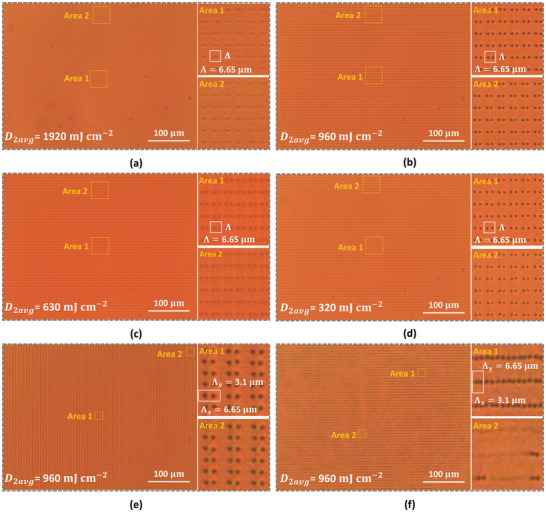 Figure 3
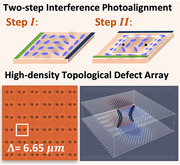 Figure 4
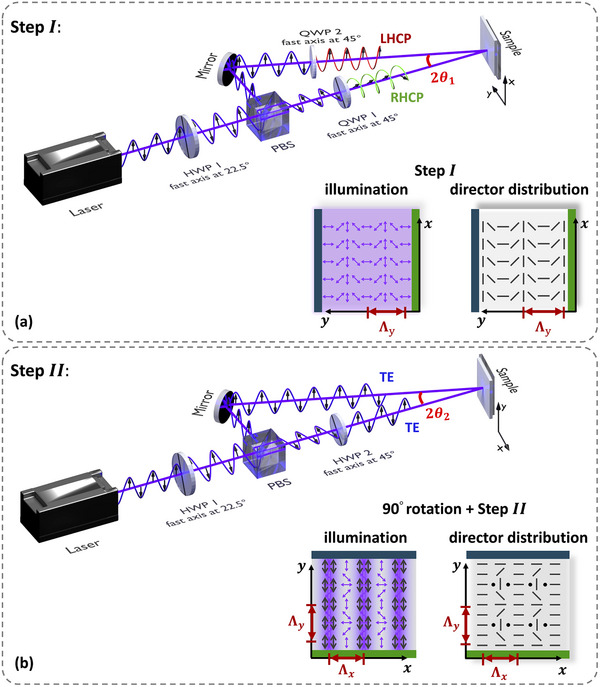 Figure 5
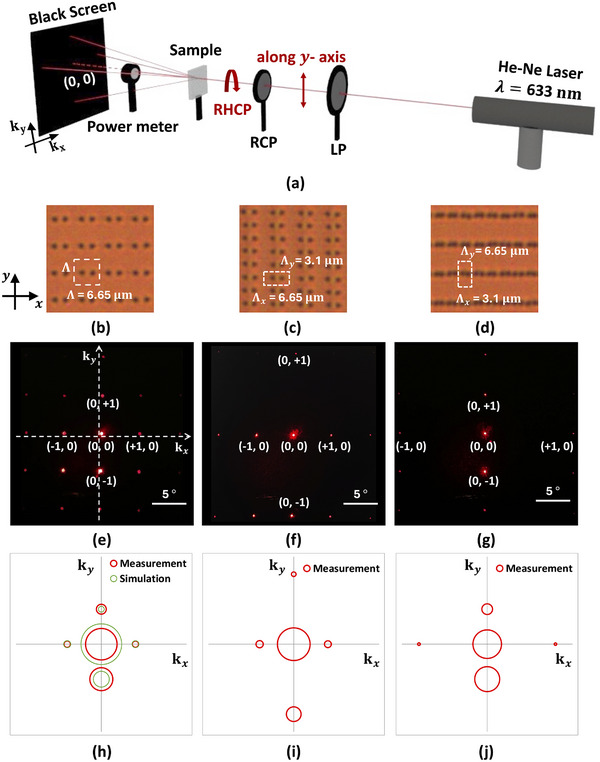 Figure 6
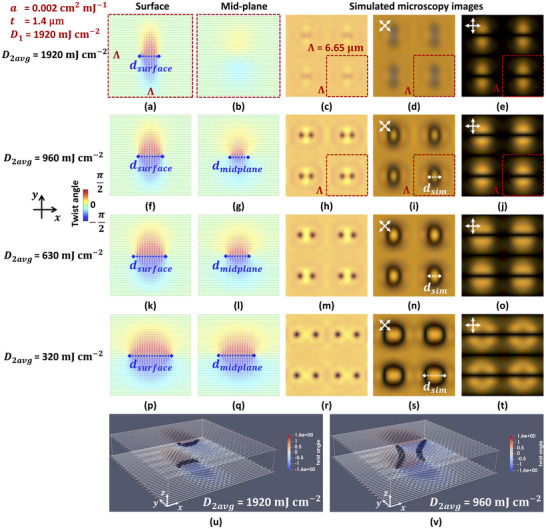 Figure 7
Peer Reviews
No public reviews on file for this paper yet. If you reviewed it on a platform where reviews are public (OpenReview, ICLR, NeurIPS, ICML), you can paste yours below so the community can read it here.
Videos
No videos yet. Explain this paper in a talk, walkthrough, or lecture? Add one.
Taxonomy
TopicsMetamaterials and Metasurfaces Applications · Orbital Angular Momentum in Optics · Advanced Antenna and Metasurface Technologies