High‐Performance Flexible Near‐Infrared Organic Light‐Emitting Diodes with a Heterogeneous Alloy Semitransparent Electrode
Mengxin Xu, Meina Han, Minying Xue, Shihao Liu, Yi Li, Gaoqiang Deng, Letian Zhang, Yuantao Zhang, Gang Cheng, Wenfa Xie, Chi‐Ming Che

TL;DR
A new flexible near-infrared OLED design uses a magnesium-bismuth alloy electrode to improve light efficiency and achieve record performance.
Contribution
A magnesium-bismuth alloy electrode is introduced to enhance efficiency in flexible near-infrared OLEDs.
Findings
The Mg-Bi alloy electrode achieves 40% broadband transmittance and 29.3 Ω ◻−1 conductivity.
The design reaches 42.3% light outcoupling efficiency and 71.8% photoluminescence quantum yield.
Flexible NIR OLEDs achieve a record 24.3% external quantum efficiency.
Abstract
Flexible near‐infrared (NIR) organic light‐emitting diodes (OLEDs) face efficiency challenges due to low photoluminescence quantum yields (PLQYs) in NIR emitters, governed by the energy gap law. Accelerating radiative transitions via the Purcell effect in optical microcavities offers a solution, but conventional flexible semitransparent electrodes struggle to balance microcavity‐enhanced PLQY and light outcoupling efficiency (OCE). We address this with a micro‐structured magnesium‐bismuth (Mg‐Bi) alloy electrode offering 40% broadband transmittance (400–1600 nm) and conductivity (29.3 Ω ◻−1). The alloy's low real permittivity supports less confined surface plasmon polariton and, with a capping layer, yields 60% NIR transmittance in an organic‐to‐air optical configuration. This design achieves 42.3% OCE and elevates the PLQY of a 704 nm NIR emitter to 71.8%, enabling flexible NIR‐OLEDs…
Genes, proteins, chemicals, diseases, species, mutations and cell lines named across the full text — each resolved to its canonical identifier and authoritative record.
Click any figure to enlarge with its caption.
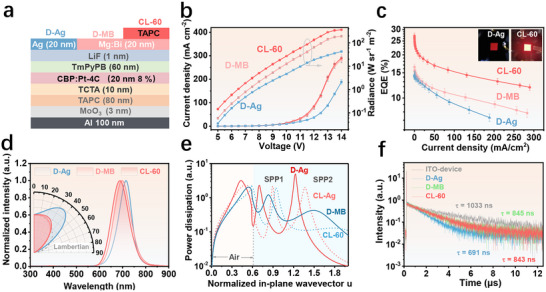 Figure 1
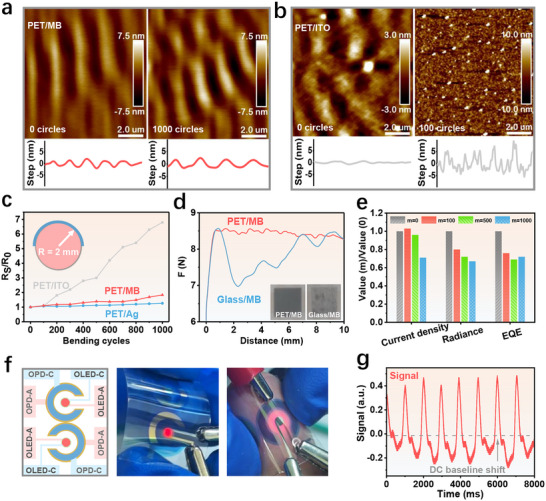 Figure 2
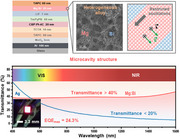 Figure 3
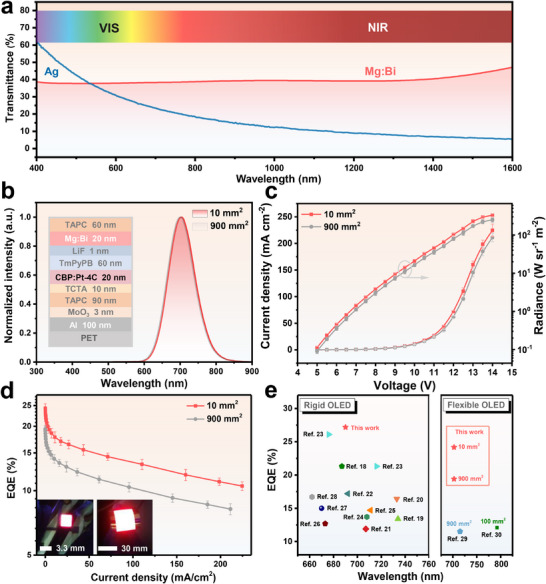 Figure 4
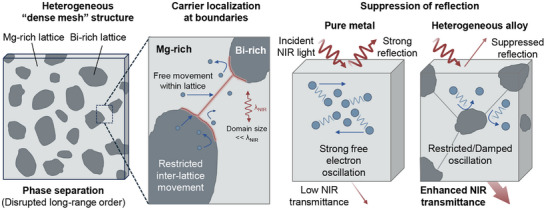 Figure 5
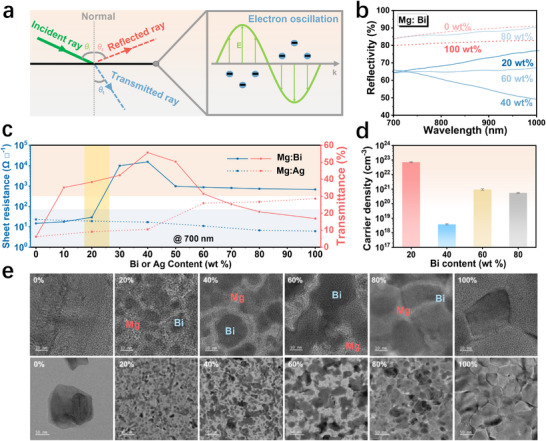 Figure 6
Peer Reviews
No public reviews on file for this paper yet. If you reviewed it on a platform where reviews are public (OpenReview, ICLR, NeurIPS, ICML), you can paste yours below so the community can read it here.
Videos
No videos yet. Explain this paper in a talk, walkthrough, or lecture? Add one.
Taxonomy
TopicsOrganic Light-Emitting Diodes Research · Nanomaterials and Printing Technologies · Strong Light-Matter Interactions