A post-marketing surveillance study on the safety and effectiveness of recombinant antithrombin gamma in patients with congenital antithrombin deficiency in Japan
Hidesaku Asakura, Manabu Iwabuchi, Masaki Fujita, Satoru Ito, Yuka Kanda, Hiroshi Kuwazawa

TL;DR
This study evaluated the safety and effectiveness of a treatment for a rare blood clotting disorder in Japanese patients, finding it generally safe and effective, especially during pregnancy.
Contribution
The study provides real-world evidence on the safety and effectiveness of recombinant antithrombin gamma in Japanese patients with congenital antithrombin deficiency.
Findings
rhAT-gamma was judged effective in all patients, with increased antithrombin activity in most.
Among pregnant women, no thrombosis occurred before or after delivery, leading to safe childbirth outcomes.
Adverse events were observed in 31.8% of patients, but no deaths occurred.
Abstract
Congenital antithrombin deficiency (CAD) is a serious inherited thrombophilia, classified as a rare disease. According to a study measuring antithrombin (AT) activity in the general Japanese population, approximately one in 650 people (0.15%) have AT deficiency. Deep vein thrombosis of the lower limbs is the most common clinical symptom. Pregnancy further increases the risk of venous thromboembolism in thrombophilia carriers. Recombinant human AT gamma (rhAT-gamma) is marketed for the treatment of thrombophilia due to CAD; however, no clinical trials for Japanese CAD patients have been conducted. Post-marketing surveillance was conducted at 22 sites in Japan from April 2016 to March 2022 to evaluate the safety and effectiveness of rhAT-gamma under clinical use conditions in CAD patients. Patients who had received rhAT-gamma for thrombophilia due to CAD were enrolled. The observation…
Genes, proteins, chemicals, diseases, species, mutations and cell lines named across the full text — each resolved to its canonical identifier and authoritative record.
Click any figure to enlarge with its caption.
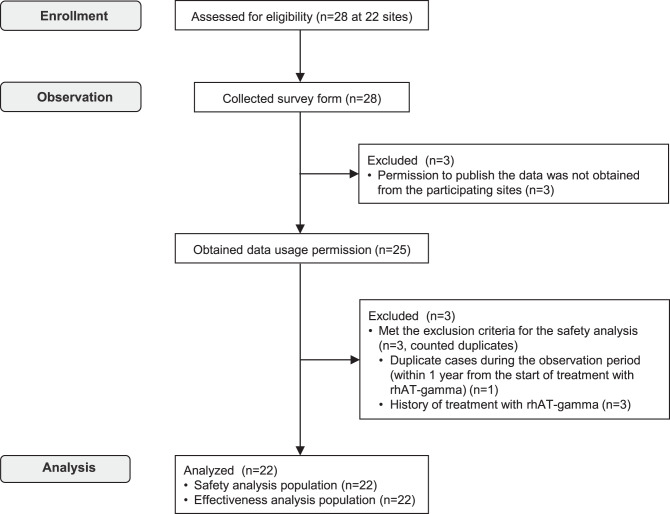 Figure 1
 Figure 2
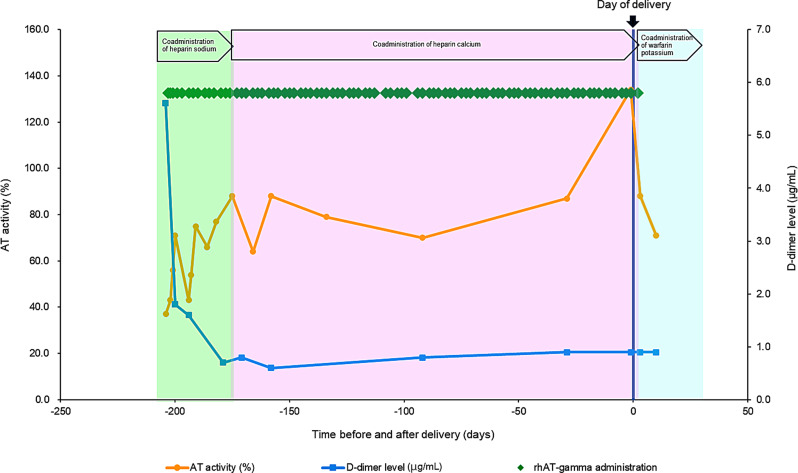 Figure 3
Peer Reviews
No public reviews on file for this paper yet. If you reviewed it on a platform where reviews are public (OpenReview, ICLR, NeurIPS, ICML), you can paste yours below so the community can read it here.
Videos
No videos yet. Explain this paper in a talk, walkthrough, or lecture? Add one.
Taxonomy
TopicsBlood Coagulation and Thrombosis Mechanisms · Hemophilia Treatment and Research · Vitamin K Research Studies