Evolutionary genomics and divergence of Cacopsylla species with a special focus on the apple proliferation vectors Cacopsylla melanoneura and Cacopsylla picta
Lapo Ragionieri, Liliya Štarhová Serbina, Erika Corretto, James M. Howie, Fernando Cruz, Tyler S. Alioto, Nicola Zadra, Tobias Weil, Gianfranco Anfora, Christian Stauffer, Lino Ometto, Omar Rota-Stabelli, Hannes Schuler

TL;DR
This study explores the evolutionary history of Cacopsylla species, focusing on those that spread Apple Proliferation disease, revealing two distinct genetic groups and how vector traits evolved independently.
Contribution
The study provides the first genomic resources for Cacopsylla species and shows that vector competence evolved independently rather than being inherited from a common ancestor.
Findings
Cacopsylla species are divided into two major clades with divergence times dating back to the Miocene era.
Vector competence in Cacopsylla melanoneura and Cacopsylla picta evolved independently, not from shared ancestry.
Genome size differences between species are largely due to transposable element expansions, especially LINE elements.
Abstract
The psyllid genus Cacopsylla includes several species that act as vectors for phytoplasma-associated diseases affecting plantations across Europe. Among them, Cacopsylla melanoneura and Cacopsylla picta are the primary vectors of ‘Candidatus Phytoplasma mali’, the phloem-restricted bacterium responsible for Apple Proliferation disease in Europe. To explore whether vector competence in these species reflects shared ancestry or independent evolution, we assembled mitochondrial and draft nuclear genomes of Italian populations of C. melanoneura and C. picta and reconstructed time-calibrated phylogenies using 13 mitochondrial protein-coding genes from 12 Cacopsylla species. Phylogenetic analyses revealed two major Cacopsylla clades (Clade I and II) whose divergence times range from the Early Miocene (18.4 MYA; 95% HPD: 10.8–27.5) to the Middle Miocene (12.7 MYA; 95% HPD: 9.7–16.0). Both C.…
Genes, proteins, chemicals, diseases, species, mutations and cell lines named across the full text — each resolved to its canonical identifier and authoritative record.
Click any figure to enlarge with its caption.
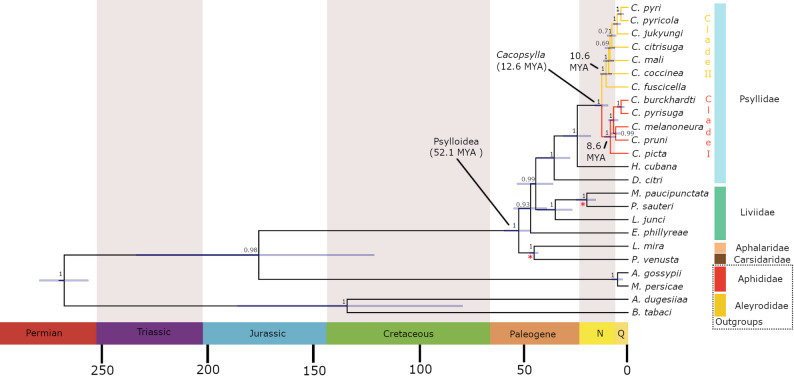 Figure 1
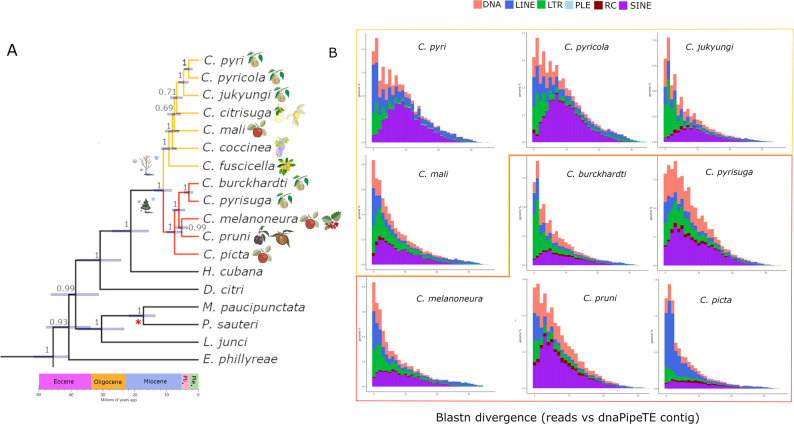 Figure 2
Peer Reviews
No public reviews on file for this paper yet. If you reviewed it on a platform where reviews are public (OpenReview, ICLR, NeurIPS, ICML), you can paste yours below so the community can read it here.
Videos
No videos yet. Explain this paper in a talk, walkthrough, or lecture? Add one.
Taxonomy
TopicsPhytoplasmas and Hemiptera pathogens · Plant Virus Research Studies · Genomics and Phylogenetic Studies