Benefits and pitfalls in newborn screening for carnitine uptake deficiency: a 4-year single-center experience
Mariagrazia Turturo, Alessandro Rossi, Ferdinando Barretta, Lucia Albano, Daniela Crisci, Fabiana Vallone, Fabiana Uomo, Simona Fecarotta, Marianna Alagia, Pietro Strisciuglio, Giancarlo Parenti, Giulia Frisso, Margherita Ruoppolo

TL;DR
This study examines the effectiveness of newborn screening for carnitine uptake deficiency, finding a high false positive rate and suggesting ways to improve screening accuracy.
Contribution
The study provides a 4-year single-center analysis of newborn screening for carnitine uptake deficiency, highlighting limitations and proposing strategies to reduce false positives.
Findings
Newborn screening for CUD has a high false positive rate, with 41% of cases being false positives.
Factors like gestational age, low birth weight, and breastfeeding may contribute to false positives.
Strategies like revising diagnostic cutoffs and using second-tier tests could improve screening efficiency.
Abstract
Carnitine uptake deficiency (CUD) is an inherited disorder caused by SLC22A5 gene variants resulting in low plasma and intracellular carnitine concentrations. Although newborn screening (NBS) enables a timely diagnosis of CUD, its efficiency is being debated. The aim of this work was to assess the benefits and limitations of NBS for CUD. A retrospective, observational single-center study was conducted on newborns born between 2017 and 2020 recalled for low free carnitine (C0) values. Biochemical, molecular, dietary and perinatal data were collected. Maternal acylcarnitine profiles and SLC22A5 genotype were also recorded, if available. Among 160,015 newborns in the study period, forty-six infants were enrolled in the study: three infants were diagnosed with CUD (incidence 1:53,338 newborns), sixteen infants with a maternal disorder, five infants with one heterozygous SLC22A5 variant,…
Genes, proteins, chemicals, diseases, species, mutations and cell lines named across the full text — each resolved to its canonical identifier and authoritative record.
Click any figure to enlarge with its caption.
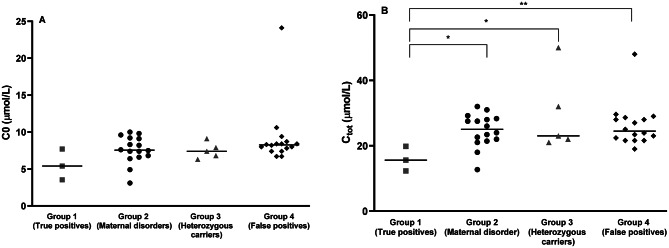 Figure 1
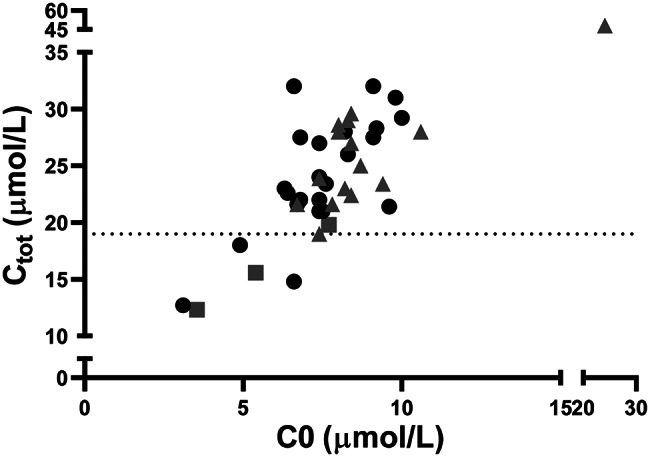 Figure 2
Peer Reviews
No public reviews on file for this paper yet. If you reviewed it on a platform where reviews are public (OpenReview, ICLR, NeurIPS, ICML), you can paste yours below so the community can read it here.
Videos
No videos yet. Explain this paper in a talk, walkthrough, or lecture? Add one.
Taxonomy
TopicsMetabolism and Genetic Disorders · Folate and B Vitamins Research · Pediatric Urology and Nephrology Studies