Designing for Dispersibility: How Crystallinity and Solubilizing Groups Affect Quantum Dot Dispersion in Diphenylhexatriene Matrices
Rachel C. Kilbride, Anastasia Leventis, Stephanie Montanaro, Ashish Sharma, James Xiao, Simon A. Dowland, Jurjen F. Winkel, Hugo Bronstein, Neil C. Greenham, Richard H. Friend, Akshay Rao, Oleksandr O. Mykhaylyk, Richard A. L. Jones, Anthony J. Ryan, Daniel T. W. Toolan

TL;DR
This study shows how the design of organic semiconductor materials affects the dispersion of quantum dots in nanocomposite films for optoelectronic applications.
Contribution
A new design rule for improving quantum dot dispersibility in diphenylhexatriene matrices by tuning solubilizing groups.
Findings
PbS quantum dots with oleic acid ligands are poorly dispersed in DPH derivatives.
Hexanoic acid or DPH-carboxylic acid ligands significantly improve quantum dot dispersibility.
Amorphous DPH derivatives can initially disperse QDs but later cause aggregation upon crystallization.
Abstract
Nanocomposite films combining organic semiconductors (OSCs) and colloidal quantum dots (QDs) are promising systems for next-generation optoelectronic technologies such as singlet-fission photon multiplication (SF-PM). Here, we show that tuning the solubilizing substituents on the high-triplet-energy SF-OSC (1E,3E,5E)-1,6-diphenylhexa-1,3,5-triene (DPH) enables precise control over film morphology and QD dispersibility. Grazing-incidence X-ray scattering reveals that PbS QDs ligated with oleic acid are poorly dispersed in all DPH derivatives, whereas hexanoic acid or DPH-carboxylic acid ligands significantly improve QD dispersibility. A clear design rule emerges: increasing solubilizing group volume relative to the DPH core enhances QD dispersibility, enabling well-dispersed QDs even in highly ordered DPH matrices. An exception arises in a derivative that forms an amorphous,…
Genes, proteins, chemicals, diseases, species, mutations and cell lines named across the full text — each resolved to its canonical identifier and authoritative record.
Click any figure to enlarge with its caption.
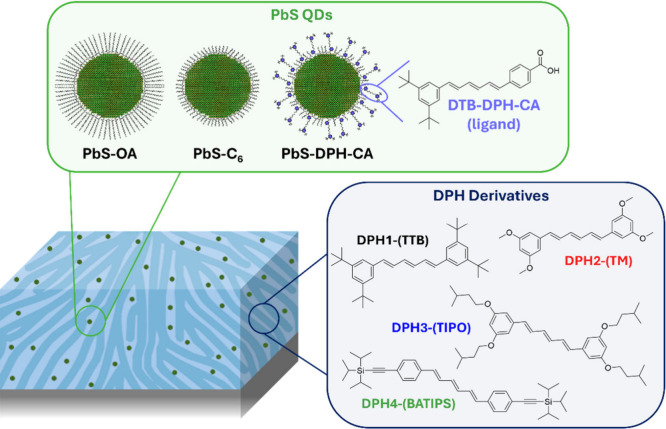 Figure 1
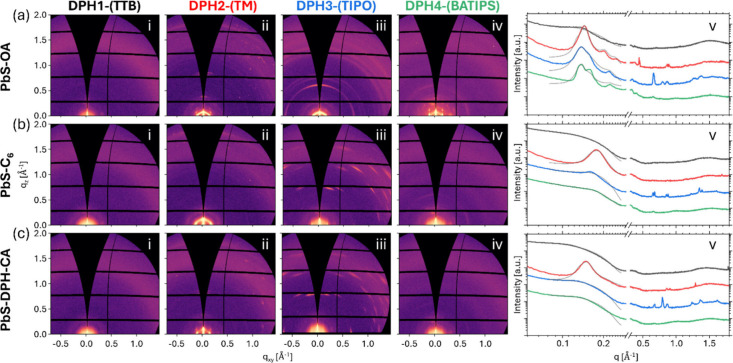 Figure 2
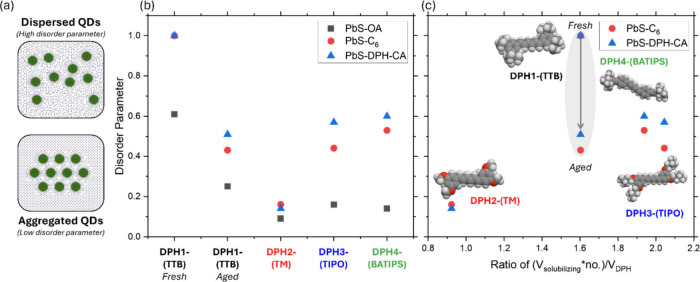 Figure 3
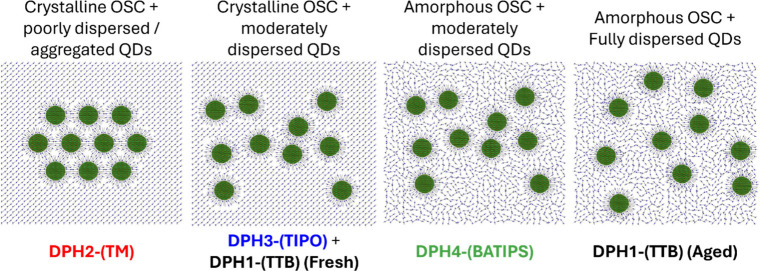 Figure 4
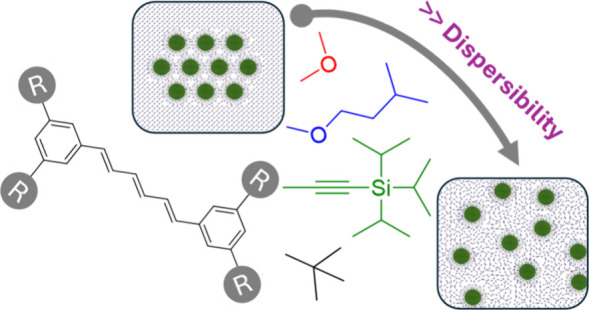 Figure 5
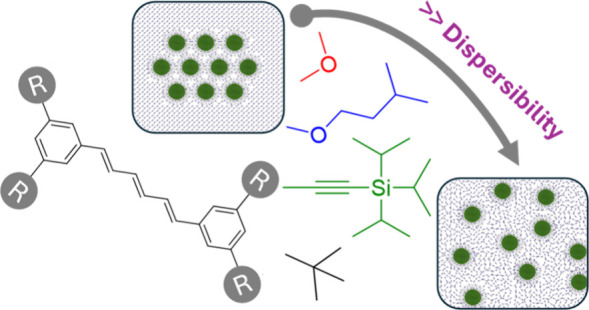 Figure 6
Peer Reviews
No public reviews on file for this paper yet. If you reviewed it on a platform where reviews are public (OpenReview, ICLR, NeurIPS, ICML), you can paste yours below so the community can read it here.
Videos
No videos yet. Explain this paper in a talk, walkthrough, or lecture? Add one.
Taxonomy
TopicsQuantum Dots Synthesis And Properties · Luminescence and Fluorescent Materials · Carbon and Quantum Dots Applications