Erectile dysfunction, type 2 diabetes, and cardiovascular disease: a narrative review and insights from a global real-world cohort analysis
Santiago Martínez Mores, Josep Franch-Nadal, Didac Mauricio, Bogdan Vlacho

TL;DR
Erectile dysfunction in men with type 2 diabetes is linked to cardiovascular disease and reflects shared vascular and metabolic issues, suggesting it could be an early warning sign.
Contribution
The study provides real-world evidence of the bidirectional relationship between erectile dysfunction and cardiometabolic disease in men with type 2 diabetes.
Findings
Men with ED and T2DM had higher risks of ischemic heart disease, stroke, and heart failure compared to those without ED.
Improvements in cardiometabolic factors like blood pressure and lipids are associated with better erectile function.
GLP-1 receptor agonists and SGLT2 inhibitors show potential vascular benefits but have mixed effects on erectile function.
Abstract
Erectile dysfunction (ED) is highly prevalent among men with type 2 diabetes mellitus (T2DM) and reflects systemic vascular and metabolic dysfunction. Shared mechanisms include endothelial dysfunction, oxidative stress, inflammation, autonomic neuropathy, and hypogonadism. Therefore, ED may function not only as a complication of T2DM but also as an early clinical marker of cardiometabolic disease. This narrative review summarizes current evidence on the epidemiology, mechanisms, and cardiometabolic implications of ED in men with T2DM, and evaluates the impact of major cardiometabolic therapies on erectile function. A real-world cohort study was conducted using the TriNetX Global Collaborative Network, a large federated electronic health record database comprising healthcare organizations across multiple countries. ED is closely linked with hypertension, obesity, dyslipidaemia, heart…
Genes, proteins, chemicals, diseases, species, mutations and cell lines named across the full text — each resolved to its canonical identifier and authoritative record.
Click any figure to enlarge with its caption.
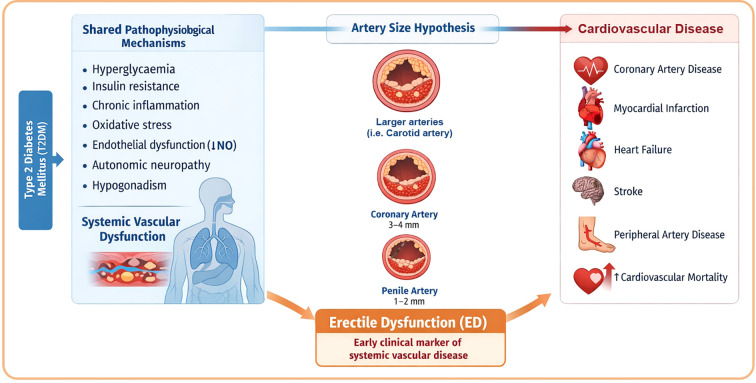 Figure 1
Peer Reviews
No public reviews on file for this paper yet. If you reviewed it on a platform where reviews are public (OpenReview, ICLR, NeurIPS, ICML), you can paste yours below so the community can read it here.
Videos
No videos yet. Explain this paper in a talk, walkthrough, or lecture? Add one.
Taxonomy
TopicsSexual function and dysfunction studies · Hormonal and reproductive studies · Cardiac Health and Mental Health