Enantioselective Synthesis of Spirolactones and Spirolactams Under Low Catalyst Loadings
Takeru Saito, Antonio Navarro, Huw M. L. Davies

TL;DR
This paper presents a highly efficient and enantioselective method for synthesizing spirocyclic compounds using a rhodium catalyst at extremely low loadings.
Contribution
A novel Rh2-catalyzed [2+1] cyclopropanation method for spirocyclopropanes with exceptional enantioselectivity and turnover numbers.
Findings
The reaction achieves up to 98% yield and 98% ee with 0.00005 mol% catalyst.
7-membered diazo compounds provide enhanced stereocontrol but require low temperatures.
The method enables the synthesis of 5-oxa and 5-azaspiro[2.5]octanones with high efficiency.
Abstract
The stereoselective construction of spirocyclic compounds as medicinally relevant scaffolds is of considerable current interest. One underexplored area in this field is the asymmetric synthesis of spirocyclopropanes via transition-metal catalysis, using α-diazo lactones and lactams as carbene precursors. In this study, we report a Rh2(S-p-PhTPCP)4-catalyzed [2 + 1] cyclopropanation between 3-diazo δ-lactones and lactams and a wide range of alkene substrates, enabling the facile synthesis of 5-oxa and 5-azaspiro[2.5]octanones in yields up to 98%, reasonable levels of diastereoselectivity (up to 11:1 d.r.), and high levels of enantioselectivity (up to 98% ee). The reaction can be run with 0.00005 mol % of catalyst, resulting in 1,740,000 TON, while maintaining stereocontrol. The ring size of the diazo compound, in conjunction with the reaction temperature, has a considerable influence on…
Genes, proteins, chemicals, diseases, species, mutations and cell lines named across the full text — each resolved to its canonical identifier and authoritative record.
Click any figure to enlarge with its caption.
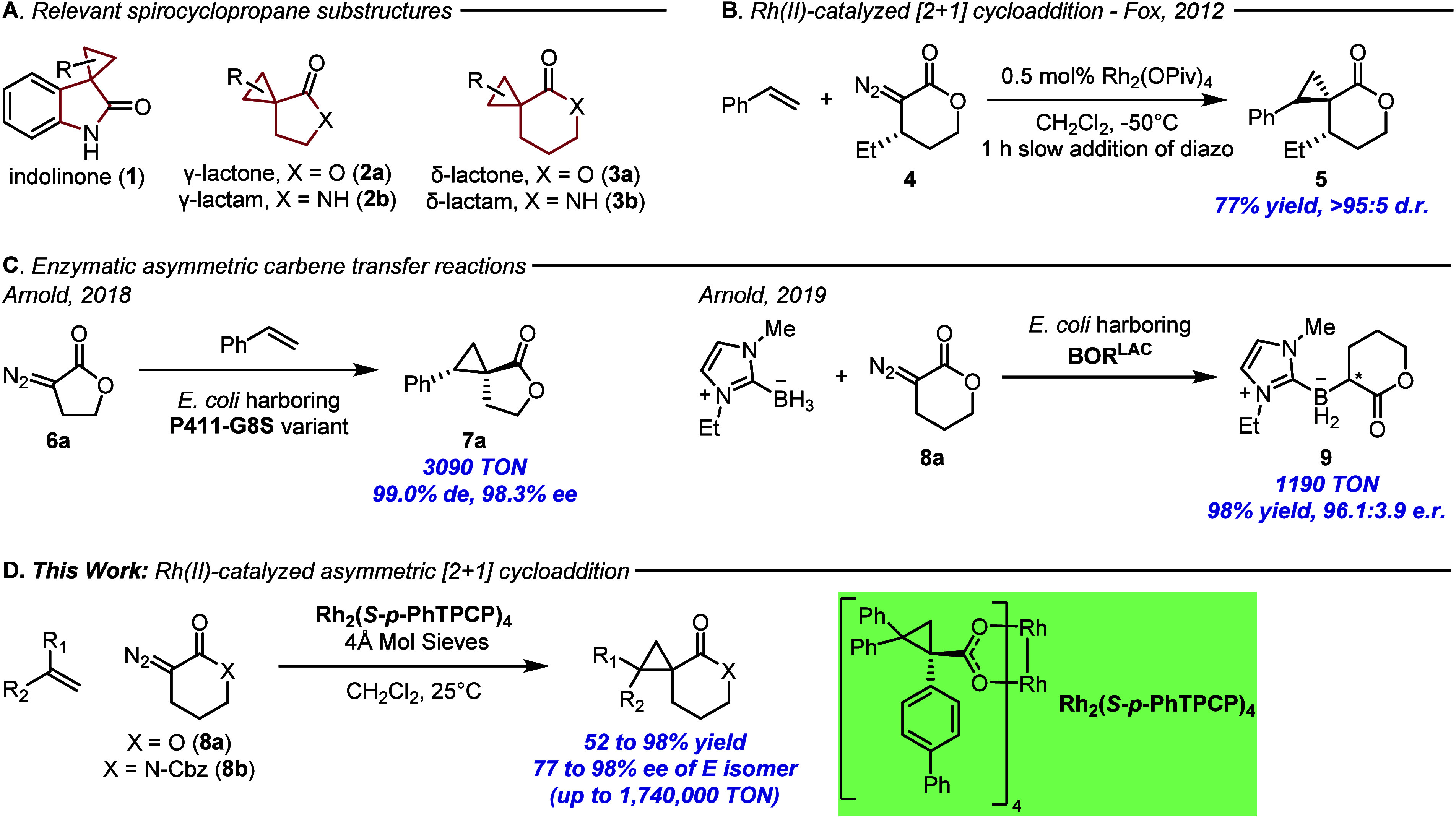 Figure 1
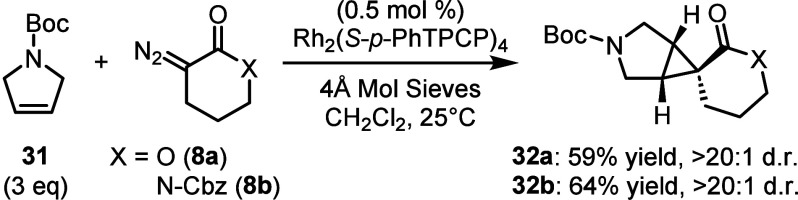 Figure 2
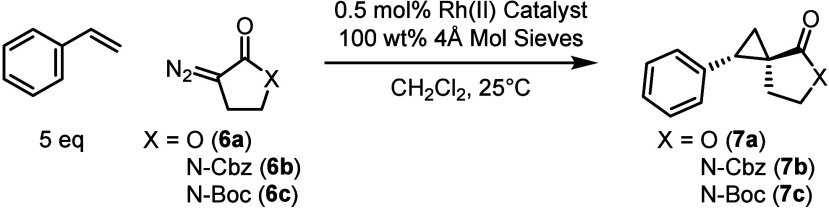 Figure 3
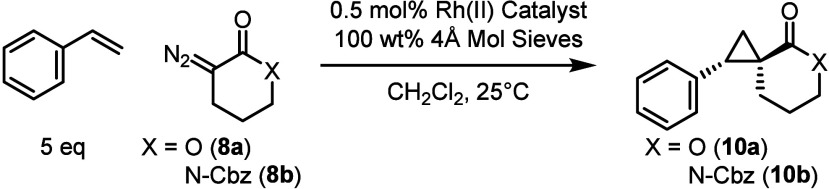 Figure 4
 Figure 5
 Figure 6
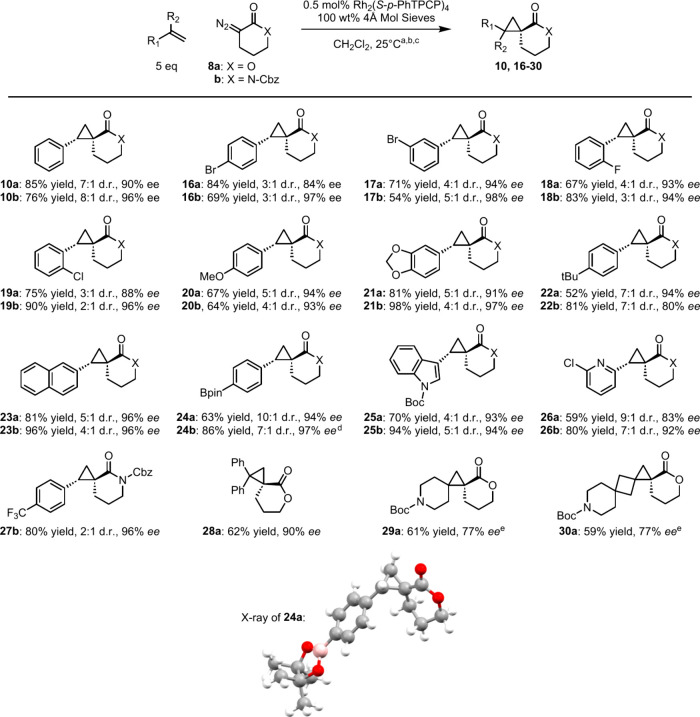 Figure 7
 Figure 8
 Figure 9
 Figure 10
Peer Reviews
No public reviews on file for this paper yet. If you reviewed it on a platform where reviews are public (OpenReview, ICLR, NeurIPS, ICML), you can paste yours below so the community can read it here.
Videos
No videos yet. Explain this paper in a talk, walkthrough, or lecture? Add one.
Taxonomy
TopicsSynthetic Organic Chemistry Methods · Asymmetric Synthesis and Catalysis · Catalytic Cross-Coupling Reactions