Early Warning Scores in Emergency Department Patients Aged 80 Years or Older
Marcello Covino, Piergiacomo Maria Cacciamani Fanelli, Nicola Bonadia, Valeria Maccauro, Davide Antonio Della Polla, Giuseppe De Matteis, Andrea Piccioni, Antonio Gasbarrini, Claudio Sandroni, Francesco Franceschi

TL;DR
This study evaluates how well five early warning scores predict short-term health decline in patients 80+ years old in Italian emergency departments.
Contribution
The study provides a comparative analysis of EWS performance in older patients, identifying REMS as the most reliable for those over 94 years.
Findings
All five EWSs showed fair discrimination in predicting clinical deterioration within 24 hours.
REMS outperformed other scores in calibration and improved with increasing age beyond 94 years.
Oxygen supplementation, systolic blood pressure, and Glasgow Coma Scale were key predictors for patients aged 87+.
Abstract
This prognostic study assesses the accuracy of 5 early warning scores to predict death or intensive care unit admission within 24 hours of being seen in the emergency department in patients aged 80 years or older in Italy. Do early warning scores (EWSs) accurately predict short-term clinical deterioration among older patients in the emergency department (ED)? In this prognostic study including 50 645 Italian patients aged 80 years or older, 5 evaluated EWSs showed fair discrimination. The National Early Warning Score (NEWS) achieved the highest area under the curve, while the Rapid Emergency Medicine Score (REMS) showed superior calibration and positive predictive value and was the only score whose performance improved with increasing age. NEWS and its derivatives offered greater sensitivity, whereas REMS provided higher precision that may reduce alarm fatigue and outperformed other…
Genes, proteins, chemicals, diseases, species, mutations and cell lines named across the full text — each resolved to its canonical identifier and authoritative record.
Click any figure to enlarge with its caption.
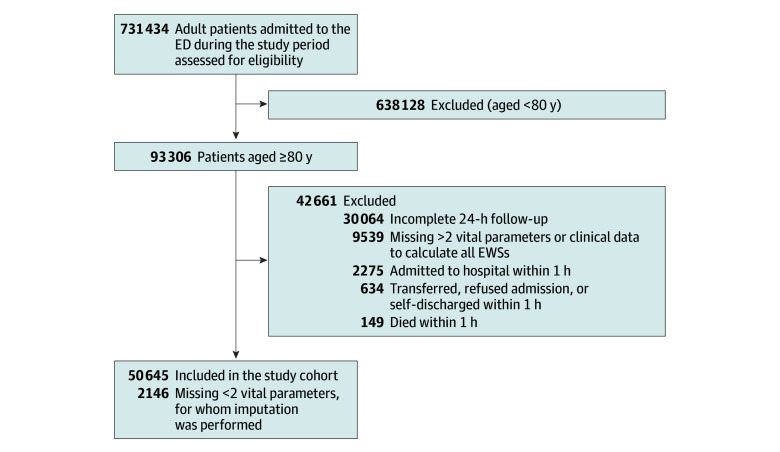 Figure 1
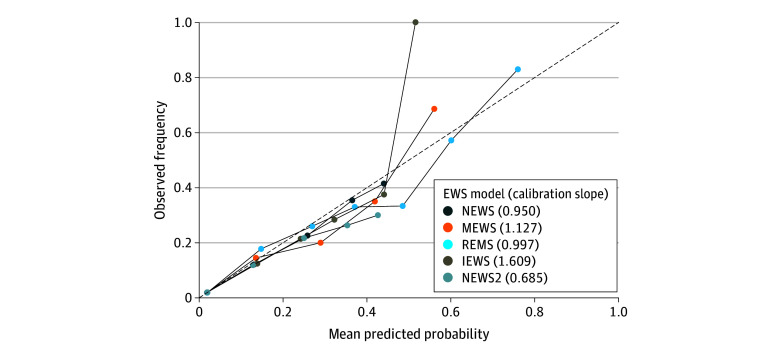 Figure 2
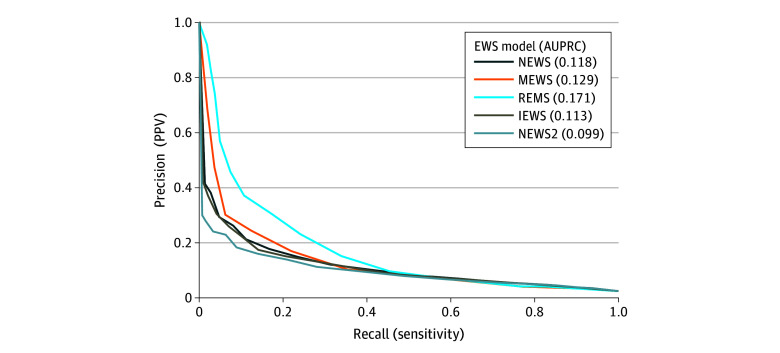 Figure 3
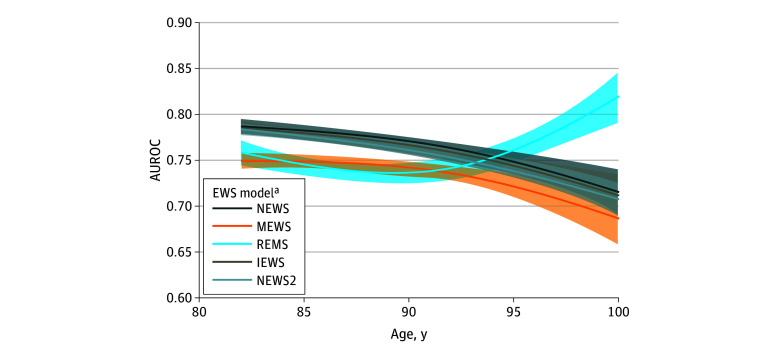 Figure 4
Peer Reviews
No public reviews on file for this paper yet. If you reviewed it on a platform where reviews are public (OpenReview, ICLR, NeurIPS, ICML), you can paste yours below so the community can read it here.
Videos
No videos yet. Explain this paper in a talk, walkthrough, or lecture? Add one.
Taxonomy
TopicsEmergency and Acute Care Studies · Sepsis Diagnosis and Treatment · Hydrology and Drought Analysis