Continuous Positive Airway Pressure Improves Marital Relationship and Sexual Satisfaction in Obstructive Sleep Apnea Patients and Partners
J. Chorvoz, C. Rabec, M. Labruyère, H. Devilliers, P. Sabot, A. Berrier, D. Schenesse, P. Mouillot, P. Bonniaud, M. Georges

TL;DR
Using CPAP treatment for sleep apnea improves marital and sexual satisfaction for both patients and their partners.
Contribution
This study demonstrates that CPAP treatment improves dyadic adjustment and sexual satisfaction in couples affected by obstructive sleep apnea.
Findings
CPAP treatment significantly improved dyadic adjustment scores in both patients and partners after 2 months.
Sexual satisfaction and sleep quality improved in both groups following CPAP treatment.
Anxiety, depression, and daytime sleepiness decreased in both patients and partners.
Abstract
Symptoms of obstructive sleep apnea and hypopnea can interfere with sleep and quality of life for the patient's partner and affect marital relationships. Our primary objective was to assess how continuous positive airway pressure (CPAP) treatment affects couples using the Dyadic Adjustment Questionnaire (DAS‐16). Secondary objectives focused on the effects on the dyad's quality of life and sleep, depending on the technical characteristics of the device. Prospective monocentric study including consecutive couples in which one of the partners began treatment by CPAP between July 2022 and February 2024 at Dijon University Hospital. After inclusion, dyads were evaluated 2 and 6 months after treatment initiation. Fifty‐four couples were analysed. After 2 months under CPAP, the dyadic adjustment score (DAS‐16) significantly improved in partners (ΔDAS‐16 = +1 [−1; 3], p = 0.025) and in…
Genes, proteins, chemicals, diseases, species, mutations and cell lines named across the full text — each resolved to its canonical identifier and authoritative record.
Click any figure to enlarge with its caption.
 Figure 1
 Figure 2
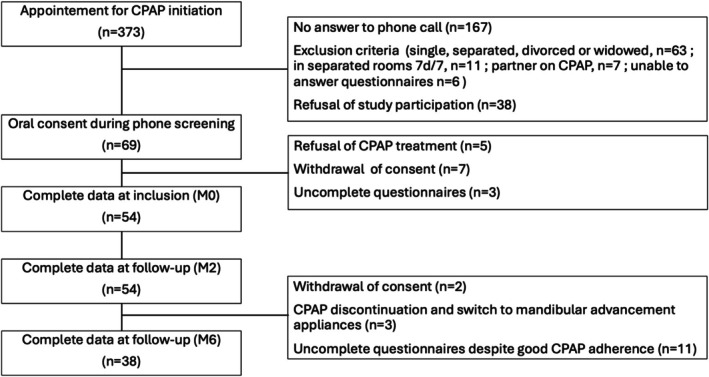 Figure 3
Peer Reviews
No public reviews on file for this paper yet. If you reviewed it on a platform where reviews are public (OpenReview, ICLR, NeurIPS, ICML), you can paste yours below so the community can read it here.
Videos
No videos yet. Explain this paper in a talk, walkthrough, or lecture? Add one.
Taxonomy
TopicsObstructive Sleep Apnea Research · Sleep and related disorders · Neuroscience of respiration and sleep