Excessive Daytime Sleepiness Should Be Systematically Assessed in Individuals With Insomnia: A Population‐Based Study Employing a Virtual Agent‐Based Digital Tool
Julien Coelho, Florian Pécune, Alex Chanteclair, Christophe Gauld, Etienne de Sevin, Emmanuel d'Incau, Patricia Sagaspe, Tafsir Ka, Hervé Alia, Charles M. Morin, Jean‐Arthur Micoulaud‐Franchi, Pierre Philip

TL;DR
A study using a digital tool found that many people with insomnia also experience daytime sleepiness, often linked to conditions like depression, but still respond well to treatment.
Contribution
The study identifies a high prevalence of sleepy insomniacs and shows they respond well to digital interventions despite comorbidities.
Findings
Excessive daytime sleepiness is common in individuals with insomnia, with comorbidities like depression explaining about half of the cases.
Sleepy insomniacs showed similar treatment responses to insomnia-only individuals after a 17-day digital intervention.
Sleepy insomniacs were more likely to experience middle or late insomnia symptoms compared to those without sleepiness.
Abstract
Insomnia and excessive daytime sleepiness (EDS) often co‐occur, despite involving distinct physiological mechanisms. The KANOPÉE application, a fully autonomous virtual agent that collects sleep‐related data and delivers personalised behavioural recommendations over a 17‐day period, offers a unique opportunity to better understand this unexpected phenotype. Our primary aim was to characterise these ‘sleepy insomniacs’, and our secondary aim was to evaluate their response to this digital sleep intervention. Among 21,590 participants, individuals with an Epworth Sleepiness Scale score ≥ 11 and an Insomnia Severity Index score ≥ 15 were classified as ‘sleepy insomniacs’. Comorbidities (i.e., obstructive sleep apnea syndrome, restless legs syndrome, depression, and sleep medication use) were first described and then excluded for further analyses. At baseline, 4843 (47.9%) of the 10,114…
Genes, proteins, chemicals, diseases, species, mutations and cell lines named across the full text — each resolved to its canonical identifier and authoritative record.
Click any figure to enlarge with its caption.
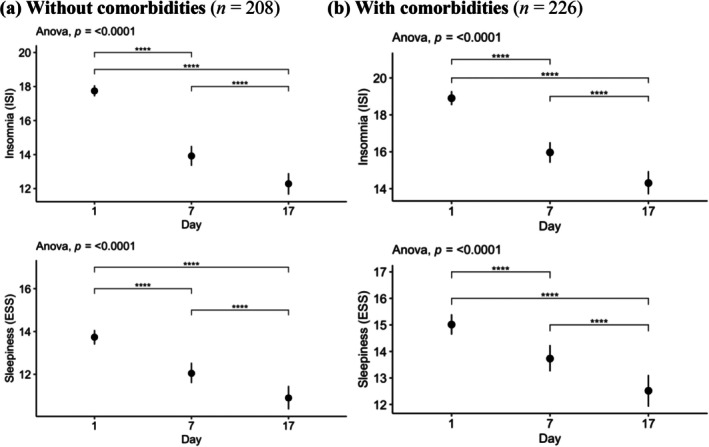 Figure 1
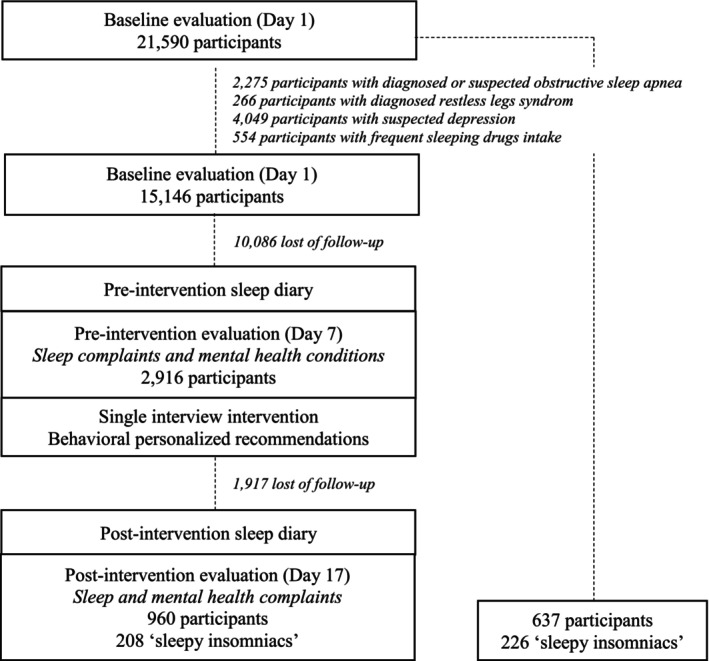 Figure 2
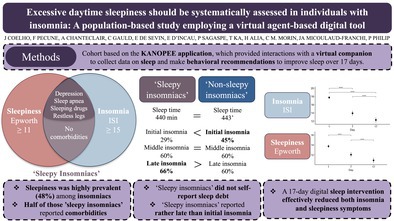 Figure 3
Peer Reviews
No public reviews on file for this paper yet. If you reviewed it on a platform where reviews are public (OpenReview, ICLR, NeurIPS, ICML), you can paste yours below so the community can read it here.
Videos
No videos yet. Explain this paper in a talk, walkthrough, or lecture? Add one.
Taxonomy
TopicsSleep and related disorders · Sleep and Wakefulness Research · Circadian rhythm and melatonin