Genome wide association study of vaginal microbiota genetic diversity in French women
Samuel Alizon, Claire Bernat, Vanina Boué, Sophie Grasset, Soraya Groc, Tsukushi Kamiya, Massilva Rahmoun, Christian Selinger, Nicolas Tessandier, Marine Bonneau, Vincent Foulongne, Christelle Graf, Jacques Reynes, Michel Segondy, Vincent Tribout, Jacques Ravel, Nathalie Boulle

TL;DR
This study explores how human genetic variations might influence the diversity of the vaginal microbiota in French women.
Contribution
This is one of the first genome-wide association studies (GWAS) to use microbial genetic data instead of symptoms to analyze vaginal microbiota.
Findings
Shannon diversity of the vaginal microbiota is the trait most strongly explained by human genetic factors.
Two genomic regions were identified as being associated with variations in microbiota diversity.
The study suggests the need for larger and more comprehensive studies to confirm these findings.
Abstract
The composition of the vaginal microbiota is known to be highly structured into five main community state types (CSTs) that are found in all human populations. Several associations between self-reported ethnicity and the type of community have been reported. Analysing data from in 168 women from the PAPCLEAR cohort study in France, we perform a genome wide association studies (GWAS) looking for human genetic polymorphisms that may impact vaginal microbiota community composition. We show that Shannon diversity is the trait related to the vaginal microbiota that is best explained by the human genome. Furthermore, we identify two genomic regions associated with its variations. This is one of the first GWAS to use microbial genetic data instead of symptoms to characterise the vaginal microbiota and our results call for more powered studies in terms of participants and genome coverage.…
Genes, proteins, chemicals, diseases, species, mutations and cell lines named across the full text — each resolved to its canonical identifier and authoritative record.
Click any figure to enlarge with its caption.
 Figure 1
 Figure 2
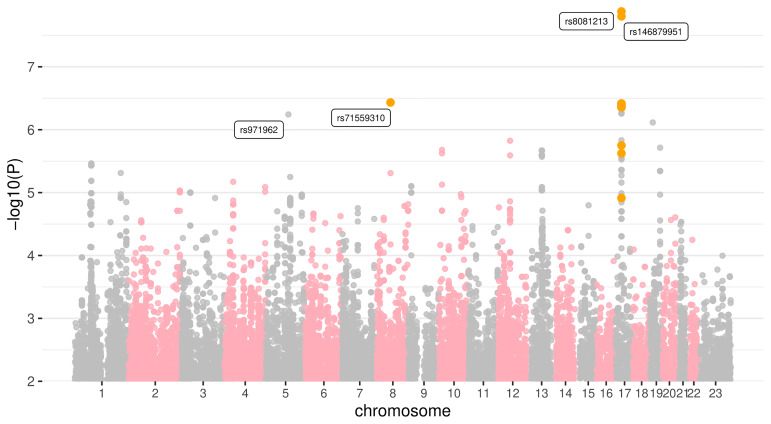 Figure 3
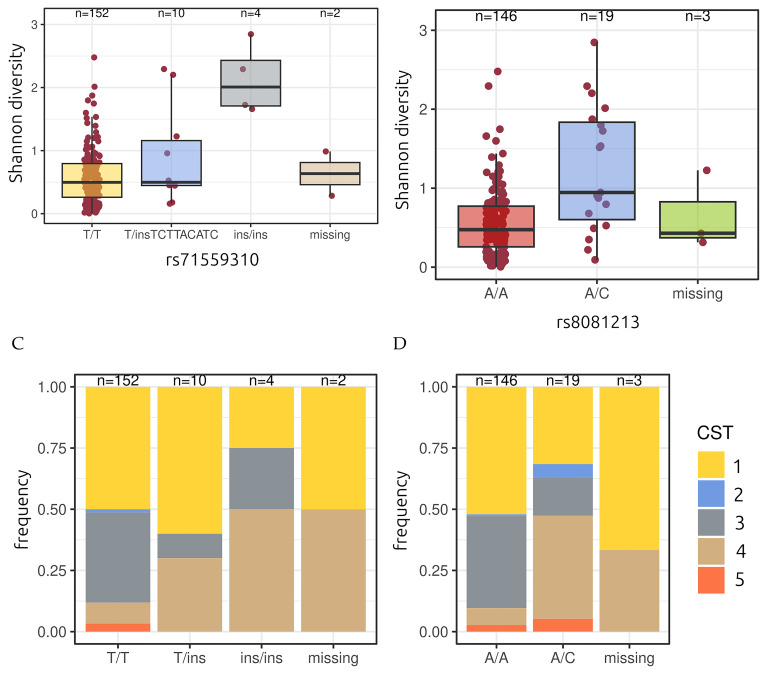 Figure 4
Peer Reviews
No public reviews on file for this paper yet. If you reviewed it on a platform where reviews are public (OpenReview, ICLR, NeurIPS, ICML), you can paste yours below so the community can read it here.
Videos
No videos yet. Explain this paper in a talk, walkthrough, or lecture? Add one.
Taxonomy
TopicsReproductive tract infections research · Pelvic floor disorders treatments · Urinary Tract Infections Management