Comparison of innovative medical devices between China and the United States
Xu Song, Bo Yuan, Kai Zhang, Chunying Chen, Yuliang Zhao, Antonios G Mikos, Xingdong Zhang

TL;DR
This paper compares how China and the U.S. have reformed their systems for approving innovative medical devices to better meet patient needs.
Contribution
The paper provides a comparative analysis of IMD approval systems and trends in China and the U.S.
Findings
China and the U.S. have implemented reforms to accelerate the approval of innovative medical devices.
Special review pathways have been established in both countries to address unmet clinical needs.
The analysis includes data on IMD designations and marketing authorizations over the study period.
Abstract
From October 1, 2014 to June 30, 2025, China and the United States (U.S.) have implemented varying degrees of reform in the review and approval systems for innovative medical devices (IMDs), establishing and developing special review pathways for such devices. These reforms aim to further encourage the development of IMDs and accelerate the provision of safe and effective medical solutions to patients with unmet clinical needs. In this perspective, we analyze data on IMDs granted IMD Designations and that received marketing authorizations, and examine their development trends. Graphical Abstract
Genes, proteins, chemicals, diseases, species, mutations and cell lines named across the full text — each resolved to its canonical identifier and authoritative record.
Click any figure to enlarge with its caption.
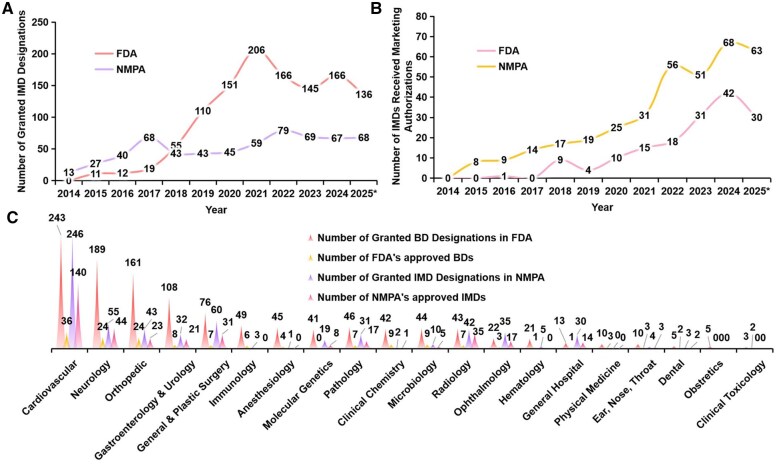 Figure 1
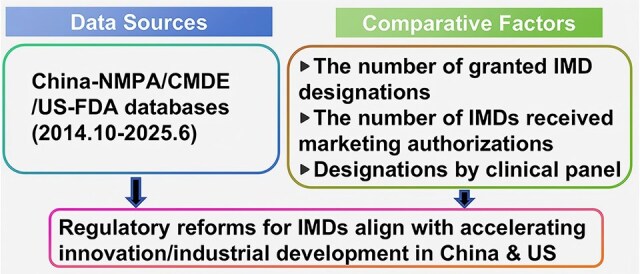 Figure 2
Peer Reviews
No public reviews on file for this paper yet. If you reviewed it on a platform where reviews are public (OpenReview, ICLR, NeurIPS, ICML), you can paste yours below so the community can read it here.
Videos
No videos yet. Explain this paper in a talk, walkthrough, or lecture? Add one.
Taxonomy
TopicsBiomedical Ethics and Regulation · Health Systems, Economic Evaluations, Quality of Life · Pharmaceutical Economics and Policy