Longitudinal Relations Among Theory of Mind, Advanced Theory of Mind, and Executive Function From Ages Four to Seven
Christopher Osterhaus, Beate Sodian, Özgün Köksal, David M. Sobel

TL;DR
This study shows how early thinking skills and understanding others' thoughts develop together in children from ages 4 to 7.5.
Contribution
The study reveals that early executive function and theory of mind predict later advanced theory of mind, with distinct developmental pathways.
Findings
Early executive function at age 4 predicts advanced theory of mind at age 7.5.
Four distinct developmental theory of mind profiles were identified in children.
Language and inhibition differentiate theory of mind development groups more than general cognition.
Abstract
This longitudinal study examined the developmental relations between first‐order Theory of Mind (ToM), advanced ToM, and executive function (EF) from ages 4 to 7.5. Two‐hundred‐three German children were assessed at ages 4, 5.5, and 7.5 on measures of ToM, EF (working memory, inhibition, cognitive flexibility), general cognition, and language. Using regression, structural equation modeling (SEM), and latent class analysis, we investigated whether early ToM and EF predict advanced ToM performance and how the developmental pathways unfold. We found significant concurrent relations between ToM and EF at all time points, as well as a predictive relation from EF at age 4 to advanced ToM at age 7.5. ToM at age 4 also significantly predicted ToM at age 7.5, suggesting early ToM lays a foundation for later conceptual growth. Cross‐lagged SEM revealed that EF at age 4—but not at 5.5—predicted…
Genes, proteins, chemicals, diseases, species, mutations and cell lines named across the full text — each resolved to its canonical identifier and authoritative record.
Click any figure to enlarge with its caption.
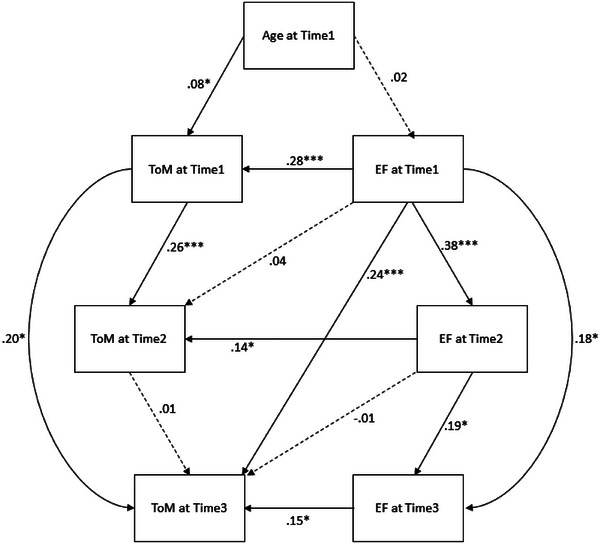 Figure 1
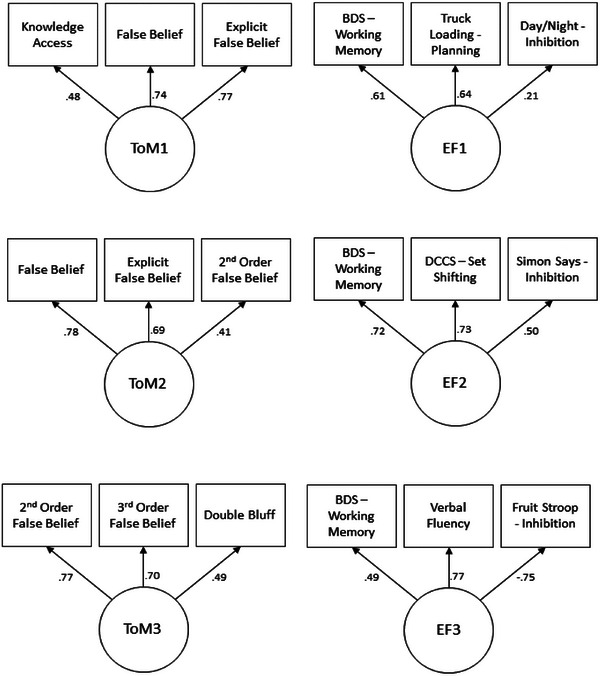 Figure 2
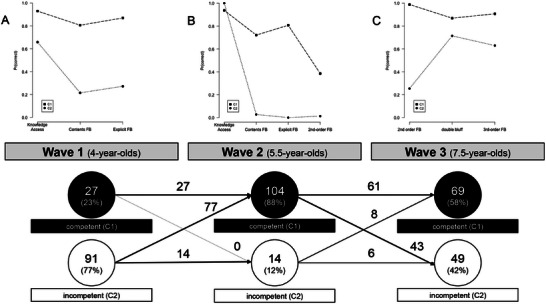 Figure 3
Peer Reviews
No public reviews on file for this paper yet. If you reviewed it on a platform where reviews are public (OpenReview, ICLR, NeurIPS, ICML), you can paste yours below so the community can read it here.
Videos
No videos yet. Explain this paper in a talk, walkthrough, or lecture? Add one.
Taxonomy
TopicsChild and Animal Learning Development · Embodied and Extended Cognition · Action Observation and Synchronization