An MSA-P patient presenting with preserved glucose metabolism in the putamen, cerebellar hypometabolism and pronounced loss of presynaptic dopamine transporter in the striatum
Swen Hesse, Manja Schiefer, Solveig Tiepolt, Dorit Prochnow, Larissa Mämecke, Frank Hoffmann, Iñaki Schniewind, Osama Sabri, Björn Falkenburger, Sebastian Brock

TL;DR
A patient with multiple system atrophy showed preserved glucose metabolism in the putamen and reduced metabolism in the cerebellum, suggesting a distinct subtype of synucleinopathy.
Contribution
Identifies a distinct metabolic pattern in MSA that could represent a unique synucleinopathy subtype.
Findings
Preserved glucose metabolism in the putamen was observed in an MSA patient.
Significant cerebellar hypometabolism was detected alongside reduced presynaptic dopamine transporter in the striatum.
Seed-amplification assay confirmed synucleinopathy, indicating a possible distinct subtype of MSA.
Abstract
Positron emission tomography (PET) of the brain using [18F]fluorodeoxyglucose (FDG) is becoming increasingly important for the diagnosis and differential diagnosis of atypical parkinsonian syndrome such as multiple system atrophy (MSA), which is characterized by hypometabolism of the putamen, pons, and cerebellum. We report on a patient with clinically established MSA based on a rapidly progressive, poorly levodopa-responsive parkinsonian syndrome, multidomain autonomic failure, and imaging findings where hereditary spastic paraplegia was discussed as a differential diagnosis. PET images revealed a well-preserved glucose metabolism in the striatum, specifically in the putamen, while metabolism in the cerebellum was significantly reduced. This pattern of glucose metabolism might indicate a distinct subtype of synucleinopathy as proven by seed-amplification assay and should be taken into…
Genes, proteins, chemicals, diseases, species, mutations and cell lines named across the full text — each resolved to its canonical identifier and authoritative record.
Click any figure to enlarge with its caption.
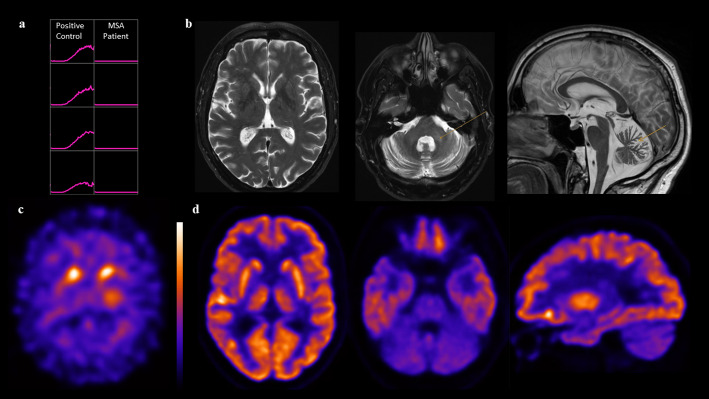 Figure 1
Peer Reviews
No public reviews on file for this paper yet. If you reviewed it on a platform where reviews are public (OpenReview, ICLR, NeurIPS, ICML), you can paste yours below so the community can read it here.
Videos
No videos yet. Explain this paper in a talk, walkthrough, or lecture? Add one.
Taxonomy
TopicsParkinson's Disease Mechanisms and Treatments · Neurological diseases and metabolism · Hereditary Neurological Disorders