Predicting multiphase flow and tracer transport for an underground chemical explosive test
John P. Ortiz, Dolan D. Lucero, Esteban Rougier, Earl E. Knight, S. Michelle Bourret, Bradley G. Fritz, Miles A. Bodmer, Jason E. Heath, Chelsea W. Neil, Hakim Boukhalfa, Kristopher L. Kuhlman, Shawn Otto, Souheil Ezzedine, Barry L. Roberts, R. Charles Choens

TL;DR
This paper uses simulations and field data to better understand how gases move after an underground explosion, improving monitoring and safety planning.
Contribution
The study uniquely integrates field data with modeling to predict gas migration after underground explosions.
Findings
Predictions of tracer arrival matched observations within one order-of-magnitude using a simplified 2D-radial model.
Transient blast forcing rapidly mobilizes gases from the cavity into surrounding rock.
Abstract
Detecting radionuclide gas seepage from clandestine underground nuclear tests is central to nonproliferation explosion monitoring research. Yet, early-time (<6 day) gas transport driven by the explosive pressure wave remains poorly constrained due to scarcity of field data. We simulate multi-phase gas transport in the vadose zone using pre-shot data from a recent chemical explosion in P-Tunnel at the Nevada National Security Site, USA. Despite using a simplified 2D-radial model, predictions of tracer arrival matched observations within one order-of-magnitude. Our results show how transient blast forcing rapidly mobilizes gases from the cavity into surrounding rock – critical for optimizing sensor placement and test planning. This unique integration of field data and modeling represents a significant improvement in our ability to predict gas migration from underground explosions. More…
Genes, proteins, chemicals, diseases, species, mutations and cell lines named across the full text — each resolved to its canonical identifier and authoritative record.
Click any figure to enlarge with its caption.
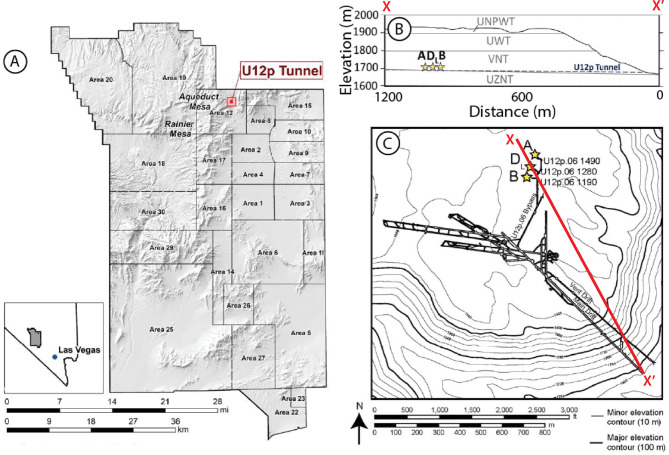 Figure 1
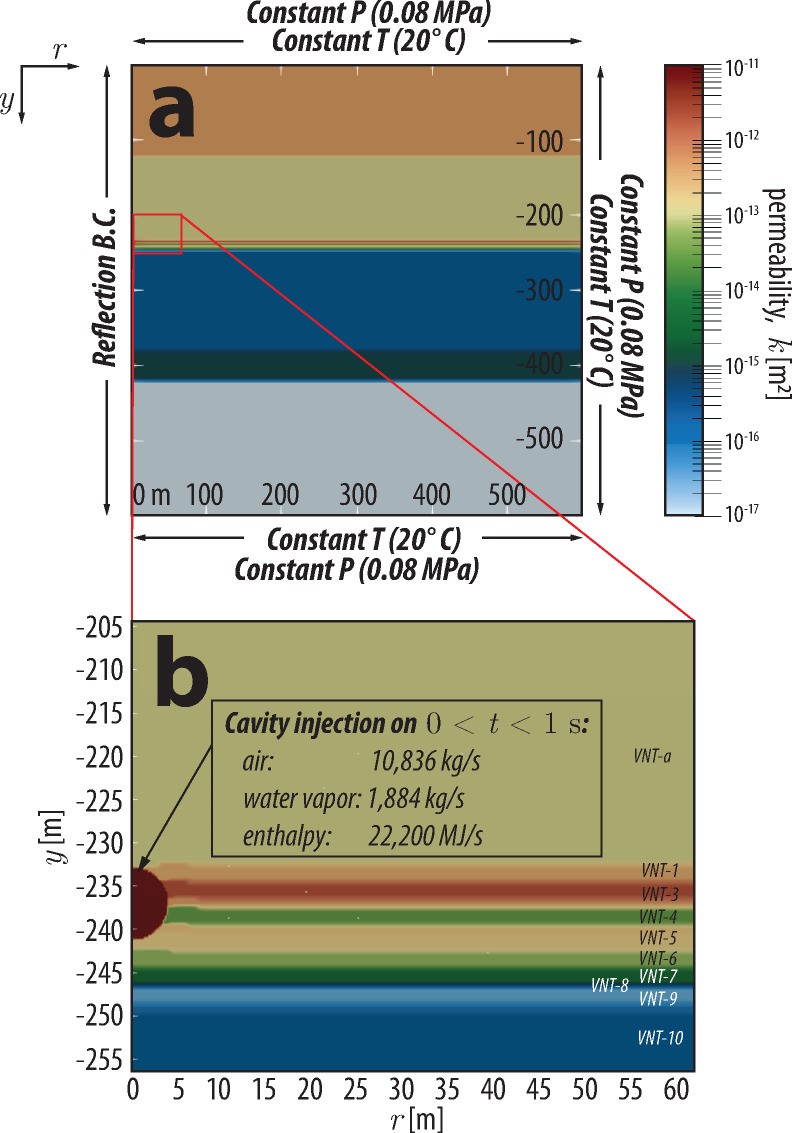 Figure 2
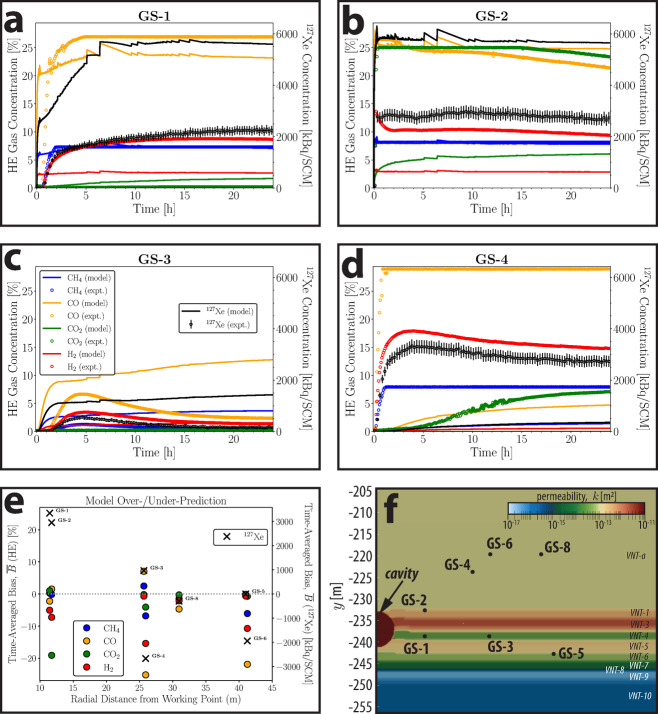 Figure 3
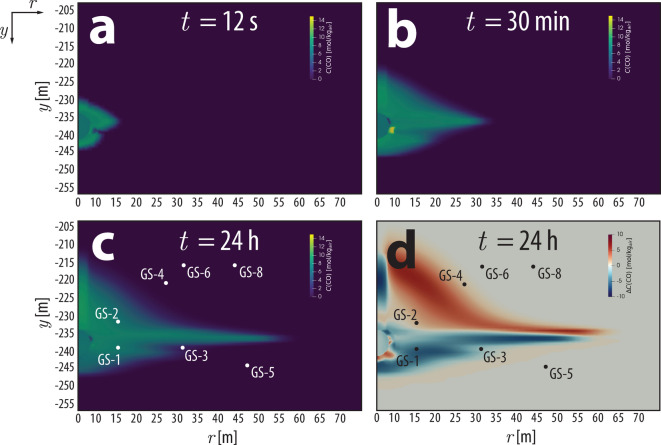 Figure 4
Peer Reviews
No public reviews on file for this paper yet. If you reviewed it on a platform where reviews are public (OpenReview, ICLR, NeurIPS, ICML), you can paste yours below so the community can read it here.
Videos
No videos yet. Explain this paper in a talk, walkthrough, or lecture? Add one.
Taxonomy
TopicsRadioactive contamination and transfer · Wind and Air Flow Studies · Groundwater flow and contamination studies