Compact and programmable large-scale optical processor in free space
Maria Gorizia Ammendola, Nazanin Dehghan, Lukas Scarfe, Alessio D’Errico, Francesco Di Colandrea, Ebrahim Karimi, Filippo Cardano

TL;DR
A new free-space optical platform uses three layers to process light efficiently, enabling large-scale quantum simulations and scalable information processing.
Contribution
The platform introduces a compact, programmable free-space photonic system that achieves high-dimensional unitary transformations with minimal layers.
Findings
The platform distributes a single input mode across over 7,000 outputs using only three layers.
It supports quantum walks with up to 30 time steps in one- and two-dimensional lattices.
The system is compatible with quantum optics protocols and can simulate topological effects and synthetic gauge fields.
Abstract
Photonic circuits are central to classical and quantum information processing. While integrated technologies dominate, free-space architectures are emerging as attractive alternatives, offering broad bandwidth and direct manipulation of optical modes without confinement in waveguides. A key challenge for scalability lies in circuit depth, as the number of layers manipulating the optical field typically grows with the system size. Here, we introduce a programmable free-space photonic platform that implements translation-invariant, high-dimensional unitary transformations using only three layers. Information is encoded in structured light modes defined by circular polarization and quantized transverse momenta, and processed with spatial light modulators interleaved with half-wave plates. We implement unitaries that are equivalent to quantum walks over up to 30 time steps, in one- and…
Genes, proteins, chemicals, diseases, species, mutations and cell lines named across the full text — each resolved to its canonical identifier and authoritative record.
Click any figure to enlarge with its caption.
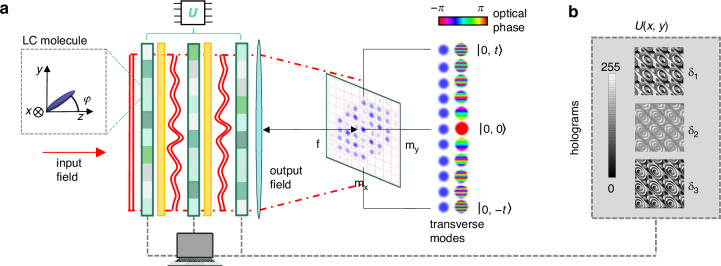 Figure 1
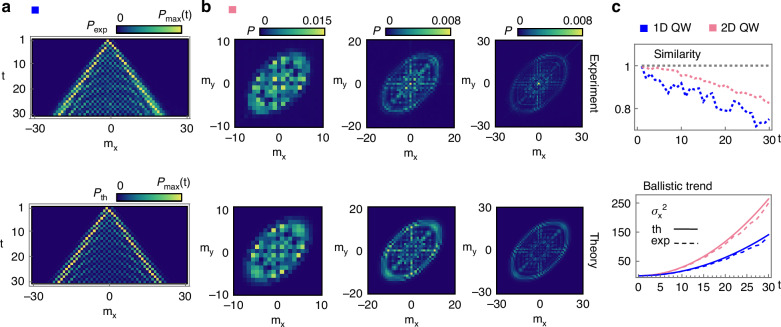 Figure 2
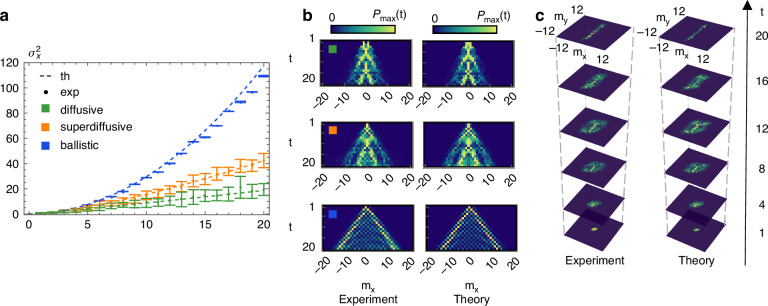 Figure 3
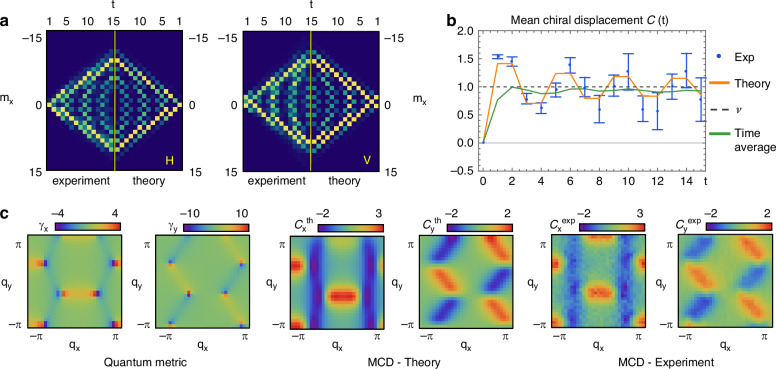 Figure 4
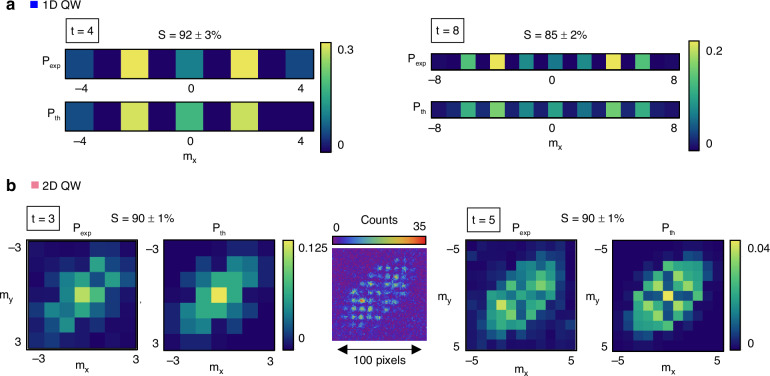 Figure 5
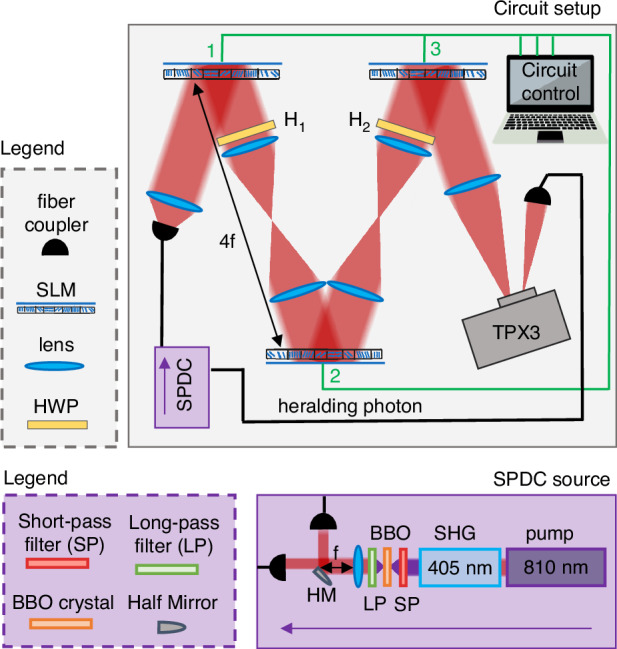 Figure 6
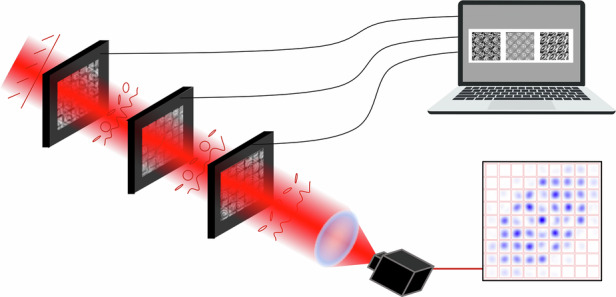 Figure 7
Peer Reviews
No public reviews on file for this paper yet. If you reviewed it on a platform where reviews are public (OpenReview, ICLR, NeurIPS, ICML), you can paste yours below so the community can read it here.
Videos
No videos yet. Explain this paper in a talk, walkthrough, or lecture? Add one.
Taxonomy
TopicsQuantum Computing Algorithms and Architecture · Neural Networks and Reservoir Computing · Quantum Information and Cryptography