Feasibility and effectiveness of distal radial access in ST-elevation myocardial infarction from a SPEEDY PCI subanalysis
Akihiko Takahashi, Sho Torii, Yujiro Ono, Masanori Taniwaki, Mitsutoshi Oguri, Masanori Teramura, Ryuichi Kato, Shuji Otsuki, Hiroshi Suzuki, Fuminobu Yoshimachi, Hironori Ueda, Keisuke Shioji, Gaku Nakazawa, Kaoru Sakurai, Mitsuru Tsujimoto, Motosu Ando, Toshiyuki Kozai

TL;DR
This study examines whether a less common wrist access method for heart procedures is effective and safe for patients with severe heart attacks.
Contribution
The study provides new evidence on the feasibility and effectiveness of distal radial access in STEMI patients undergoing PCI.
Findings
dTRA resulted in significantly shorter sheath-to-balloon and door-to-balloon times compared to conventional radial access.
Procedural success and 30-day mortality rates were similar between dTRA and conventional radial access groups.
Shorter time metrics may be influenced by institutional practices and operator experience rather than the access site alone.
Abstract
The distal radial approach (dTRA) is increasingly recognized as a viable alternative to the conventional radial approach in coronary interventions. However, its utility in ST-elevation myocardial infarction (STEMI)—where rapid revascularization is critical—remains underexplored. To evaluate the feasibility and procedural characteristics of dTRA in STEMI patients undergoing primary percutaneous coronary intervention (PCI), using a prespecified subanalysis of the SPEEDY PCI study. Among 370 STEMI patients enrolled, 63 underwent PCI via dTRA and 307 via the conventional radial approach. A propensity score–matched analysis was performed using Killip class, GRACE score, and door-to-sheath time as covariates. After matching, the dTRA group had significantly shorter sheath-to-balloon (12.5 ± 11.5 vs. 19.7 ± 11.7 min, p = 0.002) and door-to-balloon times (50.2 ± 25.9 vs. 62.3 ± 19.9 min, p =…
Genes, proteins, chemicals, diseases, species, mutations and cell lines named across the full text — each resolved to its canonical identifier and authoritative record.
Click any figure to enlarge with its caption.
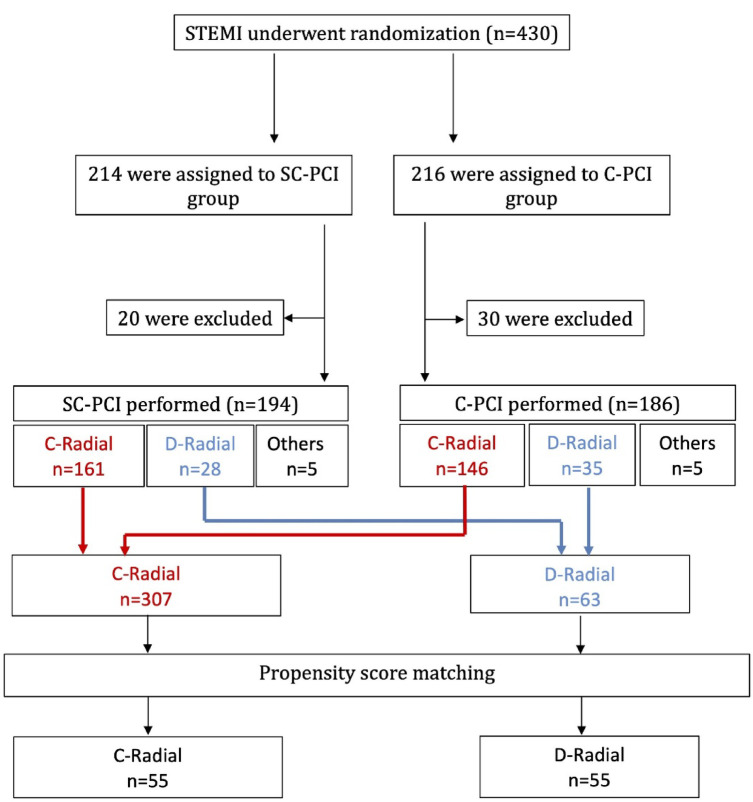 Figure 1
Peer Reviews
No public reviews on file for this paper yet. If you reviewed it on a platform where reviews are public (OpenReview, ICLR, NeurIPS, ICML), you can paste yours below so the community can read it here.
Videos
No videos yet. Explain this paper in a talk, walkthrough, or lecture? Add one.
Taxonomy
TopicsCoronary Interventions and Diagnostics · Vascular Procedures and Complications · Acute Myocardial Infarction Research