Synthesis of high-entropy hydride from the cantor alloy (fcc–CoCrFeNiMn) at extreme conditions
Konstantin Glazyrin, Kristina Spektor, Maxim Bykov, Paulo H. B. Carvalho, Weiwei Dong, Fritz Körmann, Asami Sano-Furukawa, Takanori Hattori, Doreen C. Beyer, Martin Sahlberg, Yuji Ikeda, Ji Hun Yu, Yang Sangsun, Jai-Sung Lee, Shrikant Bhat, Michael Hanfland, Blazej Grabowski

TL;DR
This study shows that a Cantor alloy forms a hydride under extreme conditions, revealing new insights into high-entropy materials and their hydrogen interactions.
Contribution
The formation of a stoichiometric hydride from a Cantor alloy under high-pressure and high-temperature conditions is newly demonstrated.
Findings
The Cantor alloy forms an fcc hydride under high-pressure and high-temperature conditions.
Hydrogen content in the hydride was estimated through experimental and computational methods.
X-ray and neutron diffraction confirmed the hydride's structure.
Abstract
Studies of high-entropy materials contribute to various fields of science and reveal ever more exciting properties of applied interest. Here, we perform a study of the resistance of a Cantor alloy (CoCrFeNiMn) to hydrogen through high-pressure experiments at elevated temperatures by X-ray and neutron time-of-flight experiments and ab initio calculations. We report formation of an fcc hydride based on the Cantor alloy composition. We also provide its characterization, including an estimate of hydrogen content. These findings contribute to the growing body of knowledge on the complex chemistry of high-entropy alloys and high-entropy hydrides. This study shows that the Cantor alloy (CoCrFeNiMn), inert to hydrogen at room temperature, forms a stoichiometric hydride under high-pressure, high-temperature conditions, supported by X-ray, neutron diffraction, and ab initio calculations.
Genes, proteins, chemicals, diseases, species, mutations and cell lines named across the full text — each resolved to its canonical identifier and authoritative record.
Click any figure to enlarge with its caption.
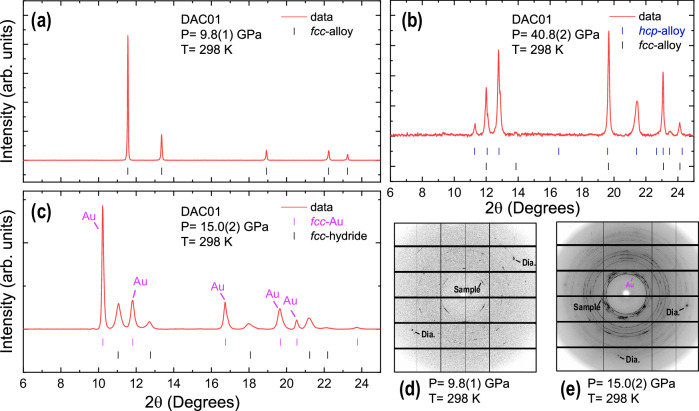 Figure 1
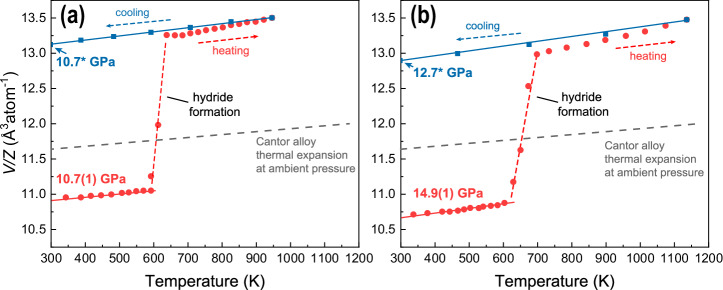 Figure 2
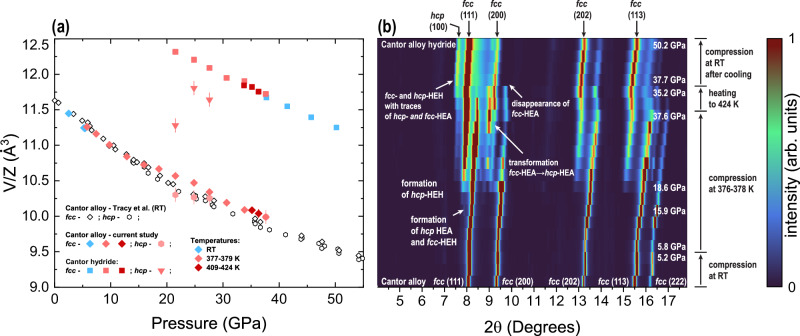 Figure 3
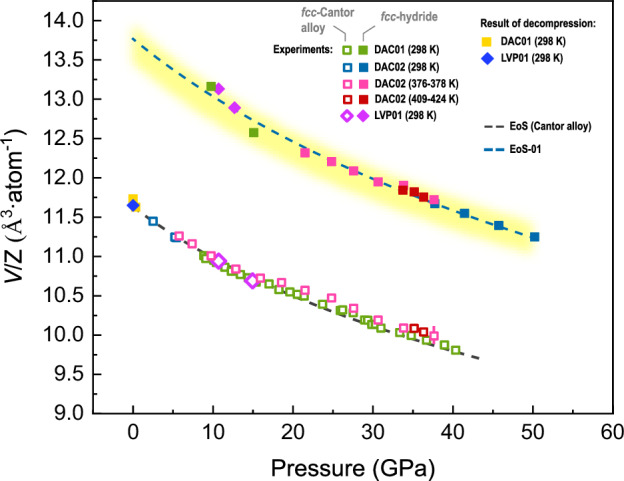 Figure 4
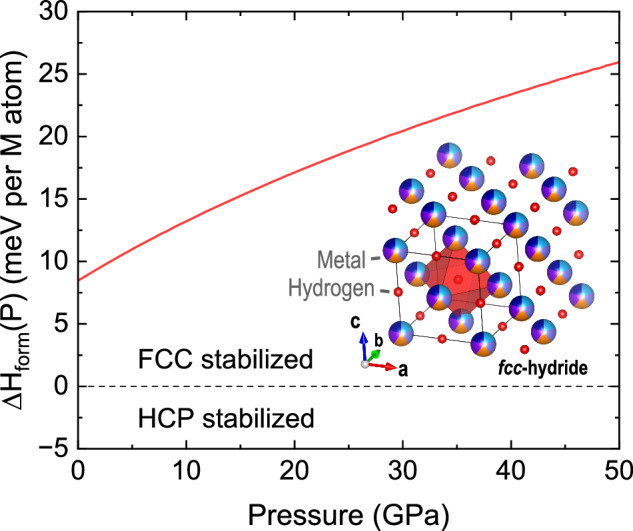 Figure 5
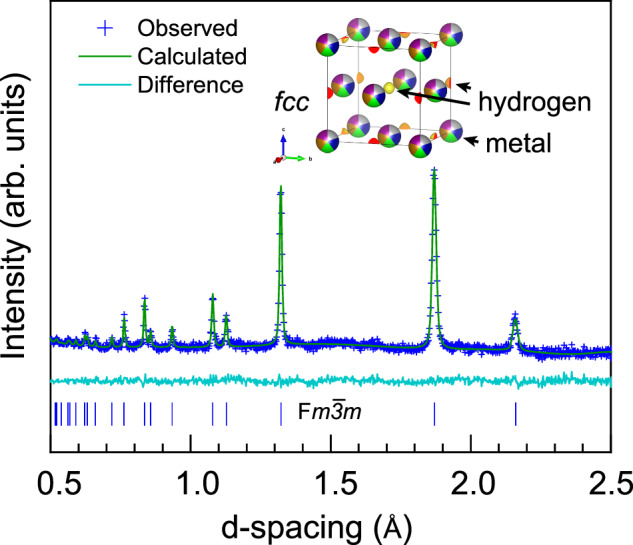 Figure 6
Peer Reviews
No public reviews on file for this paper yet. If you reviewed it on a platform where reviews are public (OpenReview, ICLR, NeurIPS, ICML), you can paste yours below so the community can read it here.
Videos
No videos yet. Explain this paper in a talk, walkthrough, or lecture? Add one.
Taxonomy
TopicsHigh Entropy Alloys Studies · Hydrogen Storage and Materials · Additive Manufacturing Materials and Processes