The IDO1/AhR-HIF-1α metabolic axis: ARNT competition as a central antagonistic switch in autoimmune pathogenesis
Zhaocheng Dong, Haoran Dai, Xiaoyan Zhang, Zhijing Zhao, Yangzi Chen, Yang Zheng, Hongliang Rui, Baoli Liu, Xianggen Zhong

TL;DR
This paper explores how two competing immune pathways, IDO1/AhR and HIF-1α, influence autoimmune diseases through their shared use of ARNT, suggesting new treatment strategies.
Contribution
The paper introduces the IDO1/AhR-HIF-1α metabolic axis as a central regulatory mechanism in autoimmune disease pathogenesis.
Findings
The IDO1/AhR and HIF-1α pathways compete for ARNT, forming distinct immune-regulating complexes.
Dysregulation of this axis leads to Treg/Th17 imbalance and tissue damage in autoimmune diseases.
Targeting this axis with HIF-1α inhibitors and IDO1/AhR agonists may offer new treatment strategies.
Abstract
The immunometabolic checkpoint axis formed by the IDO1/AhR pathway and the HIF-1α pathway, which functionally antagonize each other via their competition for the shared transcriptional partner aryl hydrocarbon receptor nuclear translocator (ARNT), profoundly regulates the pathogenesis and progression of autoimmune diseases. Following activation of the aryl hydrocarbon receptor (AhR) by kynurenine (Kyn), a tryptophan metabolite generated by IDO1, the activated AhR and hypoxia-induced HIF-1α intensely compete for the limited pool of ARNT protein. This competition results in the formation of two distinct transcriptional complexes: AhR/ARNT and HIF-1α/ARNT. These complexes drive opposing immune programs. The AhR/ARNT complex promotes immune tolerance by facilitating Treg cell differentiation, inducing a tolerogenic phenotype in dendritic cells, promoting M2 macrophage polarization, and…
Genes, proteins, chemicals, diseases, species, mutations and cell lines named across the full text — each resolved to its canonical identifier and authoritative record.
Click any figure to enlarge with its caption.
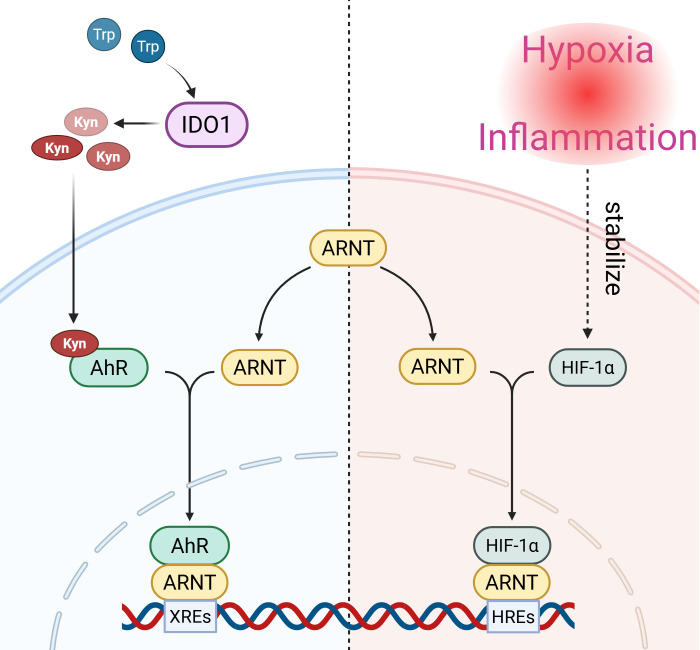 Figure 1
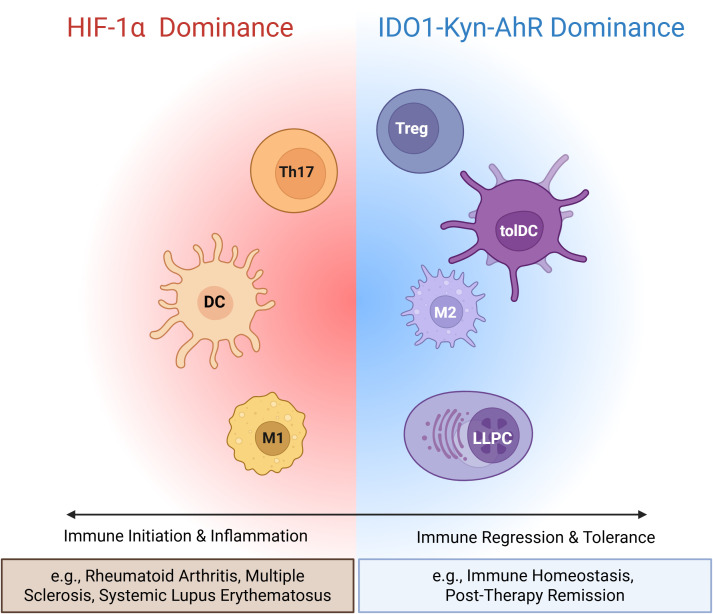 Figure 2
Peer Reviews
No public reviews on file for this paper yet. If you reviewed it on a platform where reviews are public (OpenReview, ICLR, NeurIPS, ICML), you can paste yours below so the community can read it here.
Videos
No videos yet. Explain this paper in a talk, walkthrough, or lecture? Add one.
Taxonomy
TopicsTryptophan and brain disorders · Toxic Organic Pollutants Impact · Immune cells in cancer