Potential profile and influencing factors of feedback-seeking behavior among nursing interns during the early stages of internships: a multicenter cross-sectional study
Chuqin Xiong, Shuge Wang, Peiran Guo, Yao Lei, Yanling Xiao, Qiuxia Chen, Liuliu Guo, Zhixia Zhang, Limin Liu

TL;DR
This study identifies different levels of feedback-seeking behavior in early-stage nursing interns and suggests targeted interventions to improve their professional development.
Contribution
The study reveals distinct feedback-seeking profiles and their predictors, offering new insights for educational interventions in nursing training.
Findings
Three distinct feedback-seeking profiles were identified: low (20.87%), moderate (38.3%), and high (40.83%).
Education level, student cadre experience, hospital type, and career adaptability significantly predict feedback-seeking profiles.
Tiered interventions are recommended to enhance proactive feedback-seeking behavior and support role transition in nursing interns.
Abstract
Nursing interns often face maladjustment during the early stages of clinical practice, which not only directly affects their physical and mental health as well as work efficiency but also significantly inhibits their proactive feedback-seeking behavior (FSB). As an active self-regulation strategy, FSB can enhance interns’ work initiative and promote role transition. However, existing research has yet to thoroughly investigate the potential heterogeneity and categorical characteristics of FSB within this population, and the role of psychological resources such as career adaptability in shaping these patterns requires further investigation. To investigate the status of FSB in early-stage nursing interns, identify latent subgroups via latent profile analysis (LPA), and analyze associated factors, thereby providing evidence for targeted clinical educational interventions. Multicenter…
Click any figure to enlarge with its caption.
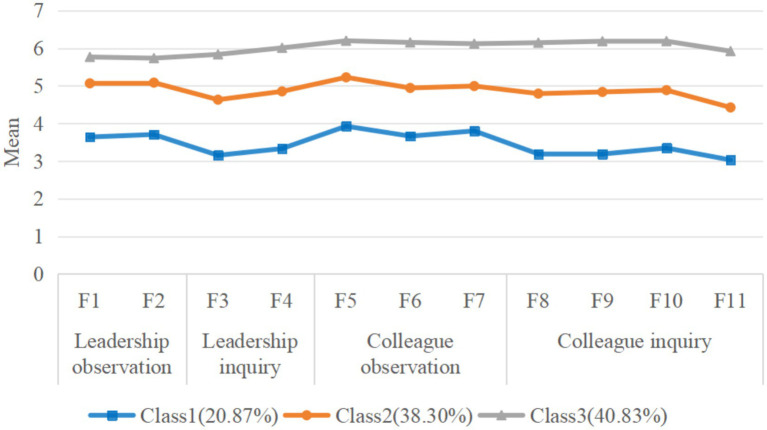 Figure 1
| Component | Total | Initial eigenvalues % of variance | Cumulative % | Total | Extraction sums of squared loadings % of variance | Cumulative % |
|---|---|---|---|---|---|---|
| 1 | 10.17 | 29.057 | 29.057 | 10.17 | 29.057 | 29.057 |
| 2 | 4.488 | 12.824 | 41.881 | 4.488 | 12.824 | 41.881 |
| 3 | 2.857 | 8.163 | 50.043 | 2.857 | 8.163 | 50.043 |
| 4 | 1.721 | 4.917 | 54.96 | 1.721 | 4.917 | 54.96 |
| 5 | 1.509 | 4.313 | 59.273 | 1.509 | 4.313 | 59.273 |
| 6 | 1.157 | 3.306 | 62.58 | 1.157 | 3.306 | 62.58 |
| 7 | 1.063 | 3.038 | 65.618 | 1.063 | 3.038 | 65.618 |
| Variable | Classification | Overall | C1 | C2 | C3 |
| |
|---|---|---|---|---|---|---|---|
| Gender | Male | 155 (11.9) | 27 (9.9) | 72 (14.4) | 56 (10.5) | 0.082 | |
| Female | 1,153 (88.1) | 246 (90.1) | 429 (85.6) | 478 (89.5) | |||
| Age (years) | ≤20 | 439 (33.6) | 97 (35.5) | 182 (36.3) | 160 (30.0) | 0.071 | |
| ≥21 | 869 (66.4) | 176 (64.5) | 319 (63.7) | 374 (70.0) | |||
| Education | Junior college degree | 593 (45.3) | 165 (60.4) | 209 (41.7) | 219 (41.0) | <0.001 | |
| Bachelor’s degree | 715 (54.7) | 108 (39.6) | 292 (58.3) | 315 (59.0) | |||
| Place of resident | City | 560 (42.8) | 103 (37.7) | 230 (45.9) | 227 (42.5) | 0.088 | |
| Rural | 748 (57.2) | 170 (62.3) | 271 (54.1) | 307 (57.5) | |||
| Student cadre experience | Yes | 856 (65.4) | 143 (52.4) | 317 (63.3) | 396 (74.2) | <0.001 | |
| No | 452 (34.6) | 130 (47.6) | 184 (36.7) | 138 (25.8) | |||
| Only-child | Yes | 344 (26.3) | 70 (25.6) | 128 (25.5) | 146 (27.3) | 0.777 | |
| No | 964 (73.7) | 203 (74.4) | 373 (74.5) | 388 (72.7) | |||
| Internship hospital type | Tertiary Grade A Hospital | 1,043 (79.7) | 188 (68.9) | 436 (87.0) | 419 (78.5) | <0.001 | |
| Tertiary Grade B Hospital | 182 (13.9) | 38 (13.9) | 53 (10.6) | 91 (17.0) | |||
| Secondary Hospital and below | 83 (6.3) | 47 (17.2) | 12 (2.4) | 24 (4.5) | |||
| Family support for career choice | Support | 1,271 (97.2) | 260 (95.2) | 488 (97.4) | 523 (97.9) | 0.084 | |
| Non-Support | 37 (2.8) | 13 (4.8) | 13 (2.6) | 11 (2.1) | |||
| Employment intention | Hospital | 866 (66.2) | 164 (60.1) | 331 (66.1) | 371 (69.5) | <0.001 | |
| Nursing institution | 82 (6.3) | 17 (6.2) | 28 (5.6) | 37 (6.9) | |||
| Further education | 161 (12.3) | 28 (10.3) | 61 (12.2) | 72 (13.5) | |||
| Career change | 48 (3.7) | 18 (6.6) | 19 (3.8) | 11 (2.1) | |||
| Other | 151 (11.5) | 46 (16.8) | 62 (12.4) | 43 (8.1) | |||
| Career Adapt-Abilities Scale (M ± SD) | 3.77 ± 0.51 | 3.52 ± 0.53 | 3.73 ± 0.51 | 3.93 ± 0.43 | <0.001 | ||
| Career concern (M ± SD) | 3.76 ± 0.65 | 3.47 ± 0.68 | 3.70 ± 0.61 | 3.96 ± 0.59 | <0.001 | ||
| Career control (M ± SD) | 3.56 ± 0.76 | 3.41 ± 0.72 | 3.63 ± 0.62 | 3.58 ± 0.88 | <0.001 | ||
| Career curiosity (M ± SD) | 3.82 ± 0.65 | 3.50 ± 0.69 | 3.75 ± 0.58 | 4.06 ± 0.59 | <0.001 | ||
| Career confidence (M ± SD) | 3.92 ± 0.62 | 3.69 ± 0.66 | 3.82 ± 0.57 | 4.13 ± 0.56 | <0.001 | ||
| Variable | Feedback-seeking behavior (M ± SD) |
|---|---|
| Feedback-seeking behavior | 5.06 ± 1.08 |
| Leader observation | 5.07 ± 1.55 |
| Leader inquiry | 4.92 ± 1.55 |
| Colleague observation | 5.25 ± 1.20 |
| Colleague inquiry | 4.99 ± 1.31 |
| Model | AIC | BIC | aBIC | Entropy | LMR ( | BLRT ( | Category probability (%) |
|---|---|---|---|---|---|---|---|
| 1 | 52,670.535 | 52,784.413 | 52,714.529 | – | – | – | – |
| 2 | 48,287.351 | 48,463.344 | 48,355.342 | 0.910 | <0.001 | <0.001 | 0.331/0.669 |
| 3 | 47,223.217 | 47,461.325 | 47,315.204 | 0.850 | 0.0081 | <0.001 | 0.209/0.383/0.408 |
| 4 | 46,289.058 | 46,589.281 | 46,405.042 | 0.903 | 0.6244 | <0.001 | 0.088/0.451/0.369/0.091 |
| 5 | 45,462.524 | 45,824.861 | 45,602.505 | 0.897 | 0.1533 | <0.001 | 0.175/0.072/0.344/0.327/0.082 |
| Model | Probability of belonging to latent profiles | ||
|---|---|---|---|
| C1 | C2 | C3 | |
| C1 | 0.926 | 0.074 | 0.000 |
| C2 | 0.020 | 0.921 | 0.059 |
| C3 | 0.000 | 0.055 | 0.945 |
| Variable | C2 vs C1a | C3 vs C1a | C2 vs C3b | |||||||||
|---|---|---|---|---|---|---|---|---|---|---|---|---|
| B |
| OR | 95%CI | B |
| OR | 95%CI | B |
| OR | 95%CI | |
| Education | ||||||||||||
| Junior college degree | −0.323 | 0.063 | 0.724 | [0.515,1.018] | −0.550 | 0.003* | 0.577 | [0.403,0.825] | 0.227 | 0.125 | 1.255 | [0.939,1.677] |
| Student cadre experience | ||||||||||||
| Yes | 0.255 | 0.117 | 1.29 | [0.938,1.775] | 0.616 | <0.001* | 1.852 | [1.324,2.590] | −0.361 | 0.012 | 0.697 | [0.526,0.923] |
| Internship hospital type | ||||||||||||
| Tertiary Grade A Hospital | 1.982 | <0.001* | 7.255 | [3.648,14.427] | 0.934 | 0.002* | 2.546 | [1.392,4.655] | 1.047 | 0.006* | 2.85 | [1.349,6.023] |
| Tertiary Grade B Hospital | 1.628 | <0.001* | 5.093 | [2.351,11.033] | 1.215 | <0.001* | 3.37 | [1.698,6.690] | 0.413 | 0.313 | 1.511 | [0.677,3.372] |
| Employment intention | ||||||||||||
| Hospital | 0.128 | 0.58 | 1.137 | [0.723,1.788] | 0.353 | 0.165 | 1.423 | [0.865,2.340] | −0.225 | 0.318 | 0.799 | [0.514,1.242] |
| Nursing institution | −0.14 | 0.715 | 0.869 | [0.410,1.843] | 0.256 | 0.517 | 1.292 | [0.595,2.803] | −0.396 | 0.242 | 0.673 | [0.347,1.307] |
| Further education | 0.037 | 0.907 | 1.038 | [0.556,1.940] | 0.226 | 0.502 | 1.253 | [0.648,2.424] | −0.188 | 0.503 | 0.828 | [0.477,1.437] |
| Career change | −0.481 | 0.236 | 0.618 | [0.279,1.370] | −0.847 | 0.081 | 0.429 | [0.165,1.111] | 0.366 | 0.423 | 1.443 | [0.589,3.533] |
| Career adapt-abilities scale | ||||||||||||
| Career concern | 0.141 | 0.403 | 1.152 | [0.827,1.603] | 0.314 | 0.076 | 1.369 | [0.968,1.936] | −0.173 | 0.24 | 0.841 | [0.631,1.122] |
| Career control | 0.317 | 0.012* | 1.374 | [1.072,1.760] | −0.106 | 0.402 | 0.9 | [0.703,1.152] | 0.423 | <0.001* | 1.527 | [1.241,1.877] |
| Career curiosity | 0.548 | 0.004* | 1.73 | [1.185,2.525] | 0.964 | <0.001* | 2.621 | [1.771,3.878] | −0.415 | 0.011* | 0.66 | [0.480,0.908] |
| Career confidence | −0.292 | 0.100 | 0.746 | [0.527,1.058] | 0.403 | 0.028 | 1.496 | [1.045,2.141] | −0.695 | <0.001* | 0.499 | [0.368,0.677] |
Peer Reviews
No public reviews on file for this paper yet. If you reviewed it on a platform where reviews are public (OpenReview, ICLR, NeurIPS, ICML), you can paste yours below so the community can read it here.
Videos
No videos yet. Explain this paper in a talk, walkthrough, or lecture? Add one.
Taxonomy
TopicsNursing education and management · Career Development and Diversity · Healthcare professionals’ stress and burnout
Introduction
1
World Health Organization (1) State of the World’s Nursing Report 2025 predicted that the total global shortage of nurses will reach 4.1 million by 2030. The Nursing Solution Inc. (2) report indicated that over 22.3% of newly registered nurses leave their jobs within the first year. In China, 69.4% of nurses exhibit high turnover intention (3). Given that nurses constitute the largest group in global healthcare (1), their high turnover exacerbates workforce shortages and threatens healthcare quality (4). In 2023, more than 600,000 Chinese nursing interns sat for licensing exams, with nearly 300,000 new nurses entering the profession annually (5). Therefore, as a critical reserve for the future workforce, nursing interns require enhanced training to ensure professional stability and retention, thereby effectively addressing nurse shortages.
Clinical internships, which are a core component of practical nursing education, are critical for transforming theoretical knowledge into practical skills and facilitating a smooth transition from academic learning to professional nursing, thereby significantly shaping career trajectories. The initial internship phase (≤3 months) is a pivotal starting point for career development (6). Previous studies have indicated that during the initial stage of clinical practice, nursing interns face challenges in role transition, hospital environment adaptation, and interpersonal relationship building (6, 7), which often lead to anxiety, tension, and avoidance. These issues impair internship outcomes and may suppress proactive feedback-seeking behaviors (FSB), thereby affecting career commitment and professional identity. Thus, fostering FSB among early-stage interns to enhance work proactivity is crucial for successful role transition, strengthening professional identity, and ensuring the nursing workforce’s long-term stability.
Proposed by Ashford and Cummings (8), FSB refers to individuals’ proactive actions to obtain valuable organizational information through observation or inquiry from leaders and colleagues to meet adaptation and development needs. Active FSB mitigates career transition challenges and enhances nurses’ work adaptability (9), whereas passive FSB may cause burnout and reduce job embeddedness (10). Previous studies have indicated that higher FSB among nursing interns correlates with stronger professional identity (11). However, previous studies on FSB have predominantly focused on novice and newly graduated nurses, with limited exploration of early-stage nursing interns. Therefore, it is important to examine FSB among this group to provide new insights into nursing management.
Previous studies indicate that individual traits, feedback provider characteristics, hospital organizational environment, and sociocultural factors significantly influence FSB (12–14). Additionally, positive psychological factors, particularly career adaptability, which is a key psychological resource for navigating career tasks, transitions, and major events, are critical predictors (15). Previous studies indicated that career adaptability positively influences career construction, motivation, and psychological resilience (16–18); however, its effect on FSB remains underexplored. Studies have also indicated that career adaptability can positively predict proactive behaviors among nursing students (19), with adaptable nursing interns exhibiting stronger proactive FSB in supportive feedback environments (20). Interns often face various degrees of maladjustment during clinical internships (21). Enhancing career adaptability among early-stage interns can mitigate career anxiety, boost proactive FSB, and lay a foundation for future career success.
Few previous studies explored the role of career adaptability in shaping FSB among early-stage nursing interns, and existing studies often adopted a singular perspective, assessing FSB based on total scale scores without addressing interns’ internal diversity. Latent profile analysis (LPA), which is a statistical technique that uncovers latent characteristics and subgroup distributions based on observed variable scores (22), has not been applied to examine latent features of FSB among this population. Therefore, this study utilized LPA in a multicenter, large-sample, cross-sectional investigation to identify latent characteristics of FSB among early-stage nursing interns. Furthermore, this study also sought to determine the factors influencing these profiles and offer insights for nursing educators and clinical managers to develop comprehensive, targeted feedback training programs.
Methods
2
Study design
2.1
A multicenter cross-sectional study.
Participants and procedures
2.2
Between June and September 2024, a multistage stratified cluster sampling method was used to recruit nursing interns from universities in Hubei Province. During the first stage, Wuhan, Yichang, and Jingzhou were selected as sample regions based on their high rankings in gross domestic product and population density rankings. During the second stage, between two and four higher education institutions were selected per city according to the population size of their nursing programs. During the third stage, cluster sampling was conducted by selecting internship classes from institutions that met the inclusion and exclusion criteria. Ultimately, nine institutions (five undergraduate and four vocational colleges) were included. The inclusion criteria were (1) internship duration of 3 months or less, (2) full-time associate degree or undergraduate nursing interns, and (3) voluntary signing of informed consent. Exclusion criteria were (1) absence from duty for more than 1 month due to illness or personal leave, and (2) a non-continuous internship at the same hospital.
Sample size considerations
2.3
The sample size was estimated using Kendall’s formula, which recommends that the sample size be 10–15 times the number of independent variables (23). With 13 independent variables in this study, and considering a 20% attrition rate, the calculated sample size ranged between 156 and 234. In addition, studies indicate that LPA typically requires a sample size exceeding 500 to ensure robust model estimation (24). Ultimately, 1,308 participants were included in this study.
Measures
2.4
The survey instruments included a sociodemographic characteristics questionnaire, the Feedback-Seeking Behavior Scale (FSBS), and the Career Adapt-Abilities Scale (CAAS).
Sociodemographic characteristics
2.4.1
The demographic survey was constructed through a literature review (25). The survey included nine variables, such as gender, age, education, place of residence, student cadre experience, only-child status, type of internship hospital, family support for career choice, and employment intention.
Feedback-seeking behavior scale (FSBS)
2.4.2
The FSBS, developed by Callister et al. (26) and adapted into Chinese by Gong (27), the FSBS measures employees’ FSB (Cronbach’s α = 0.890). The scale comprises 11 items in four dimensions: leaders-observed (two items), leaders-inquiry (two items), colleagues-observed (three items), and colleagues-inquiry (four items). The scale has been widely used in nursing research, Ning et al. (28) applied the scale to new nurses and reported a Cronbach’s α of 0.894. Yuan et al. (29) further adapted the scale for use with nursing interns by replacing “leaders” with “mentors” and “colleagues” with “students,” reporting a Cronbach’s α of 0.898. Items are rated on a 7-point Likert scale (1 = “strongly disagree” to 7 = “strongly agree”), yielding total scores between 11 and 77. Higher scores indicate greater FSB. In the present study, the Cronbach’s α was 0.901, and subscale α values ranged from 0.874 to 0.905.
The career adapt-abilities scale (CAAS)
2.4.3
The CAAS, developed by Savickas and Porfeli (15) and translated into Chinese by Hou et al. (30), was used to assess university students’ career adaptability. This scale has been widely applied in the field of nursing to measure the career adaptability of nursing interns, demonstrating a Cronbach’s alpha of 0.920 within this population (31). The scale consists of four dimensions: concern (six items), control (six items), curiosity (six items), and confidence (six items), totaling 24 items each. Items are scored on a 5-point Likert scale (1 = “not strong” to 5 = “strongest”), with total scores ranging from 24 to 120; higher scores denote stronger career adaptability. In the current study, the Cronbach’s α was 0.913.
Data collection
2.5
Data were collected online via the Wenjuanxing platform.1 Upon obtaining authorization from internship coordinators at the participating universities, survey links were forwarded via WeChat to class advisors, who distributed them directly to the class groups of eligible early-stage nursing interns. To encourage participation and minimize non-response bias, a small incentive (handmade soap) was provided to each participant upon completion. The study purpose was outlined on the survey homepage, where electronic informed consent was obtained. To ensure data integrity, the system restricted submissions to one per IP address, and all items were mandatory. Based on a pilot survey of 30 interns, a benchmark for focused completion time (120–261 s) was established, and attention check items (i.e., trap questions) were embedded in the main questionnaire. Following data collection, two researchers conducted a rigorous manual review. Responses were excluded if they failed attention checks, fell outside the focused time range (<120 s or >261 s), or exhibited obvious response patterns, thereby ensuring the quality of the final dataset. Strict confidentiality was maintained throughout the process to protect participant privacy.
Statistical methods
2.6
The questionnaire data were entered and analyzed after being verified by two individuals. Mplus 8.3 was used to conduct LPA on the early-stage nursing interns’ FSB, with the optimal number of profiles selected based on the following criteria: (1) the Akaike information criterion (AIC), Bayesian information criterion (BIC), and sample-size-adjusted BIC (aBIC), with lower values indicating a better model fit; (2) entropy, where values closer to 1 denote higher classification accuracy (32); and (3) the Lo–Mendell–Rubin (LMR) test and bootstrap likelihood ratio test (BLRT), where p < 0.05 indicates that the K-class model is superior to the K − 1-class model. These metrics guided model selection; however, the interpretability of each profile was also considered (33). Statistical analyses were performed using SPSS version 23.0. Categorical data were expressed as frequencies and percentages (%), and continuous data as means ± standard deviations (x ± s). Group comparisons were performed using t-tests and analysis of variance. Multivariate logistic regression was used to assess factors influencing different profiles, with a significance level of 0.05.
Ethics considerations
2.7
This research was conducted in accordance with the Declaration of Helsinki and was approved by the Medical Ethics Committee of Tianyou Hospital affiliated with Wuhan University of Science and Technology (Approval No.: LL2025-04-01-01). All participants were voluntarily recruited and provided electronic informed consent before their participation. The survey was administered anonymously, with all data kept confidential, and participants retained the right to withdraw from the study at any time.
Results
3
Common method bias test
3.1
A common method bias test was performed using Harman’s single-factor test. The results showed that seven factors had eigenvalues greater than 1, and the first factor accounted for 29.057% of the variance, which is below the 40% threshold. Therefore, this study does not suffer from serious common method bias (Table 1).
Participant characteristics
3.2
A total of 1,370 questionnaires were collected, of which 1,308 were valid, with an effective recovery rate of 95.47%. The sample comprised 155 male (11.9%) and 1,153 female (88.1%). The demographic details are presented in Table 2.
Feedback-seeking behavior score
3.3
The mean score of the FSBS was 5.06 ± 1.08, and the specific scores are presented in Table 3.
Latent profile analysis of feedback-seeking behavior
3.4
This study used the FSB dimension scores as manifest indicators to fit models with one to five latent profiles. The fit indices for these models are presented in Table 4. First, as the number of profiles increased, the AIC, BIC, and aBIC values decreased progressively; the three-profile model represented a turning point at which the downward trend of each value slowed. Second, the LMR tests for Models 4 and 5 were not statistically significant (p > 0.05). Third, the three-profile model had an entropy exceeding 0.80, and both the LMRT and BLRT were statistically significant (p < 0.05). In addition, the average probability for each profile exceeded 90%, indicating that the classification results of Model 3 were highly reliable. These model comparisons are detailed in Table 5. Collectively, the results indicated that Model 3 was the optimal fit.
Naming of the latent profiles of feedback-seeking behavior
3.5
Based on the FSBS scores provided by the nursing interns during the initial stage of their internship, the three latent profiles were identified. A visualization of these profiles, with the x-axis representing the dimensions and the y-axis representing the average scores, is shown in Figure 1. Each latent profile was named based on its scores across various dimensions and its external characteristics. Regarding the C1 category, the scores in all dimensions were low; therefore, it was named the “Low Feedback-Seeking Group,” comprising 273 (20.87%) participants. Regarding the C2 category, the scores in all dimensions were at a medium level; therefore, this was designated as the “Medium Feedback-Seeking Group,” comprising 501 (38.3%) participants. The C3 category was marked by high scores across all dimensions; therefore, it was named the “High Feedback-Seeking Group,” comprising 534 (40.83%) participants.
Mean value characteristics for the three-profile solution (n = 1,308).
Predictors of latent profiles of feedback-seeking behavior
3.6
The univariate analysis revealed statistically significant differences among the FSB categories of early-stage nursing interns concerning education level, student leadership experience, internship hospital type, employment intention, and career adaptability scale scores (p < 0.05; Table 2). Following this, variables in the univariate analysis with statistical significance were incorporated into a multivariate logistic regression model, with the low and high feedback-seeking groups as reference groups. The results indicated that education level, student leadership experience, internship hospital type, and career adaptability were predictors of FSBs among early-stage nursing interns (p < 0.05).
The results revealed that early-stage nursing interns who had experience as student leaders (OR = 1.852, CI = [1.324, 2.590]), were from tertiary Grade A hospitals (OR = 2.546, CI = [1.392, 4.655]), were from tertiary Grade B hospitals (OR = 3.37, CI = [1.698, 6.690]), exhibited career curiosity (OR = 2.621, CI = [1.771, 3.878]), and exhibited career confidence (OR = 1.496, CI = [1.045, 2.141]) were more likely to be in the high feedback-seeking group than the low group. Additionally, those with a junior college degree (OR = 0.577, CI = [0.403, 0.825]) had a higher probability of being in the low feedback-seeking group. Further details are presented in Table 6.
Discussion
4
This study employed LPA to examine the heterogeneity of FSB among early-stage nursing interns and explored the associated psychological variables and demographic factors, thereby offering a novel perspective. This approach facilitated targeted interventions for nursing educators and clinical managers, thus enabling the development of stratified guidance strategies to enhance FSB, improve clinical internship quality, and promote long-term professional development among nurses.
Current status of feedback-seeking behaviors and latent profiles
4.1
The mean FSBS score among early-stage nursing interns was 5.06 ± 1.08, which was lower than that reported by Zhang et al. (9), thus indicating a moderately low level. This difference may be attributed to the characteristics of their career development stage. Compared with new nurses who possess some clinical experience (10), early-stage interns, transitioning from “knowledge recipients” to “practice explorers” lack sufficient professional knowledge and struggle to make accurate judgments or respond effectively to complex clinical situations (6). Consequently, they exhibit conservative feedback-seeking tendencies in clinical practice. This emphasizes the need for nursing managers to establish systematic, individualized feedback mechanisms, with senior nurses providing accurate feedback and fostering effective learning environments and positive ward atmospheres to enhance interns’ willingness to actively seek feedback.
Moreover, this study categorized early-stage nursing interns, into three groups based on their FSB: low (20.87%), moderate (38.3%), and high (40.83%). The “Low Feedback-Seeking Group” (20.87%) was characterized by lower educational levels and career adaptability. This group is likely accustomed to passive, teacher-centered learning (34). They often lack self-improvement awareness and undervalue feedback for professional growth. Due to insufficient adaptability, they are sensitive to “transition shock” and tend to use defensive avoidance strategies. Wan et al. (35) found through weekly diaries that consistent feedback-seeking significantly boosts work engagement and performance. For this group, experienced mentors should conduct weekly one-on-one dialogues. Guiding clinical reflection and feedback journaling can help enhance their intrinsic motivation.
The “Moderate Feedback-Seeking Group” (38.3%) was characterized by bachelor’s degrees, tertiary hospital internships, and high scores in career control and curiosity. These interns received systematic theoretical education (36) and possess a solid professional foundation. Research by Sümen and Adibelli (37) showed that inquiry-based learning, such as leading case discussions, effectively satisfies curiosity and improves clinical decision-making. Therefore, we recommend granting moderate autonomy during rotations. For example, interns could lead brief case reports during ward rounds. Such tasks expose knowledge gaps, transforming latent curiosity into concrete feedback-seeking. This helps them shift from passive acceptance to active problem discovery.
The “High Feedback-Seeking Group” (40.83%) scored high across most dimensions, excluding “monitoring of instructor feedback.” Key traits include student leadership experience and high career confidence. These students typically understand organizational mechanisms and the role of feedback in achieving goals. They are also adept at identifying key feedback sources. Driven by strong confidence and goal orientation (38), they are willing to expose deficiencies and actively seek growth. As noted by Baldwin et al. (39), peer-assisted learning offers reciprocal benefits: it reinforces the mentor’s professional identity while reducing the peer’s anxiety. For this group, we recommend a “peer mentor” mechanism. Organizing experience-sharing sessions or participating in training allows them to model positive behaviors, fostering a proactive feedback atmosphere.
Predictors of feedback-seeking behavior for different profiles
4.2
Education level
4.2.1
Higher educational levels among early-stage nursing interns were associated with stronger FSB, This finding was consistent with the conclusions of most existing studies (9, 25). This association stems from their more systematic knowledge frameworks, clearer professional accountability, and enhanced self-directed learning cultivated through advanced education (13, 40). However, notable heterogeneity exists, as evidenced by research indicating that in high-pressure clinical environments like emergency departments, highly educated nurses exhibit reduced feedback-seeking frequency and increased burnout risk (41), potentially due to role strain and heightened self-expectations in stressful or unsupportive settings. These findings suggest the influence of educational background on proactive behavior is non-linear and moderated by environmental and psychological factors. Consequently, nursing education should implement a dual-support framework that refines tiered training while concurrently fostering a clinical feedback culture and psychologically safe environments through tailored strategies, thereby translating academic advantages into sustainable professional competencies.
Student cadre experience
4.2.2
Early-stage nursing interns who had student leadership experience exhibited increased FSB. This is primarily attributed to the behavioral and cognitive patterns internalized through their role experience. Student leaders are accustomed to proactively seeking feedback to calibrate their actions and achieve goals during their duties, which cultivates stronger feedback-seeking motivation and habitual practice. This observation aligns with the findings of Wright et al. (42). Research by Li et al. (43) further supports that holding leadership roles can systematically enhance an individual’s sense of responsibility and goal orientation. Additionally, the adaptability and relational coordination skills developed in practice enable these interns to more effectively identify clinical support resources and initiate feedback-seeking with lower perceived social costs, as noted by Shen et al. (44). This role-based identity and increased self-efficacy strengthen their intrinsic motivation to view feedback as a growth tool, thereby reducing hesitation in seeking it. Therefore, nursing managers should establish structured training mechanisms and provide targeted opportunities for interns with leadership backgrounds to leverage their strengths. In practical arrangements such as clinical rotations and shift groupings, strategically placing these interns can encourage them to serve as role models, foster peer-assisted learning, and enhance the overall culture of feedback-seeking.
Internship hospital type
4.2.3
Higher hospital levels correlated with stronger FSB among early-stage nursing interns. This correlation aligned with the findings of Jiang et al. (45). The abundant case resources, well-developed teaching systems, and professional mentorship support in higher-level hospitals effectively stimulated interns’ feedback initiative (46, 47). However, research by Liu et al. (48) indicates that nursing interns in secondary hospitals may exhibit stronger FSB. This may be attributed to the flatter management structures and lower workload in lower-level hospitals, which can foster a greater sense of psychological safety, thereby reducing interns’ perceived risks associated with seeking feedback. Furthermore, the complexity of clinical tasks in such environments aligns more closely with interns’ initial competencies, making it easier for them to view feedback as a valuable tool for professional growth rather than a negation of their abilities, thus enhancing their intrinsic motivation for feedback-seeking. This suggests that educators and managers should shift their focus from merely emphasizing hospital hierarchy. Instead, they should consciously cultivate supportive, inclusive, and appropriately challenging learning microenvironments across all clinical training settings to more systematically enhance the professional development of nursing interns.
Career adaptability
4.2.4
Stronger career adaptability among nursing interns was associated with inclusion in the high feedback-seeking group, which aligned with career construction theory. As a key psychological resource for managing predictable tasks and workplace changes (15), career adaptability enables interns to better regulate stress, accelerate role transitions, and maintain professional engagement in complex clinical settings, thereby promoting active feedback-seeking. Studies indicate that higher adaptability correlates with enhanced self-efficacy, career curiosity, and clearer career direction (49), leading interns to perceive feedback as valuable for performance improvement and behavioral adjustment rather than as criticism to avoid. Moreover, highly adaptable interns demonstrate greater resilience in addressing professional challenges and achieve better alignment between their career aspirations and professional practice. A Korean study of 90 nursing interns confirmed that structured vocational education strengthens professional values, curiosity, and confidence (38). Therefore, nursing educators should prioritize developing career adaptability through targeted support mechanisms such as career planning guidance and stress management training. Additionally, strategically assigning such interns as role models in clinical groups can encourage peer feedback-seeking and foster a positive professional learning environment.
Conclusion
5
This study found that FSB among early-stage nursing interns was generally at a low-to-moderate level. LPA identified three distinct profiles—low, moderate, and high seekers—revealing the heterogeneity of this behavior. Significant differences were observed among these groups regarding educational background, student leadership experience, internship hospital type, and career adaptability. Based on individual characteristics, nursing educators and clinical managers should adopt targeted interventions. For low and moderate seekers, strategies such as supportive mentoring, structured feedback training, and case-based discussions may be employed to gradually enhance feedback awareness and clinical adaptability. Conversely, for high seekers, reinforcing motivation and leveraging their role as peer models can foster a positive feedback atmosphere, further elevating the overall level of feedback-seeking and facilitating a smooth transition to professional nursing roles.
Limitations
6
This research has some limitations. First, the cross-sectional design prevents causal inference and fails to capture dynamic changes in FSB. Future longitudinal or cross-lagged panel studies are needed to clarify developmental trajectories. Second, reliance on self-reported data collected in a single survey wave may introduce social desirability bias and common method variance (CMV). Although procedural remedies (e.g., anonymity) were applied, future research should employ multi-source data—such as objective evaluations from clinical preceptors—to mitigate these biases. Third, strict exclusion criteria based on response time and attention checks were applied to ensure data quality. While enhancing validity, this process may have introduced selection bias by omitting valid responses from slower readers. Fourth, regarding the LPA, although the total sample size was robust, the relatively small size of certain identified subgroups may affect profile stability and replicability. Validation through larger-scale studies is recommended. Finally, the predominance of female participants and the restriction to universities in Hubei Province limit gender and geographic generalizability. Nationwide multi-center studies are recommended to obtain more representative samples.
The reference list from the paper itself. Each links out to its DOI / PubMed record.
- 1World Health Organization. State of the world’s nursing 2025 (2025). Available online at: https://www.who.int/publications/i/item/9789240110236 (Accessed May 20, 2025).
- 2Nursing Solution Inc. 2025 NSI national health care retention & RN staffing report (2025). Available online at: https://www.nsinursingsolutions.com/Documents/Library/NSI%20National%20Health%20Care%20Retention%20Report.pdf (Accessed May 21, 2025).
- 3Liu Y Duan Y Guo M. Turnover intention and its associated factors among nurses: a multi-center cross-sectional study. Front Public Health. (2023) 11:1141441. doi: 10.3389/fpubh.2023.1141441, 37397760 PMC 10311009 · doi ↗ · pubmed ↗
- 4Zhang H Wong LP Hoe VCW. Bibliometric analyses of turnover intention among nurses: implication for research and practice in China. Front Psychol. (2023) 14:1042133. doi: 10.3389/fpsyg.2023.1042133, 37404587 PMC 10316129 · doi ↗ · pubmed ↗
- 5National Health Commission. The National Health Commission introduced the relevant situations regarding the development of the nursing team and the improvement of nursing services (2023). Available online at: http://www.nhc.gov.cn/xwzb/webcontroller.do?title Seq=11517&gecstype (Accessed May 8, 2025).
- 6Liu J Yang Y Chen J Zhang Y Zeng Y Li J. Stress and coping styles among nursing students during the initial period of the clinical practicum: a cross-section study. Int J Nurs Sci. (2022) 9:222–9. doi: 10.1016/j.ijnss.2022.02.004, 35509703 PMC 9052268 · doi ↗ · pubmed ↗
- 7Cai T. Transition of newly graduated nurses in China: an evaluation study. Nurse Educ Pract. (2021) 50:102951. doi: 10.1016/j.nepr.2020.102951, 33310507 · doi ↗ · pubmed ↗
- 8Ashford SJ Cummings LL. Feedback as an individual resource: personal strategies of creating information. Organ Behav Hum Perform. (1983) 32:370–98. doi: 10.1016/0030-5073(83)90156-3 · doi ↗