A systematic review of experimental evidence on microbial pathogen transmission by Stomoxys spp
Metlholo Andries Phukuntsi, Maropeng Charles Monyama, Moeti Oriel Taioe, Ana Mbokeleng Tsotetsi-Khambule

TL;DR
This study reviews experimental evidence on how Stomoxys flies transmit microbial pathogens, highlighting their role in spreading diseases to various hosts.
Contribution
The study systematically compiles and evaluates experimental transmission data on Stomoxys spp. for the first time.
Findings
Stomoxys spp. can transmit pathogens to nine mammalian hosts and substrates like blood and tissue culture.
Most studies focused on S. calcitrans, with limited data on other species like S. transvittatus and S. inornatus.
Three pathogens (MERS-CoV, Neorickettsia risticii, and E. coli) were not transmitted by Stomoxys flies in experiments.
Abstract
Vector-borne microbial pathogens previously isolated from Stomoxys spp. are currently considered to be emerging or re-emerging threats to public health and the veterinary sector. Transmission of pathogens by flies in the Stomoxys genus is largely mechanical, indicating that they can transmit a wide range of pathogens to a variety of hosts. This study evaluated the diversity of pathogens demonstrably transmitted by a variety of Stomoxys flies, concerning species diversity, host diversity, and geographic distribution. Preferred Reporting Items for Systematic reviews and Meta-Analyses (PRISMA) guidelines were applied to screen studies based on pathogen type, host species, and experimental transmission outcomes. Journal articles published from 1973 to 2025 were sourced from six electronic databases. After evaluation, 30 studies were eligible for this review. Of these studies, 20% (6/30)…
Genes, proteins, chemicals, diseases, species, mutations and cell lines named across the full text — each resolved to its canonical identifier and authoritative record.
Click any figure to enlarge with its caption.
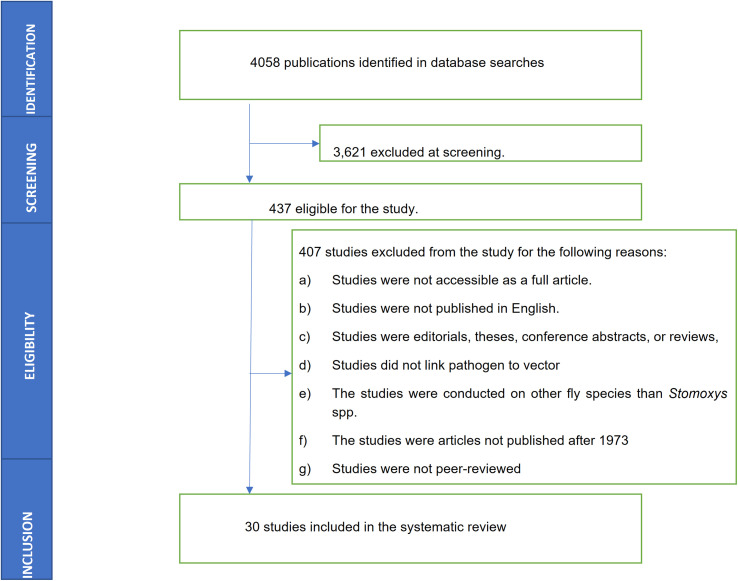 Figure 1
 Figure 1
Peer Reviews
No public reviews on file for this paper yet. If you reviewed it on a platform where reviews are public (OpenReview, ICLR, NeurIPS, ICML), you can paste yours below so the community can read it here.
Videos
No videos yet. Explain this paper in a talk, walkthrough, or lecture? Add one.
Taxonomy
TopicsForensic Entomology and Diptera Studies · Coccidia and coccidiosis research · Helminth infection and control
Introduction
The genus Stomoxys comprises 18 species and is classified under the family Muscidae and order Diptera in Arthropoda [16]. Both sexes of the Stomoxys spp. are hematophagous and use small prestomal teeth to pierce the skin and a proboscis to suck blood [65]. Stomoxys spp. are major pests and vectors of pathogens and they play a major role in the emergence and re-emergence of zoonotic diseases across the world [13]. In the last decade, diseases caused by fly-borne pathogens, previously detected in Stomoxys spp., such as African swine fever and besnoitiosis, have been increasingly documented in areas where they had not been reported before or in recent years, and are considered emerging or re-emerging threats [2, 52, 21].
A variety of microbial pathogens that include protists, bacteria, and viruses have been isolated from Stomoxys spp. These include, but are not limited to, agriculturally important protozoan pathogens such as Trypanosoma spp., Babesia spp., and Besnoitia spp. (causative agents of nagana, babesiosis, and besnoitiosis, respectively), bacterial pathogens such as Anaplasma marginale (causative agent of anaplasmosis) and viral pathogens such as lumpy skin disease virus (LSDV) and African swine fever virus (ASFV) [1, 41]. Host defence response due to painful bites interrupts feeding, leading to the fly finding an alternate host and thus increasing the likelihood of spreading pathogens within herds in a relatively short time. Dispersal in the species is suspected to be reliant on available hosts. Therefore, they may travel great distances to find hosts [65], thus increasing the likelihood of expansions of local outbreaks of diseases.
Stomoxys spp. are largely associated with the agricultural sector, where they occur in high abundance in areas with livestock activity, including feedlots, slaughterhouses, and markets [60]. They have also been found at other sites with a wide range of land-use, including national parks and other conservation areas, pasture areas, and villages [16]. Except for Stomoxys calcitrans [39], the stable fly, a cosmopolitan species found across all major biogeographic realms, except for Antarctica [16], species within Stomoxys are tropical and variably distributed across Africa and Asia [16, 15]. Fourteen of the species are found in Afrotropical bioregions, three species in Reunion Island and six species in the Indomalaya bioregions (Supplementary Table S1).
The last comprehensive review of the flies in the Stomoxys genus, as well as their impact and transmission of pathogens, was undertaken by Zumpt [74]. Since then, the last review of pathogen transmission by Stomoxys was undertaken and published by Baldacchino et al. [1], who documented mechanical and biological transmission of viral, bacterial, protozoan, and helminth pathogens established through natural, experimental, and isolation studies. Since the review of Baldacchino et al. [1], there have been major emerging and re-emerging diseases across the world that have been identified from Stomoxys spp., such as African swine fever (ASF), besnoitiosis, and lumpy skin disease [2, 21, 40, 51]. We therefore performed this review to determine the diversity of the microbial pathogens that have been experimentally transmitted by Stomoxys flies, looking at the diversity of the experimental hosts and the geographic distribution of the Stomoxys spp. that experimentally transmit the pathogens.
Materials and methods
Study design
The systematic review was conducted using the recommended method as outlined in the Preferred Reporting Items for Systematic Reviews and Meta-analyses (PRISMA) guidelines [53]. The following procedures were followed during the review: (i) articles that might be relevant were classified using database searches, (ii) assessments of the articles’ applicability to the review, (iii) assessments of the quality of relevant articles, and (iv) data extraction, screening, and analysis.
Review questions
This systematic review was conducted to synthesise the outcomes of studies on experimental microbial pathogen transmission by Stomoxys spp. The objectives of the review were to determine the diversity of the pathogens that have been demonstrably transmitted by Stomoxys flies through experimental designs, the diversity of the hosts, and the geographic distribution of the Stomoxys spp. that experimentally transmit the pathogens. The research question of this review is “What was the diversity of pathogens demonstrably being transmitted by flies in the Stomoxys genus, and What was the host diversity of the flies?”
Systematic search strategy and selection criteria for journal articles
Following the endorsed methodology by the PRISMA guidelines [53], keywords were used to retrieve studies from electronic databases, namely, PubMed (https://pubmed.ncbi.nlm.nih.gov), Science Direct (https://www.sciencedirect.com), Google Scholar (https://scholar.google.com), Semantic Scholar (https://www.semanticscholar.org), OpenAlex (https://openalex.org), and Scopus (https://www.scopus.com). The search was conducted independently by two researchers (MAP and CMM), both manually and using the program “Publish or Perish” [22]. The search was conducted between March (MAP) and April (CMM), 2025. The systematic search was accomplished following the combination of free text and wordlist terms in diverse distinctions: “Stomoxys”, “Stomoxys spp.”, “transmission”, “pathogen”, “bacteria”, “bacterial”, “protozoa”, “protozoan”, “virus”, and “viral”, using the Boolean operators “AND” and “OR”. Thereafter, titles and abstracts were assessed, and potential articles were reviewed and downloaded for analysis. The reference lists from the potentially searched published articles were also screened for articles relating to the review. The following criteria were used to narrow the final list of articles: (a) duplicate articles were checked and removed from consideration, (b) articles that did not meet the inclusion criteria were also removed, (c) articles that did not fit the aim and scope were not taken into consideration, and (d) articles published before 1973 were not included in this systematic review.
Eligibility criteria
Records from the electronic databases were initially identified using the title and abstract. To determine eligible journal articles for the review, all retrieved articles that were relevant based on their titles were further screened based on their abstracts. When the emphasis was not on flies in the Stomoxys genus, the fly hosts and their associated pathogens, the records were typically excluded. Theses, dissertations, and records with unclear methodology were also removed.
Inclusion criteria
The inclusion criteria were peer-reviewed studies published in English from 1973 to 2025, whose objectives included explicit experimental demonstration of transmission of bacterial, protozoan, and/or viral pathogens by Stomoxys spp., where transmission is determined by the presence of the pathogen in the vector and host within a prescribed period and location. Inconclusive studies where transmission can neither be confirmed nor rejected and studies with negative outcomes (where the hypothesis of transmission is rejected) were also included. Only studies published in peer-reviewed journals were considered for final selection.
Exclusion criteria
As evidence of transmission of pathogens was the explicit objective, the studies that focused on isolation of pathogens from the vector or host, by any means (culturing, cloning, molecular, etc.), without linking the pathogen to both the host and the vector, were excluded.
Identifying bias risk
Thirty articles were included and analysed for quality to avoid the risk of bias. Included articles were analysed according to the JBI critical appraisal checklist (JBI Evidence Synthesis Manual) and guidelines in the gradebook and Cochrane handbook for systematic reviews of interventions [26]. The risk assessment was conducted by evaluating the following variables: (i) study location, (ii) year of publication, (iii) pathogen type, (iv) pathogen name/species, (v) sample size, (vi) detection method, (vii) specific gene detected, (viii) experimental design, (ix) transmission outcome, and (x) other present vectors.
The quality of relevant studies was evaluated by a system of scoring through a modified checklist that was based on the following questions: (a) Was the title and abstract of the study relevant? (b) Were the methods and data analysis of the study clear and sufficiently covered? (c) Does the study give a detailed description of the statistical approach and analysis? (d) Was the sample size acceptable? (e) Was the interpretation of the results and discussion considering the aim/objectives of the study? (f) Were the vector and host samples randomly selected from the population? (g) Were the vector, host, and pathogen(s) clearly identified and allocated? (h) Was the study/experimental design ethically acceptable? and (i) Were the transmission outcomes clearly stated? The assessment carried out on every paper was based on these nine questions and scored at 9/9 × 100% (Supplementary Table S2). A score above 70% was signified as a high-quality journal article, between 50% and 69% an average-quality journal article, and below 49% a low-quality journal article. Thus, no paper was omitted from this review manuscript based on the scores, since any score obtained reflects the quality of the study. Eligibility, inclusion, quality evaluation, and data extraction were all handled by two reviewers throughout the systematic review process.
Data collection and analysis
For the analysis, data were extracted from all the eligible studies. Data were extracted manually by MAP and CMM. The following variables were extracted and documented in an Excel spreadsheet: author and publication year, year of study, fly species, host species, pathogen species, pathogen type, study type, experimental design, vector sample size, host sample size, detection method, geographic location (at three levels), and outcome of the study. The dataset was cleaned and formatted in Excel and analysed using Excel and the R programme.
Results
Literature search and outcomes
The literature search yielded a total of 4,058 articles from the six databases that were queried. After elimination based on the title, eligibility, exclusion and inclusion criteria, 30 articles were selected for analysis (Fig. 1).
Figure 1PRISMA flow diagram showing the process of finding and choosing published articles for the Stomoxys spp. diversity involved in the transmission of pathogens.
Quality assessment of studies
Based on a quality score between 67% and 100%, all studies included in this systematic review were deemed to have a low risk of bias (Supplementary Table S2).
Characteristics of studies in the systematic review
The geographic distribution of studies conducted in this review is summarised in Table 1. The majority of studies were conducted in the European and North American regions. The other regions (Asia, Africa, and South America) represented fewer than half of the studies conducted. Seven of the studies did not report on the region of interest. Diversity of the species studied is also summarised in Table 1. The total number of studied species was 12. Stomoxys calcitrans was studied in all regions. Two species, S. sitiens and S. indicus, were studied in Asia. The rest of the species were studied only in Africa.
Table 1. Characteristics and summary of eligible studies on experimental transmission of microbial pathogens by Stomoxys spp.Geographic regionCountrySpecies namePathogen nameHost ReferenceAfricaCameroon, Kenya, South AfricaStomoxys calcitrans, S. niger niger, S. omega, Stomoxys n. bilineatus, S. pallidus, S. transvittatus, S. taeniatus, S. inornatus, and S. varipesFoot-and-mouth disease virus, Trypanosoma brucei, T. congolense, T. evansi, T. vivax, Anaplasma marginaleCow, mouse, camel[37, 43, 49, 56, 67]AsiaMiddle East, Kazakhstan Stomoxys calcitrans, S. sitiens, S. indica Middle East respiratory syndrome, coronavirus, Lumpy skin disease virusCamel, cow[25, 30]EuropeRomania, Belgium, England, France, Denmark Stomoxys calcitrans African Swine Fever Virus, Lumpy skin disease virus, Capripox virus, Besnoitia besnoiti Pig, cow, sheep, sterile blood, rabbit[2, 21, 34, 38, 51, 63, 64, 66]North AmericaUSA, Canada Stomoxys calcitrans Ehrlichia risticii, Equine infectious anaemia virus, Staphylococcus aureus, Anaplasma marginale, Rift Valley Fever VirusPig, mouse, horse, sterile blood, cow[4, 23, 47, 59, 62, 70]South AmericaBrazil Stomoxys calcitrans Escherichia coli, Trypanosoma vivaxCow[7, 24]Unknown Stomoxys calcitrans Bovine leucosis virus, Equine infectious anaemia virus, Bovine herpes mammillitis, Capripox virus, African Swine fever virus, Eperythrozoon suis, Porcine Reproductive and Respiratory Syndrome Virus*, Bacillus anthracis,* Bovine leukaemia virusSheep, cow, horse, tissue culture, goat, pig, mouse, guinea pig[5, 18,19, 42, 57, 69, 73]
Only 10% (3/30) of studies incorporated in vitro hosts, namely, cell culture and sterile blood (Supplementary Table S4). The host range of Stomoxys spp. included wildlife species (rabbit), domesticated wildlife species (mice and guinea pigs), and domesticated animals (camel, cow, goat, horse, pig, and sheep) (Table 1). The diversity of pathogens in experimental transmission by Stomoxys spp. is summarised in Table 1. The pathogens studied in Africa were the Trypanosoma spp. (East Africa), A. marginale (southern Africa) and Foot and mouth disease virus (FMDV) in Central Africa. In Western Europe, the pathogens studied were ASFV, LSDV, Capripox virus, and Besnoitia besnoiti. In Eastern Europe, the Middle East, and Central Asia, the studied pathogens were ASFV, Middle East respiratory syndrome coronavirus, and LSDV, respectively. In South America, the pathogens studied were E. coli and T. vivax. In North America, pathogens studied were S. aureus, A. marginale, N. risticii, Porcine Reproductive and Respiratory Syndrome Virus, and Rift Valley Fever Virus.
Of the thirty reviewed studies, four studies (13%) used a field approach, one each (3%) allowed the flies to feed on cultured tissue medium or be ingested by the host, three (10%) allowed the flies to feed on sterile blood substrate, two (7%) injected fly material into the host, while 22 (73%) allowed the flies to feed on the host (Supplementary Table S3).
Experimental microbial pathogen transmission by Stomoxys spp.
Species and host diversity in the transmission of pathogens by Stomoxys spp.
Of the thirty studies eligible in this review, 21 (70%) reported at least one positive outcome for demonstration of the transmission of a pathogen by Stomoxys spp., six (20%) reported negative outcomes (no transmission), while three (10%) were inconclusive (Supplementary Table S4). Based on the data from these studies, S. calcitrans can transmit a wide variety of bacterial, protozoan, and viral pathogens to a wide range of hosts in experimental settings. Stomoxys calcitrans successfully transmitted bacterial, protozoan, and viral pathogens in 20 of the 29 studies conducted, on pathogens occurring on all five continents. Stomoxys calcitrans was able to transmit pathogens to all but one livestock species studied (pigs, cows, sheep, and goats), with the exception of camels. Furthermore, S. calcitrans was able to transmit pathogens to domesticated wildlife species, namely, guinea pigs, mice, and rabbits. Most notably, this species successfully transmitted known re-emergent viral diseases in Europe and America (LSDV, ASFV, and RVF). In addition to this, the species also demonstrated the ability to transmit B. besnoiti, a known re-emergent protozoan pathogen in Europe, to a cow and a rabbit. Thus, the data in this review further highlight the risk of S. calcitrans in transmitting a variety of pathogens in livestock and wildlife globally, with an increased risk of spreading re-emerging or introduced pathogens.
Aside from S. calcitrans, seven other species can experimentally transmit pathogens. The largely Asian species, S. indicus and S. sitiens, were shown to successfully transmit LSDV to a cow. Thus, in Asia, S. calcitrans is not the only Stomoxys spp. posing a transmission risk and spread for this virus. Notably, S. niger niger, the most ubiquitous species in Africa, could successfully transmit multiple Trypanosoma species, including T. evansi, T. congolense and T. vivax, although experiments were unsuccessful for T. brucei. This demonstrates that in Africa, S. n. niger poses a high risk as a vector of these Trypanosoma pathogens. Other Stomoxys spp. that can transmit Trypanosoma spp. in an experimental setup are S. bilineatus (T. brucei and T. vivax), S. pallidus (T. brucei), S. taeniatus (T. brucei), and S. varipes (T. brucei and T. evansi). However, there appears to be variation among these species regarding transmission risk of various Trypanosoma species, although T. brucei demonstrates a higher flexibility among the species.
Other factors governing transmission of pathogens by Stomoxys spp.
While Stomoxys spp. demonstrate the ability to transmit a wide variety of bacterial, viral, and protozoan pathogens, not all exposures are successful. The transmission success in this review ranged from 0% to 100%, and this varied within and between pathogens, hosts and species, as well as between time of exposure after feeding. However, due to the wide variation in methodology and reporting of results, no summary statistics are reported. As such, notable observations are highlighted here. The lowest success rate in terms of positive results was 20% in bacteria and 2.4% in protozoa. Stomoxys spp. transmitted a variety of pathogens from immediately after feeding to a least a day after feeding. This was demonstrated in bacterial (S. aureus), protozoan (B. besnoiti), and viral (Capripox virus) pathogens. While there is not much information on the length of time after feeding at which the flies can no longer transmit pathogens, there is at least an indication that time after exposure plays a role in transmission of pathogens by the flies. The ability of the Stomoxys spp. to transmit pathogens was shown to diminish with time after exposure in Mycoplasma suis (1 h), Bacillus anthracis (24 h), and B. besnoiti (48 h) after initial successful transmission. Negative outcomes in the transmission of pathogens were reported for three pathogens, namely, Middle East respiratory syndrome coronavirus, N. risticii, and E. coli.
Interestingly, Stomoxys spp. were also able to transmit pathogens by other means aside from feeding on one host to another. Of note, S. calcitrans was able to transmit by being ingested by hosts, by hosts being infected by fly material, as well as by feeding on substrates.
Discussion
Stomoxys spp. are some of the most impactful biting flies, greatly affecting not only livestock but wildlife as well. This genus is very diverse and has an extensive range of hosts. Its impact on livestock has been widely reviewed (e.g., [1, 8, 16, 68, 74]. Recently, interest in the role of the Stomoxys flies in pathogen transmission has been renewed, considering emerging, re-emerging and range expansion of vector-borne diseases in various regions globally. This systematic review synthesised and assessed data from relevant studies on the transmission of microbial vector-borne pathogens by Stomoxys spp. This review highlights the diverse pathogens demonstrably transmitted by various Stomoxys spp. globally.
Species diversity
This genus is taxonomically diverse; however, most studies focused on S. calcitrans as it is a cosmopolitan species. The current study highlighted that S. calcitrans is the most researched species regarding pathogen transmission. This is not surprising as it is the only species that occurs outside the Indomalaya and Afrotropical regions [16]. The African continent was the most diverse region studied in terms of the number of species, which is also the most diverse region in terms of the number of known species [16]. Africa was also the only region where another species, S. n. niger (3/4 studies) was more represented than S. calcitrans (2/4). Asia is the second-most taxonomically diverse region for Stomoxys spp. [16]. Furthermore, various pathogens have been isolated from various Stomoxys spp. in the region [9, 55]. However, only one study was conducted on pathogen transmission by the vector. Three species, S. transvittatus, S. inornatus, and S. omega, did not report a single positive outcome in transmission of the pathogen by the flies. As this study revealed, various Stomoxys spp. transmit certain pathogens at various capacities. For example, S. n. niger transmitted the protozoan pathogen T. evansi at greater success than S. calcitrans. This is also considering that S. niger is considered more widely distributed in Africa than S. calcitrans [16]. It is also worth noting that while Stomoxys spp. are considered general parasites, feeding on a wide variety of hosts, there is documented variation in the genus regarding host association. For example, [16] note that 11 species in this genus are associated with wildlife. Thus, their impact and role in pathogen transmission at the wildlife-livestock-human interface is extremely under-researched.
Pathogen diversity and distribution
This review showed that Stomoxys spp. can transmit a wide variety of microbial pathogens, including protozoa, bacteria, and viruses. The importance of Stomoxys spp. as a mechanical vector is well emphasized [1]. A wide range of pathogens have been isolated from Stomoxys spp., including those that are vectored by other arthropod vectors. Babesia and Theileria, which are primarily vectored by ticks, have been isolated from three Stomoxys spp., namely, S. calcitrans, S. indicus, and S. pullus [9, 28, 55]. However, its ability to transmit these diseases has not been well studied. Therefore, Stomoxys spp., with their ability to transmit such a wide range of pathogens, may complicate the understanding of the spread, emergence, and re-emergence of diseases vectored by other arthropods. For example, tsetse flies (Glossina spp.) are known as the main vectors of Trypanosoma pathogens [10, 50]. However, our review findings showed that certain Stomoxys spp. can efficiently transmit various Trypanosoma species to different hosts. Cherenet et al. [10] noted that mechanical transmission can play an important role in the spread of these pathogens, where their main vectors are absent.
There was general variation between regions and continents regarding the pathogens studied, with the only overlap observed between Europe and Asia with regards to LSDV, North America and Africa with regards to A. marginale, and Africa and South America with regards to Trypanosoma spp. Two protozoan pathogens were demonstrably transmitted by Stomoxys spp. Trypanosoma spp., causative agents of trypanosomiasis, a variety of diseases affecting humans and animals, including a variety of domestic and wildlife vertebrates, such as surra, nagana, Chagas disease, and African sleeping sickness, are predominantly distributed across Africa, Central and South America, and Asia [14, 50]. Stomoxys spp. are considered the most significant vectors of these pathogenic agents after tsetse flies [50]. All the studies on Trypanosoma spp. species in this review are from Africa and South America, and various Stomoxys spp. demonstrably transmitted the pathogens to different hosts at transmission success rates reaching 100%, highlighting both their prioritisation and threat as risk factors. While B. besnoiti, the causative agent that affects a wide variety of domestic and wild animals, has been well documented in Africa and Asia, it has now been established as a re-emerging pathogen in Europe and other parts of the world [40, 52]. Studies of the pathogens in this review were from Europe, and S. calcitrans demonstrated the ability to transmit the pathogen in up to 100% of the trials in different hosts. This highlights that this cosmopolitan species poses a risk for re-emerging vector-borne diseases.
Four viral pathogens were demonstrably transmitted by Stomoxys spp. The African swine fever virus and the lumpy skin disease virus, two pathogenic agents of notifiable diseases, have recently been introduced into Europe through Eastern Europe and Western Asia [2, 21, 51]. Studies of the pathogens in this review were from Central Asia and Europe, where the diseases are re-emergent and emergent [2, 21, 52] and S. calcitrans demonstrably transmitted the pathogens in up to 100% of the attempts, highlighting the flies as a risk factor in emerging and introduced vector-borne diseases. The Porcine Reproductive and Respiratory Syndrome Virus is globally distributed [11]. The study on this pathogen was from the USA, where it reportedly cost the national pig farming industry approximately $560 million annually [52] and was demonstrably transmitted by S. calcitrans in up to 100% of the attempts, highlighting the economic risk that Stomoxys spp. pose to the livestock industry. The Rift Valley Fever Virus is predominantly distributed across tropical Africa towards the Middle East and is transmitted mainly by mosquito species that occur globally, some of which are found in North America, where its potential introduction has previously been assessed [20, 48]. The study on this pathogen was conducted in North America and was demonstrably transmitted by S. calcitrans in over half of the attempted transmissions, thus highlighting the risk this species poses to potentially disseminate emerging zoonoses.
Four bacterial pathogens were demonstrably transmitted by Stomoxys spp. Anaplasma marginale is distributed along the tropical and subtropical regions, mainly transmitted by ticks, and is one of the most problematic bacterial diseases in agriculture [29]. The two studies in this review were conducted in South Africa and the United States and were demonstrably transmitted to cows by the flies in one of the studies at a moderate transmission success, highlighting the threat posed by Stomoxys flies as a passive vector of pathogens. One of the most widespread and persistent pathogens, S. aureus, has gained notoriety for its persistent antimicrobial adaptation and, as zoonotic and reverse zoonotic pathogens, poses a huge risk to both human and animal health [54]. In this study, the pathogen was transmitted in North America by S. calcitrans in 100% of the attempts, highlighting the potential risk this globally distributed fly species poses at the livestock-human-wildlife interface. Mycoplasma suis, the globally distributed bacterial pathogen of pigs and wild porcine [27], was transmitted to pigs by S. calcitrans at a low rate. This highlights the potential of the fly species as a health risk factor in the wildlife-livestock interface. Bacillus anthracis, the globally distributed zoonotic pathogen [45], was transmitted to guinea pigs at a high rate and to mice at a low rate by S. calcitrans. This further highlights the risk this fly species poses to animal health regarding highly infectious diseases. Six studies reported failure of the Stomoxys spp. to transmit pathogens at all.
Host diversity
A total of nine animal hosts were identified in this review. Stomoxys spp. have a wide range of host species as general blood-feeding flies, including wild and domestic animals [16, 17, 31, 58, 60]. While S. calcitrans is commonly associated with a variety of livestock, it is also associated with wildlife; some species (S. bilineatus, S. pallidus, S. transvittatus, S. taeniatus, S. inornatus, S. omega, and S. varipes) are mostly associated with wildlife [16]. Furthermore, many of the pathogens isolated from Stomoxys have previously been documented in wildlife [3, 9, 12, 20, 31, 36, 40, 46]. Stomoxys spp. are known to occasionally bite humans [1, 16]. This study highlighted the wide range of vertebrate hosts that these flies feed on. Most of the studies examined in this review were on livestock and laboratory-reared relatives of wild animals. Stomoxys spp. successfully transmitted pathogens to all the host species they were exposed to.
Detection methods
The distribution of detection methods across the pathogens reported in this review reflects the trends in the literature. Conventionally, protozoan parasites have been detected using microscopy, supported by serological methods [35]. Viral and bacterial pathogens have traditionally been detected using culture methods, inoculation, and serology, as well as microscopy in the case of bacteria [6, 44, 71, 72]. However, these methods have been noted for their low specificity and sensitivity, in addition to being time-consuming, labour-intensive, and requiring high technical expertise [6, 35, 44, 71, 72]. Although these conventional methods are still applied, molecular methods have largely been incorporated in pathogen detection due to alleviating most of the drawbacks of the conventional methods and the universal application [6, 35, 44, 71, 72].
Pathogen transmission
Transmission experiments reported in this review ranged from biological substrates, host feeding, ingestion by host, injection of vector material, and association of vector to prevalence rates. Field experiments were few and largely yielded inconclusive outcomes. While Stomoxys spp. largely yielded at least one positive outcome in transmission of pathogens, the success rates varied widely, from very low (2.4%) to extremely high (100%). The mechanical transmission rate has been shown to vary among Stomoxys spp. and with different pathogens, even closely related ones [46]. As mechanical vectors, the flies have demonstrably lower transmission rates than other biological vectors (e.g. [62]). In field conditions, this transmission rate can be amplified due to the feeding behaviour of these flies, such as swarming and interrupted feeding [17, 61].
Conclusion
The lack of diversity in Stomoxys spp. research regarding their role in pathogen transmission is concerning, given the relatively high taxonomic diversity of the genus and the wide variety of pathogens they transmit. Future studies should include more species, especially in Africa and Asia, given the high taxonomic diversity in the former and documented evidence of pathogen corridors into Europe in the latter. The livestock-wildlife interface offers an opportunity for biting flies to transmit pathogens between wildlife and livestock [32, 33]. Considering the wide host range of Stomoxys spp., including wildlife, future research should pay more attention to wildlife species. More focus is also needed on the dispersal capabilities of the flies, especially given the variation in transmission after exposure to pathogens. This review primarily focused on studies linking the pathogen to the host and vector, missing the opportunity to assess a broader range of pathogens carried by Stomoxys spp. and their prevalence in the flies. Most studies centred on S. calcitrans, resulting in limited data on the pathogens transmitted by other species. The variability in methods, although expected given the type of research, hindered meta-analyses and prevented a more comprehensive understanding of pathogen transmission by these flies. The exclusion of non-English articles was also a missed chance to evaluate a wider geographic scope. The studies showed a broad sampling range with rather large standard deviations concerning both vectors and hosts.
The reference list from the paper itself. Each links out to its DOI / PubMed record.
- 1Baldacchino F, Muenworn V, Desquesnes M, Desoli F, Charoenviriyaphap T, Duvallet G. 2013. Transmission of pathogens by Stomoxys flies (Diptera, Muscidae): A review. Parasite, 20, 26.23985165 10.1051/parasite/2013026 PMC 3756335 · doi ↗ · pubmed ↗
- 2Balmoș OM, Supeanu A, Tamba P, Horváth C, Panait LC, Sándor AD, Cazan CD, Ungur A, Motiu M, Manita FA, Ancuceanu BC, Bărbuceanu F, Dhollander S, Mihalca AD. 2023. African swine fever virus load in hematophagous dipterans collected in outbreaks from Romania: Risk factors and implications. Transboundary and Emerging Diseases, 2023, 3548109.40303701 10.1155/2023/3548109 PMC 12017034 · doi ↗ · pubmed ↗
- 3Brothers PS, Collins NE, Oosthuizen MC, Bhoora R, Troskie M, Penzhorn B. 2011. Occurrence of blood-borne tick-transmitted parasites in common tsessebe (Damaliscus lunatus) antelope in Northern Cape Province South Africa. Veterinary Parasitology, 183, 160–165.21764218 10.1016/j.vetpar.2011.06.015 · doi ↗ · pubmed ↗
- 4Burg JG, Neely DMB, Williams NM, Knapp FW. 1994. Retention and attempted mechanical transmission of Ehrlichia risticii by Stomoxys calcitrans. Medical and Veterinary Entomology, 8, 43–46.8161843 10.1111/j.1365-2915.1994.tb 00382.x · doi ↗ · pubmed ↗
- 5Buxton BA, Schultz RD, Collins WE. 1982. Role of insects in the transmission of bovine leukosis virus: potential for transmission by mosquitoes. American Journal of Veterinary Research, 43, 1458–1459.6285782 · pubmed ↗
- 6Cassedy A, Parle-Mc Dermott A, O’Kennedy R. 2021. Virus detection: a review of the current and emerging molecular and immunological methods. Frontiers in Molecular Biosciences, 8, 637559.33959631 10.3389/fmolb.2021.637559 PMC 8093571 · doi ↗ · pubmed ↗
- 7Castro BG, Souza MM, Regua-Mangia AH, Bittencourt AJ. 2016. Genetic relationship between Escherichia coli strains isolated from dairy mastitis and from the stable fly Stomoxys calcitrans. Pesquisa Veterinária Brasileira, 36, 479–484.
- 8Chang G, Behera P, Das SK, Saikia B, Ghosh S, Biswas P, Kumar A, Alam SS, Kawlni L, Lalnunpuia C, Lalchhandama C, Bachan M, Debbarma A. 2018. Stomoxys calcitrans and its importance in livestock: a review. International Journal of Advance Agricultural Research, 6, 30–37.