Scalable and Privacy-Conscious End-to-End Processing of Large-Scale Clinical Data for Precision Medicine: Empirical Evaluation Study
Jungwoo Lee, Sangwon Hwang, Kyu Hee Lee

TL;DR
This study shows that using Apache Parquet improves efficiency in processing large clinical data without sacrificing privacy or predictive accuracy.
Contribution
A Parquet-based pipeline is empirically shown to enhance scalability and efficiency in clinical data analysis while preserving privacy and predictive performance.
Findings
Parquet reduced disk access time by 95.3% compared to CSV, improving computational efficiency.
Classification performance remained equivalent across metrics with no significant privacy risks detected.
The CC ensemble minimized Hamming loss and maintained robustness in imbalanced clinical datasets.
Abstract
In large-scale clinical data analysis, CSV and traditional relational database management system–based approaches are widely used but impose substantial storage and processing constraints that delay research preparation and hinder multicenter collaboration. Although column-oriented storage formats such as Apache Parquet have gained attention in data science, systematic end-to-end evaluations in clinical environments remain limited, particularly regarding efficiency and scalability. This study aimed to empirically evaluate whether a Parquet-based end-to-end pipeline could improve computational efficiency and scalability in large-scale clinical data analysis while preserving predictive performance and protecting privacy. Electronic health record data comprising 13.76 million rows from a large academic medical center in Korea were analyzed using Parquet, CSV, PostgreSQL, and DuckDB…
Genes, proteins, chemicals, diseases, species, mutations and cell lines named across the full text — each resolved to its canonical identifier and authoritative record.
Click any figure to enlarge with its caption.
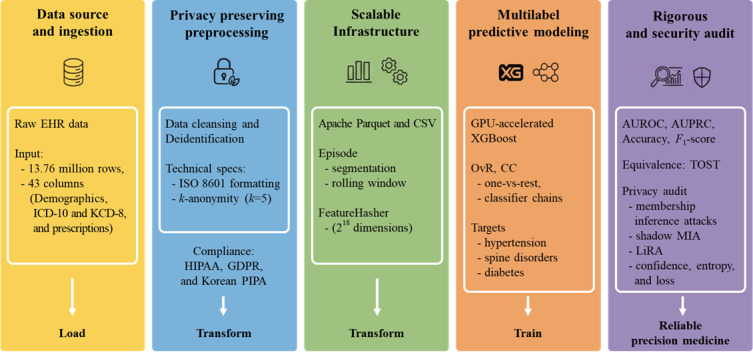 Figure 1
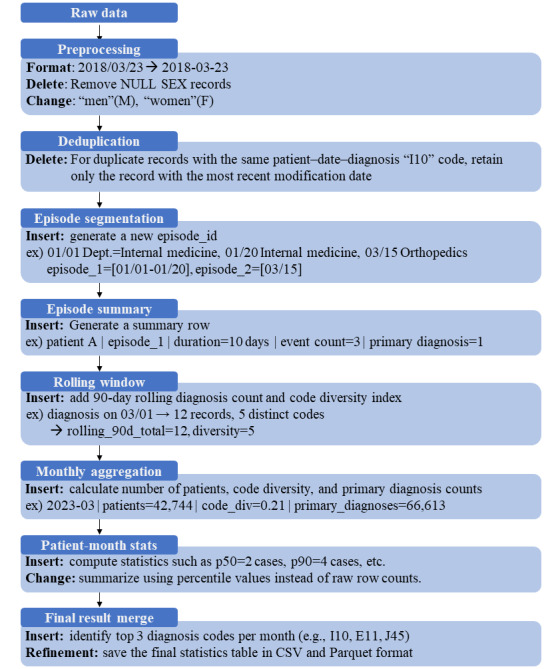 Figure 2
| Metric | CSV, mean (SD) | Parquet, mean (SD) | Differencea (95% CI) | ||||
|
| |||||||
|
| Input and output duration | 940.2 (53.3) | 44.2 (1.6) | −896.0 (−930.0 to −860.0) | |||
|
| Feature transformation | 15.0 (0.9) | 9.3 (0.7) | −5.7 (−7.0 to −4.5) | |||
|
| Model training | 8.1 (1.2) | 6.7 (0.9) | −1.4 (−2.5 to −0.3) | |||
|
| |||||||
|
| Memory maximum (GB) | 21.2 (0.8) | 22.5 (0.6) | 1.3 (0.1 to 2.0) | |||
|
| GPUb memory maximum (MB) | 4873.0 (582.6) | 4547.0 (596.9) | −326.0 (−450.0 to −200.0) | |||
| Labels | AUROCa | AUPRCb | Accuracy | |
| Hypertension | 0.920 | 0.580 | 0.906 | 0.599 |
| Spine disorder | 0.941 | 0.488 | 0.982 | 0.536 |
| Diabetesc | 0.899 | 0.567 | 0.915 | 0.521 |
| Macroaverage | 0.920 | 0.545 | 0.934 | 0.552 |
| Models | AUROCa | AUPRCb | Hamming loss | Subset accuracy | Jaccard index | ||||||
|
| |||||||||||
|
| Microaverage | 0.999 | 0.998 | 2.4×10⁻⁴ | 0.999 | 0.997 | |||||
|
| Macroaverage | 0.999 | 0.998 | —c | — | — | |||||
|
| |||||||||||
|
| Microaverage | 0.999 | 0.998 | 2.2×10⁻⁴ | 0.999 | 0.997 | |||||
|
| Macroaverage | 0.999 | 0.998 | — | — | — | |||||
| Metrics | DuckDBa | PostgreSQLb |
| Wall-clock time (s) | 90.2 | 2546.4 |
| CPUc use (%) | 72.1 | 39.6 |
| Memory use (GB) | 13.7 | 14.8 |
| Read throughput (MB/s) | 554.7 | 365.2 |
| Write throughput (MB/s) | 1116.0 | 998.0 |
| Attack strategy | Attack AUCa (95% CI) | Advantage | Best accuracy | Gain vs baseline |
| Confidence | 0.501 (0.501-0.503) | 0.006 | 0.503 | 0.003 |
| Entropy | 0.502 (0.502-0.503) | 0.007 | 0.503 | 0.003 |
| Loss (Yeom) | 0.499 (0.498-0.499) | 0.002 | 0.500 | 0.001 |
Peer Reviews
No public reviews on file for this paper yet. If you reviewed it on a platform where reviews are public (OpenReview, ICLR, NeurIPS, ICML), you can paste yours below so the community can read it here.
Videos
No videos yet. Explain this paper in a talk, walkthrough, or lecture? Add one.
Taxonomy
TopicsPrivacy-Preserving Technologies in Data · Artificial Intelligence in Healthcare · Machine Learning in Healthcare
Introduction
Clinical data, including diagnostic reports, prescriptions, laboratory results, and imaging data, hold substantial potential for precision medicine, predictive modeling, and collaborative research. The volume of electronic health records (EHRs) generated in clinical practice has grown exponentially with the expansion of digital health systems [1-4]. However, as datasets expand, bottlenecks, such as storage overhead, transmission delays, and slow query execution, become increasingly common. These challenges cannot be resolved simply by expanding storage capacity; instead, they necessitate more efficient frameworks for data storage and processing.
In medical informatics, data are most commonly stored in row-oriented formats, such as CSV files, spreadsheets, and relational databases. Although valued for their simplicity and interoperability, these approaches exhibit clear limitations in storage efficiency and analytic scalability. CSV files are uncompressed and large in size, restricting input and output throughput, while relational databases often underperform in column-level operations. In contrast, column-oriented formats offer high compression and selective input and output, making them well suited for high-volume and cloud-based environments. Among these, Apache Parquet is widely used as a standard solution owing to its scalability and interoperability [5,6]. However, few studies have systematically evaluated its end-to-end performance in clinical pipelines that incorporate deidentification procedures.
A further challenge in clinical data use is balancing privacy protection with data utility. Deidentification is mandatory in multicenter research and machine learning, but it may affect statistical distributions or compromise predictive performance. Understanding how storage architectures interact with deidentification to influence analytic outcomes is therefore of both academic and practical importance [7-13].
Unlike prior studies that focused solely on benchmarking computational efficiency, this work integrates privacy risk assessment and formal equivalence testing into a real-world end-to-end pipeline, thereby providing a clinically meaningful evaluation of Parquet as a foundation for precision medicine and collaborative research. Against this background, this study developed a scalable Parquet-based pipeline for high-volume clinical data and empirically assessed its storage efficiency, computational throughput, and preservation of predictive performance. This study also sought to establish a reliable infrastructure that enables cohort construction, secure data sharing, and clinical decision support in multicenter and precision medicine research [14-23].
Methods
Ethical Considerations
This retrospective observational study was conducted using real-world EHR data. The study protocol was approved by the institutional review board of Wonju Severance Christian Hospital (CR325065). The requirement for informed consent was waived by the institutional review board due to the retrospective nature of the study and the use of deidentified data. All data processing was performed within an independent honest broker system, and investigators had access only to deidentified data. No compensation was provided to the participants as there was no direct contact or intervention involved. The entire process complied with the Personal Information Protection Act of Korea, the Health Insurance Portability and Accountability Act Safe Harbor standard, and the General Data Protection Regulation [24-28].
Integrated End-to-End Clinical Data Processing Workflow
We developed an integrated pipeline connecting 5 core stages: raw EHR ingestion, privacy-preserving preprocessing (ISO 8601 and k-anonymity), scalable infrastructure using Apache Parquet, multilabel modeling via graphics processing unit (GPU)–accelerated Extreme Gradient Boosting (XGBoost), and rigorous statistical and privacy audits (Figure 1). To optimize analytic performance, we adopted a column-oriented storage format (Apache Parquet) over the traditional row-oriented structure (eg, CSV) [6]. For comparative evaluation, the same dataset was also maintained in CSV format. While row-oriented structures excel in transactional tasks, columnar storage significantly reduces input and output overhead and enhances compression efficiency for complex analytic queries. This architectural choice is specifically tailored for the high dimensionality and sparse distribution of clinical datasets, ensuring both system scalability and robust privacy protection across the entire workflow.
Integrated workflow for scalable and privacy-preserving clinical data processing. AUROC: area under the receiver operating characteristic curve; AUPRC: area under the precision-recall curve; CC: classifier chains; EHR: electronic health record; GDPR: General Data Protection Regulation; GPU: graphics processing unit; HIPAA: Health Insurance Portability and Accountability Act; ICD-10: International Classification of Diseases, Tenth Revision; KCD: Korean Classification of Diseases, Eighth Revision; LiRA: Likelihood Ratio Attack; MIA: membership inference attack; OvR: one-vs-rest; PIPA: Personal Information Protection Act; TOST: two 1-sided tests; XGBoost: extreme gradient boosting.
Data Preparation and Transformation
The dataset included patient demographics, diagnostic codes based on the International Classification of Diseases, Tenth Revision (ICD-10) [29-35] and the Korean Classification of Diseases, Eighth Revision (KCD-8), visit type, and prescription records. In total, the dataset comprised approximately 13.76 million rows (43 columns, approximately 3.2 GB), as detailed in Multimedia Appendix 1. After replacing patient identifiers with randomly generated surrogate IDs, quasi-identifiers were generalized to satisfy k-anonymity (k=5). Data cleansing further ensured quality control by standardizing date fields into the ISO-compliant format (YYYY-MM-DD).
Clinical Data Processing Pipeline
Clinical data processing followed a stepwise pipeline designed to reflect clinical context. In preprocessing, we standardized date formats, removed records with missing sex, and normalized sex codes (eg, “men” to M and “women” to F). Duplicate entries were resolved by retaining only the most recent record for identical combinations of patient, date, and diagnosis code. Visits were segmented into episodes by department changes or temporal gaps, and each episode was assigned an episode identifier. Episode-level summaries included episode duration, event count, and primary diagnosis status. To capture temporal continuity, a 90-day rolling window was applied to compute diagnosis counts and code diversity per patient. Monthly aggregates were then derived, including patient counts, code diversity, and primary diagnosis counts, with patient-month statistics summarized using quantiles (eg, p50 and p90). The diagnostic records for the targeted conditions—including I10.9, E10-E14, and M48.06—were identified and extracted to construct the final summary tables, which were then stored in both CSV and Parquet formats for comparative analysis. The stepwise process is illustrated in Figure 2.
Stepwise scenario of the clinical data processing pipeline.
Database Workload Benchmarking
To evaluate the efficiency of storage formats, scenario-based workloads were executed in DuckDB (DuckDB Labs) [36] and PostgreSQL (PostgreSQL Global Development Group) [37] environments. Synthetic example data are provided in Multimedia Appendix 2. Identical datasets were loaded into Parquet-based DuckDB and row-store PostgreSQL, and complex SQL queries—adapted from TPC-DS patterns [38,39] (eg, window functions, multidimensional aggregation, and ROLLUP)—were applied to compare performance. Resource use was further examined by varying chunk sizes (10,000-50,000 records) with detailed results in Multimedia Appendix 3.
Predictive Modeling and Multilabel Strategy
Predictive modeling assessed the impact of storage formats on classification performance for hypertension (I10.9), spinal disorders (M48.06), and diabetes (E10-E14). Patient-level diagnostic histories were transformed into 2^18^ dimensional sparse vectors (approximately 262,000 features) via FeatureHasher (scikit-learn; Python Software Foundation) [40-42]. The dataset was randomly partitioned into training (65%), validation (15%), and test (20%) subsets with a fixed seed of 42. Classification models were implemented using GPU-accelerated XGBoost with positive class weighting to address imbalance [43-45]. Hyperparameter details are provided in Multimedia Appendix 4.
For multilabel classification, we applied one-vs-rest (OvR) [46] and classifier chains (CC) [47]. To mitigate label-order dependence and evaluate interlabel dependencies, we constructed ensembles of 5 strategically ordered chains encompassing a prevalence gradient—from high-prevalence anchors (hypertension and diabetes) to the sparse target, spinal stenosis (M48.06, 0.50%; Multimedia Appendix 5). Prioritizing M48.06, a domain-independent and sparse condition, served to demonstrate model robustness even without the clustering benefits of related disease families (eg, I-series codes). To ensure the rigorous prevention of label leakage and validate the integrity of the performance gains, all defining ICD-10 codes were strictly excluded from the feature space. This setup ensured that the model’s predictive capability relied solely on statistical associations across hundreds of thousands of nondiagnostic features. Model performance was evaluated using area under the receiver operating characteristic curve (AUROC), area under the precision-recall curve (AUPRC), accuracy, and F1-score, calculated for each label as well as macroaverages and microaverages.
Statistical Evaluation and Privacy Assessment
Model performance was evaluated using AUROC, AUPRC, accuracy, and F1-score. To assess model reliability, calibration was further evaluated using the Brier score and expected calibration error (ECE), with detailed results provided in Multimedia Appendix 6. CSV and Parquet results were compared using paired runs with shared identifiers. Normality was assessed via the Shapiro-Wilk test, followed by paired 2-tailed t tests or Wilcoxon signed-rank tests with Bonferroni correction (P<.05) [48-50].
Equivalence was assessed via two 1-sided tests (TOST) [51] and 95% bootstrap CIs. Equivalence margins (δ) were prespecified at 0.02 for AUROC or AUPRC and 0.01 for accuracy or F1-score. These thresholds were selected to be narrower than the 0.05 margin commonly used in clinical equivalence trials [52] and are more conservative than performance variances typically observed in the external validation of clinical artificial intelligence (AI) systems [53]. Such strict margins were intended to constrain observed differences to ranges generally regarded as clinically negligible, particularly for high-performing models operating within an elevated accuracy range (0.98-1.00).
To mitigate stochastic variation, a fixed random seed was applied across all experiments, ensuring that observed differences reflected data handling effects rather than algorithmic randomness. Privacy was further audited using membership inference attacks (MIA)—including confidence, entropy, loss-based (Yeom), shadow, and Likelihood Ratio Attack (LiRA) strategies—under patient-level stratified splits (train: 240,596; test: 240,597) to verify model robustness.
Experimental Setup and Reproducibility
All experiments were conducted on a Linux Ubuntu 22.04 server with a 24-core central processing unit (CPU), 128-GB memory, and an NVIDIA RTX 5090 GPU (CUDA 12.2, cuDNN 8.9, driver 550.54). Data processing used Python (version 3.10; Python Software Foundation) with Pandas 1.5.3, PyArrow 12.0.1, scikit-learn 1.3.2, and XGBoost 2.0.3 (GPU-hist). Multiprocessing was implemented using the standard Python multiprocessing module.
As specified in the modeling strategy, XGBoost was configured with a learning rate of 0.08, maximum depth of 6, and 1000 estimators. To handle class imbalance, task-specific scale_pos_weight and an ensemble of 5 CCs were used. All random operations used a fixed seed of 42 for reproducibility. For robust performance evaluation, we conducted 20 independent experimental runs and used 5000-iteration bootstrap resampling to compute 95% CIs. Detailed hyperparameters and the statistical framework for equivalence testing are provided in Multimedia Appendix 4.
Results
Storage and Pipeline Efficiency
Conversion to Parquet substantially improved storage efficiency, reducing file size by nearly 6.9-fold relative to CSV. As summarized in Table 1, Parquet also consistently outperformed CSV across the end-to-end pipeline. File loading (input and output) time decreased by more than 95%, and both feature transformation (FeatureHasher) and model training (XGBoost) were faster under Parquet. Although peak CPU memory was about 1.3 GB higher, GPU memory consumption decreased by 326 MB, resulting in stable overall resource use. Resource consumption remained stable at 9 to 10 GB across chunk sizes, reflecting consistent scalability, with efficiency varying by chunk size. The values in Table 1 represent peak use in end-to-end runs, with minor variations arising from measurement conditions, whereas CPU, memory, and disk input and output patterns remained consistent across chunk sizes (Multimedia Appendix 3).
Classification Performance and Calibration
Single-label results are presented in Table 2. All 3 tasks achieved AUROC values above 0.920, with AUPRC ranging from 0.488 to 0.580. Hypertension (I10.9) yielded the highest F1-score (0.599), followed by spinal disorders (M48.06, 0.536) and diabetes (E10-E14, 0.521). Macroaveraged performance reached an AUROC of 0.920, an AUPRC of 0.545, an accuracy of 0.934, and an F1-score of 0.552. Calibration analyses [54,55], reported in Multimedia Appendix 6, demonstrated excellent reliability for hypertension (Brier score 2.1×10^–5^; ECE 6.0×10^–6^), while spinal disorders (ECE=0.016) and diabetes (ECE=0.018) showed mild miscalibration but remained within recommended thresholds (ECE<0.020).
Table 2 evaluates label-specific discrimination under substantial class imbalance, whereas Table 3 summarizes overall multilabel prediction performance using microaveraged aggregation across all label–instance pairs. Specifically, Table 2 focuses on the predictive performance of individual sparse labels, while Table 3 reflects aggregated performance across all prediction events. Multilabel results in Table 3 confirmed high-performance consistency for both OvR and CC, with AUROC >0.999 and AUPRC >0.998. Subset accuracy was identical (0.999), but CC showed slight improvements in Hamming loss and Jaccard index [56], suggesting modest benefits from capturing label dependencies. A numerical gap was observed between per-label AUPRC (approximately 0.5; Table 2) and multilabel AUPRC (near 1.0; Table 3). This reflects the technical difference in aggregation: multilabel metrics were calculated using microaveraging to evaluate the overall model efficacy.
Although discrimination remained high across all tasks, calibration analyses revealed modest overconfidence for diabetes and spinal disorder models. These deviations, while within accepted thresholds, emphasize the importance of calibration-aware adjustments when deploying predictive models in clinical workflows.
Database Benchmarking
As summarized in Table 4, DuckDB executed analytic workloads with an approximately 28-fold reduction in wall-clock time compared with PostgreSQL, which required 2546.4 seconds. DuckDB also exhibited higher CPU use (72.1% vs 39.6%), while memory consumption was comparable across systems.
Equivalence Analysis
Paired experiments (20 runs per condition) were conducted using shared run identifiers, with median and IQR values provided in Table S1 in Multimedia Appendix 7. Several metrics converged across all repetitions, producing zero IQR values and demonstrating high algorithmic stability. Overall, both formats achieved robust numerical consistency across all experimental iterations; for instance, mean AUROC was 1.000 for CSV and 0.984 for Parquet (Δ=−0.015). While other metrics (AUPRC, accuracy, and F1-score) were slightly higher under the CSV format, paired t tests and Wilcoxon signed-rank tests confirmed statistical significance after Bonferroni correction (P<.001; Table S2 in Multimedia Appendix 7). However, these numerical variations remained minimal.
Notably, all observed differences fell within the prespecified equivalence margins (δ=0.02 for AUROC and AUPRC and δ=0.01 for accuracy and F1-score). TOST confirmed statistical equivalence (P<.05) across all evaluated metrics, and bootstrap 95% CIs for AUROC Δ (−0.016 to −0.015) further reflected near-zero variability consistent with asymptotic performance stability (Table S3 in Multimedia Appendix 7).
Privacy Assessment
The MIA evaluations, performed based on established methodologies [57-59] and summarized in Table 5, produced area under the curve (AUC) values of 0.501, 0.502, and 0.499 for confidence, entropy, and loss-based strategies, respectively. The maximum advantage did not exceed 0.007, and the gain over random guessing was ≤0.003. Attack performance was indistinguishable from random guessing, indicating no additional privacy risk. Additional shadow and LiRA [60,61] results are available in Multimedia Appendix 8, corroborating these findings.
Discussion
Principal Findings
This study successfully implemented an integrated end-to-end pipeline (Figure 1) that ensures a seamless transition from raw EHR data ingestion to predictive modeling. By leveraging Apache Parquet, the framework effectively addressed storage and processing bottlenecks—specifically, input and output latency—inherent in traditional row-oriented workflows, substantially enhancing data throughput and accelerating the analytic preparatory phase while maintaining high predictive fidelity. Furthermore, our findings indicate that the minor performance discrepancies between formats are attributable to systematic data handling effects under a strictly controlled environment. Beyond these computational efficiencies, privacy evaluations demonstrated that the optimized workflow maintains rigorous data protection standards, providing a secure foundation for multicenter research operations without introducing additional vulnerabilities.
Although paired statistical tests yielded highly significant P values (P<.001), this result reflects the sensitivity of paired testing under large-scale data and repeated bootstrap evaluation rather than clinically meaningful divergence. From an equivalence perspective, all performance differences remained well within the prespecified margins, confirming that the Parquet-based pipeline achieves practical performance equivalence to the traditional CSV workflow.
The substantial improvement in multilabel AUPRC compared with per-label performance highlights the system-level predictive advantage gained by explicitly modeling interlabel dependencies. While individual disease prediction remains challenging under substantial class imbalance, the multilabel formulation enables the model to capture clinically meaningful comorbidity structures, thereby reframing the observed performance gap as a reflection of holistic predictive efficacy rather than a metric artifact. This gap was also driven by the extreme class imbalance inherent in clinical datasets (eg, 0.50% prevalence for spinal disorders), where high AUROCs can coexist with lower F1-scores. By integrating these dependencies within the CC architecture, the model leveraged frequent clinical co-occurrence patterns—such as hypertension and diabetes—to stabilize predictions for sparse conditions, including spinal stenosis. Importantly, the consistent performance observed despite the strict exclusion of all defining ICD-10 codes provided strong evidence against label leakage and underscored the model’s reliance on nondiagnostic clinical associations.
Clinical Implications and Research Operations
The clinical implications were considerable. By substantially shortening preparatory phases and enabling analyses to be completed within hours rather than days, Parquet-based pipelines allowed investigators to progress more rapidly from raw data to actionable evidence. Such improvements not only accelerated study initiation but also facilitated the integration of predictive models into research and clinical workflows. In multicenter settings, scalability supported the efficient integration of heterogeneous patient populations without excessive computational cost, thereby enhancing reproducibility and advancing precision medicine initiatives. These efficiencies were directly relevant to clinical workflows and regulatory-grade analyses. They enabled interim analyses and timely regulatory submissions, supporting more responsive and efficient research operations.
Privacy and Security Safeguards
Privacy evaluation reinforced the suitability of this approach. Deidentification procedures satisfied k-anonymity, and MIA yielded chance-level performance. The chance-level performance of multiple MIA methods confirmed that computational gains do not compromise patient confidentiality, a prerequisite for secure collaboration across institutions. Patient-level stratification and consistent pipeline design acted as effective safeguards. While residual risks remain inherent to secondary data use, our findings suggested that Parquet does not introduce additional vulnerabilities. For collaborative research networks—where privacy assurances are essential for sharing—these results provide practical reassurance.
Interpretation of Predictive Performance and Label Dependencies
Classification analyses revealed stable performance for common conditions such as hypertension, whereas imbalanced disorders such as diabetes and spinal disease yielded lower scores. This pattern highlights the need to account for dataset structure and interlabel dependencies when interpreting predictive outputs. The elevated AUROC values likely reflect the combination of high-prevalence conditions and extensive diagnostic feature sets. Consistent with the modeling strategy, defining codes were excluded from the feature space; however, correlated diagnostic features may still have influenced performance estimates.
While performance convergence at elevated levels constrained the sensitivity to subtle comparative differences, it underscored the robustness and reproducibility of the pipeline, supporting its suitability for large-scale clinical research, where stability and reliability are critical. Predictive reliability was not compromised by storage structure, supporting Parquet as a dependable option for secondary use of EHR data in diverse research settings.
Model Reliability and Calibration
Calibration analyses further showed that hypertension models were well aligned with observed risks, whereas diabetes and spinal disorder tasks exhibited modest miscalibration. These results underscore that even high-performing classifiers may generate overconfident probability estimates, a limitation directly relevant to clinical decision support. Future studies should evaluate calibration-aware techniques, such as temperature scaling or isotonic regression, to improve the reliability of probability estimates (Multimedia Appendix 6).
Beyond technical validation, the findings demonstrated practical value for clinical research operations. Large-scale trials and observational studies often face delays in cohort assembly and iterative validation; Parquet-based pipelines shorten these steps, enabling more adaptive study designs. In multicenter collaborations, they promote secure and efficient data exchange, reducing delays that commonly impede cooperative studies.
Limitations
Several limitations should be acknowledged. First, the datasets analyzed were derived from specific institutional cohorts, which may constrain generalizability to other health care systems. Second, the elevated performance baseline of the predictive models limited the sensitivity to subtle differences between CSV and Parquet formats. Third, while MIA offered a widely accepted proxy for privacy risk, broader adversarial evaluations were not included. Fourth, the evaluation was primarily conducted in on-premise settings, so the scalability of findings in distributed or cloud-based environments remains to be established. Finally, despite the clear efficiency advantages of Parquet, its adoption may introduce a technical learning curve for clinical researchers who are less familiar with column-oriented storage formats or big-data frameworks. Transitioning from traditional row-oriented workflows to optimized columnar architectures requires initial investments in technical training and infrastructure adjustment. However, these upfront efforts are likely to be offset by the long-term gains in scalability and processing speed demonstrated in our results, ultimately supporting more efficient and reproducible clinical evidence generation.
Future Work
Future research should extend the evaluation of Parquet-based pipelines to distributed and cloud-based environments, focusing on both scalability and cost-effectiveness. In addition, validation across hybrid and federated architectures will be important to confirm applicability in multicenter collaborations where data cannot be centralized. Beyond structured EHR data, future studies should also investigate applications to unstructured modalities, such as clinical narratives, imaging metadata, and time-series signals. Such efforts would test the versatility of Parquet-based pipelines in supporting multimodal learning and integrative analyses. Privacy assessments should likewise be expanded to encompass attribute inference, linkage, and other adversarial scenarios, ideally within federated or privacy-preserving analytic frameworks. Moreover, interoperability across international coding standards should be validated using external multicenter datasets to ensure global applicability. Pursuing these directions will enhance the technical robustness of Parquet-based infrastructures while reinforcing their clinical relevance, ultimately enabling secure collaboration and more efficient integration of evidence into patient care.
Conclusions
This study demonstrated that Parquet-based end-to-end processing effectively alleviated the storage and computational bottlenecks inherent in traditional row-oriented and relational database workflows while maintaining predictive fidelity and privacy safeguards. By improving computational efficiency and enabling the rapid preparation of analysis-ready cohorts, Parquet reduces the resources required for large-scale clinical data handling. These efficiencies translate into tangible research benefits, enabling earlier study initiation and more adaptive study designs across diverse clinical research settings.
The integration of efficiency with privacy safeguards further ensures that accelerated workflows remain suitable for secure data sharing across institutions. In parallel, these capabilities support regulatory-grade analyses and health technology assessments, where timely and reproducible evidence is critical. For clinicians and researchers, the central implication is that Parquet-based pipelines reduce the manual effort and computational overhead required to transform raw EHR data into analysis-ready cohorts. This capability not only strengthens multicenter collaboration but also facilitates the timely translation of evidence into clinical decision support.
Ultimately, by aligning computational efficiency with privacy-conscious infrastructure, Parquet-based pipelines reinforce the evidence base that informs clinical decision-making, positioning this approach as a robust foundation for sustainable precision medicine.
The reference list from the paper itself. Each links out to its DOI / PubMed record.
- 1Jensen PB Jensen LJ Brunak S Mining electronic health records: towards better research applications and clinical care Nat Rev Genet 2012050213639540510.1038/nrg 320822549152 nrg 320822549152 · doi ↗ · pubmed ↗
- 2Weiskopf NG Weng C Methods and dimensions of electronic health record data quality assessment: enabling reuse for clinical research J Am Med Inform Assoc 2013010120114451 10.1136/amiajnl-2011-00068122733976 amiajnl-2011-00068122733976 PMC 3555312 · doi ↗ · pubmed ↗
- 3Hripcsak G Albers DJ Next-generation phenotyping of electronic health records J Am Med Inform Assoc 2013010120111721 10.1136/amiajnl-2012-00114522955496 amiajnl-2012-00114522955496 PMC 3555337 · doi ↗ · pubmed ↗
- 4Birkhead GS Klompas M Shah NR Uses of electronic health records for public health surveillance to advance public health Annu Rev Public Health 20150318363455910.1146/annurev-publhealth-031914-1227472558115725581157 · doi ↗ · pubmed ↗
- 5Vohra D Apache Parquet Practical Hadoop Ecosystem: A Definitive Guide to Hadoop-Related Frameworks and Tools 2016 Berkeley, CA Apress 32535
- 6Apache parquet documentation Apache Software Foundation 2025-06-01 https://parquet.apache.org/
- 7Meystre SM Friedlin FJ South BR Shen S Samore MH Automatic de-identification of textual documents in the electronic health record: a review of recent research BMC Med Res Methodol 2010080210170 10.1186/1471-2288-10-70206782281471-2288-10-7020678228 PMC 2923159 · doi ↗ · pubmed ↗
- 8Negash B Katz A Neilson CJ Moni M Nesca M Singer A Enns JE De-identification of free text data containing personal health information: a scoping review of reviews Int J Popul Data Sci 20231212812153 10.23889/ijpds.v 8i 1.2153384145378:1:2938414537 PMC 10898315 · doi ↗ · pubmed ↗