Prediction of Aspiration Risk by Using Vocal Biomarkers: Machine Learning Development and Validation Study
Cyril Varghese, Jianwei Zhang, Sara Charney, Abdelmohaymin A Abdalla, Elizabeth Reeves, Stacy Holyfield, Adam E Brown, Michelle K Higgins, Hunter Stearns, Julie Liss, Nan Zhang, Diana Orbelo, Rebecca L Pittelko, Lindsay Rigelman, Victor Ortega, David G Lott, Visar Berisha

TL;DR
This study developed a machine learning model that uses vocal biomarkers from vowel sounds to predict aspiration risk, showing promising accuracy compared to experts.
Contribution
A novel machine learning algorithm was developed and validated to predict aspiration risk using acoustic features from vowel phonations.
Findings
The ML model showed significant differences in risk scores between high- and low-risk aspiration groups.
The model achieved an area under the curve of 0.76 in the development cohort and 0.70 in the external testing cohort.
The ML model performed comparably to trained speech language pathologists in classifying aspiration risk.
Abstract
Aspiration causes or aggravates a variety of respiratory diseases. Subjective bedside evaluations of aspiration are limited by poor interrater and intrarater reliability, while gold standard diagnostic tests for aspiration, such as video fluoroscopic swallow study and fiberoptic endoscopic evaluation of swallowing, are cumbersome or invasive and health care resource-intensive. This study aims to develop and validate a novel machine learning (ML) algorithm that can analyze simple vowel phonations to aid in predicting aspiration risk. Recorded [i] phonations during routine nasal endoscopy from 163 unique patients were retrospectively analyzed for acoustic features, including pitch, jitter, shimmer, harmonic to noise ratio, and others. Supervised ML was performed on the vowel phonations of those at high-risk for aspiration versus those at low-risk for aspiration. Ground truth of…
Genes, proteins, chemicals, diseases, species, mutations and cell lines named across the full text — each resolved to its canonical identifier and authoritative record.
Click any figure to enlarge with its caption.
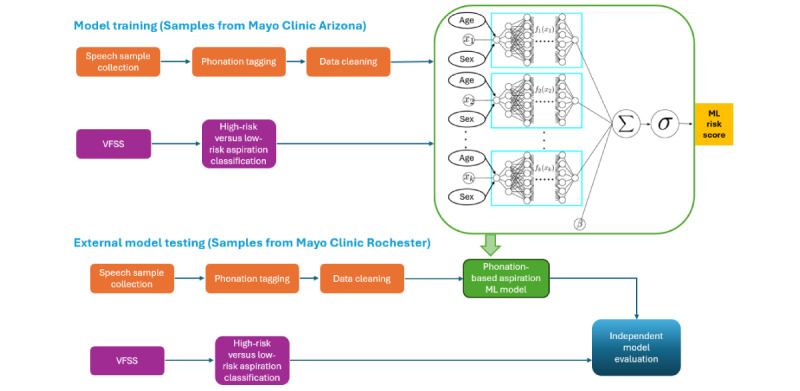 Figure 1
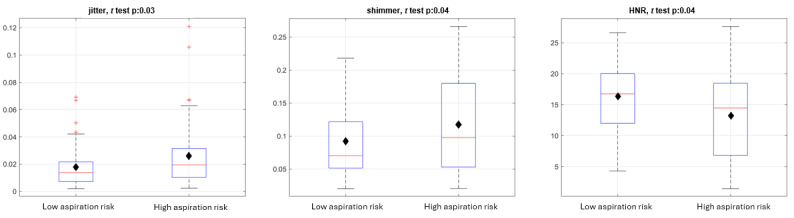 Figure 2
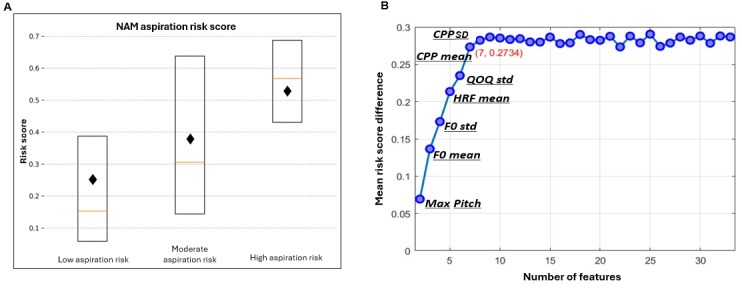 Figure 3
 Figure 4
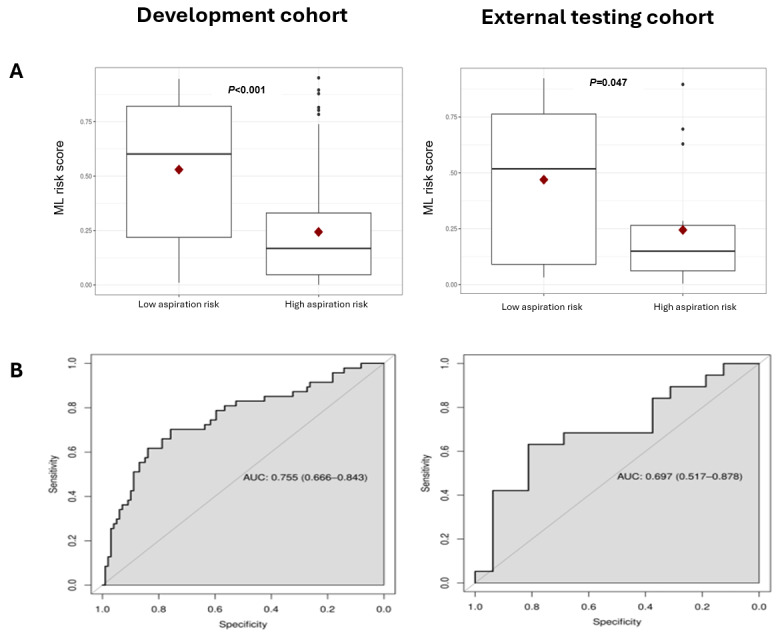 Figure 5
Peer Reviews
No public reviews on file for this paper yet. If you reviewed it on a platform where reviews are public (OpenReview, ICLR, NeurIPS, ICML), you can paste yours below so the community can read it here.
Videos
No videos yet. Explain this paper in a talk, walkthrough, or lecture? Add one.
Taxonomy
TopicsDysphagia Assessment and Management · Phonocardiography and Auscultation Techniques · Respiratory and Cough-Related Research