Matched whole-genome sequencing of blood (10×) and five single sperm cells (1×) per individual in 53 men
Weiming Chen, Lei Yu, Ruidong Li, Hao Su, Zongyu Chen, Zhixu Zhang, Hui Zhang, Xiaolan Zhang, Yani Ding, Feifei Gou, Yu Lu, Ye Pan, Yong Zhang, Jun He, Chaojun Chen, Zongjian Tan, Zhenyu Jia, Jianguo Zhu

TL;DR
This study provides a genomic dataset from 53 men, including blood and sperm samples, to better understand male infertility and improve reproductive genomics research.
Contribution
The study introduces a matched WGS dataset of blood and single sperm cells from men with and without asthenozoospermia, enabling research into male infertility genomics.
Findings
The dataset includes 263 single-sperm libraries from 53 men, with detailed metadata on sperm motility and vitality.
Sequencing metrics met quality thresholds, with mean depths of ~10× for blood and ~1.7× for single sperm.
The resource supports translational research and algorithm development for gamete-genome analysis.
Abstract
Asthenozoospermia, characterized by reduced sperm motility, is a major contributor to male infertility and motivates improved resources for studying spermatogenesis at the genomic level. Here, we present a paired whole-genome sequencing (WGS) dataset from 53 Han Chinese men, comprising matched blood WGS per participant (target ~10×) and 3–5 low-coverage single-sperm WGS libraries per participant (target ~1×). The dataset includes 263 single-sperm libraries (79 from 16 asthenozoospermic participants and 184 from 37 normozoospermic participants) and is accompanied by rich participant-level metadata, including baseline characteristics, endocrine measurements, and semen parameters such as sperm motility and vitality. Raw reads underwent standardized quality-control filtering, and key sequencing metrics (Q20 and GC content) met commonly used thresholds; the achieved mean depth was…
Genes, proteins, chemicals, diseases, species, mutations and cell lines named across the full text — each resolved to its canonical identifier and authoritative record.
Click any figure to enlarge with its caption.
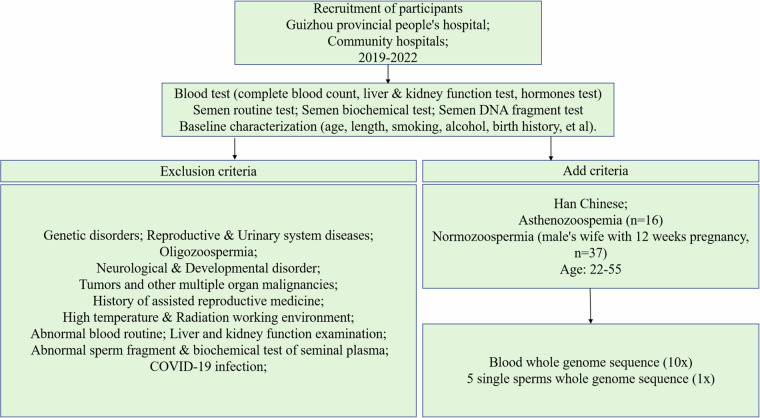 Figure 1
Peer Reviews
No public reviews on file for this paper yet. If you reviewed it on a platform where reviews are public (OpenReview, ICLR, NeurIPS, ICML), you can paste yours below so the community can read it here.
Videos
No videos yet. Explain this paper in a talk, walkthrough, or lecture? Add one.
Taxonomy
TopicsSperm and Testicular Function · Animal Behavior and Reproduction · Reproductive biology and impacts on aquatic species