Self-serving biases shape the relationship between future thinking and remembering of elections
Marius Boeltzig, Ricarda I. Schubotz, Scott Cole, Clare J. Rathbone

TL;DR
People remember past elections more vividly and favorably if they supported the winning side, showing how self-serving biases affect memory and future thinking.
Contribution
This study reveals how self-serving biases shape memory and future thinking in the context of election outcomes across multiple countries.
Findings
Election winners remember the event as more important and vivid than they predicted beforehand.
Voters misremember their pre-election predictions to align with their current partisan attitudes.
Self-serving biases in memory can reinforce political polarization by aligning past beliefs with current views.
Abstract
While there is a strong relationship between remembering and future thinking, it has been unclear whether this persists when constraining participants to one specific significant public event. We employed a unique longitudinal approach to uncover how the differences and similarities between remembering and imagining are influenced by self-serving biases evoked by the event itself. Across three longitudinal questionnaire studies testing participants before and after 2024 elections in Germany (N = 136), the UK (N = 89), and the USA (N = 243), we found evidence for self-serving biases in the congruence between future thinking and remembering. Election winners robustly remembered the election as more important and more vivid than they had imagined it before. In the US study, the inconsistency in attitudes across time caused by this shift was resolved by also misremembering the prediction…
Genes, proteins, chemicals, diseases, species, mutations and cell lines named across the full text — each resolved to its canonical identifier and authoritative record.
Click any figure to enlarge with its caption.
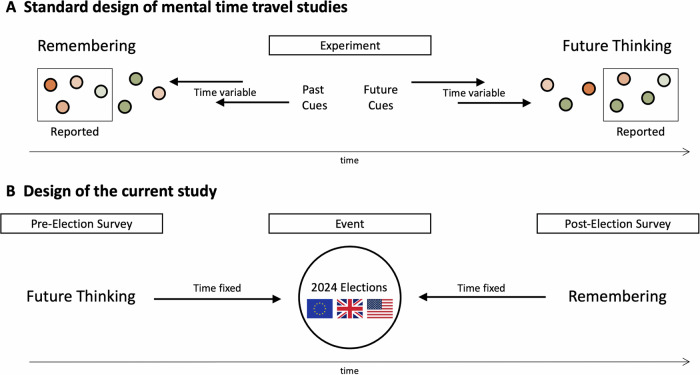 Figure 1
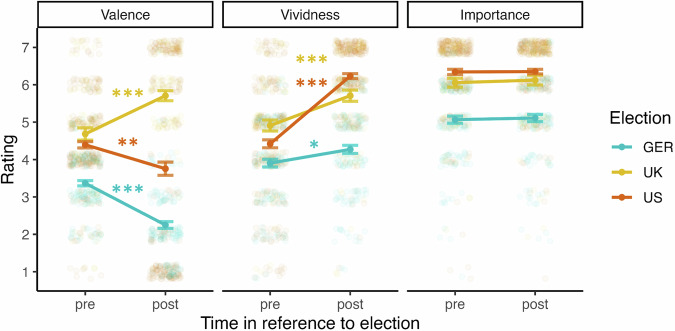 Figure 2
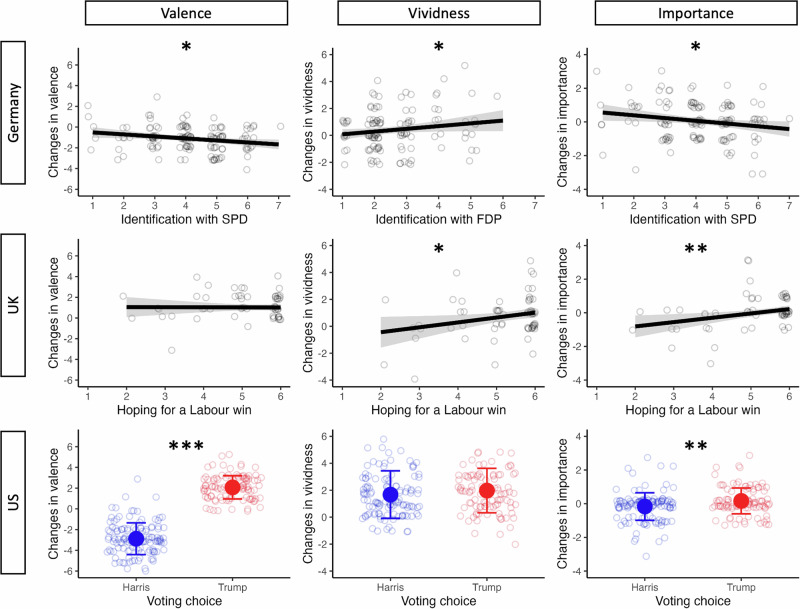 Figure 3
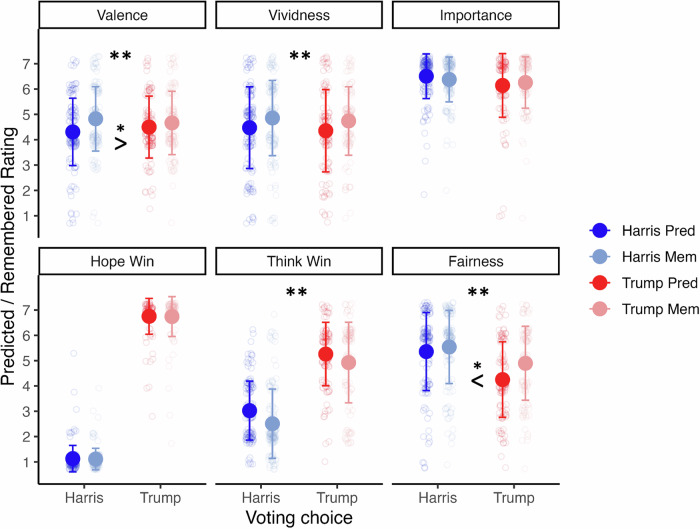 Figure 4
Peer Reviews
No public reviews on file for this paper yet. If you reviewed it on a platform where reviews are public (OpenReview, ICLR, NeurIPS, ICML), you can paste yours below so the community can read it here.
Videos
No videos yet. Explain this paper in a talk, walkthrough, or lecture? Add one.
Taxonomy
TopicsOptimism, Hope, and Well-being · Psychological and Temporal Perspectives Research · Media Influence and Health