Heterozygous frameshift KMT2A variant in a patient with Wiedemann–Steiner syndrome
Sawako Hirai, Hiroshi Mitsubuchi, Shirou Matsumoto

TL;DR
A Japanese girl with Wiedemann–Steiner syndrome was found to have a new KMT2A mutation, which helps expand understanding of the genetic causes of this condition.
Contribution
The study reports a novel KMT2A frameshift variant and its molecular and phenotypic implications in Wiedemann–Steiner syndrome.
Findings
The patient exhibited severe growth failure, developmental delay, hypertrichosis, and agenesis of the corpus callosum.
The KMT2A variant truncates the protein and disrupts the SET domain, leading to haploinsufficiency.
The mutation is predicted to trigger nonsense-mediated mRNA decay, supporting its pathogenic role.
Abstract
Here we report a case of a Japanese girl with Wiedemann–Steiner syndrome carrying a novel heterozygous frameshift variant of KMT2A (NM_001197104.2:c.10123del, p.Thr3375ProfsTer7). Her clinical features included severe pre- and postnatal growth failure, global developmental delay, hypertrichosis and complete agenesis of the corpus callosum. The identified variant truncates the protein, abolishes the C-terminal SET domain required for histone methyltransferase activity, and is predicted to trigger nonsense-mediated mRNA decay, resulting in KMT2A haploinsufficiency—the primary pathogenic mechanism of Wiedemann–Steiner syndrome. This report documents a previously unreported loss-of-function variant in KMT2A with detailed molecular interpretation and phenotypic characterization, contributing to refinement of the mutational spectrum associated with Wiedemann–Steiner syndrome.
Genes, proteins, chemicals, diseases, species, mutations and cell lines named across the full text — each resolved to its canonical identifier and authoritative record.
Click any figure to enlarge with its caption.
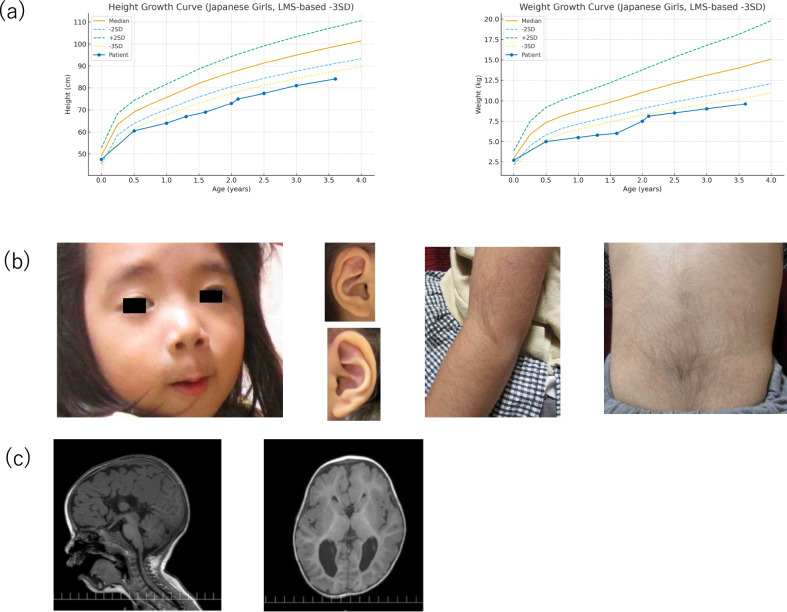 Figure 1
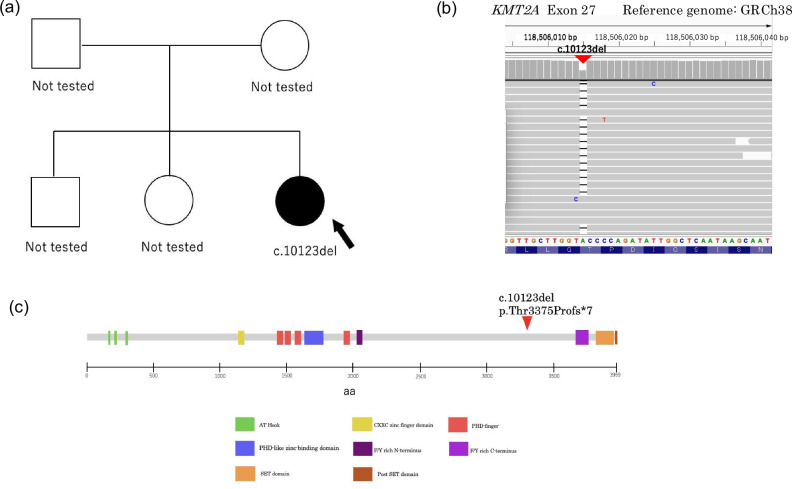 Figure 2
Peer Reviews
No public reviews on file for this paper yet. If you reviewed it on a platform where reviews are public (OpenReview, ICLR, NeurIPS, ICML), you can paste yours below so the community can read it here.
Videos
No videos yet. Explain this paper in a talk, walkthrough, or lecture? Add one.
Taxonomy
TopicsGenomics and Rare Diseases · Connective tissue disorders research · Neurogenetic and Muscular Disorders Research