Exploratory case series of circulating tumor DNA dynamics during tandem therapy in metastatic castration-resistant prostate cancer
Mariam Amghar, Tobias Rausch, Hilal Özgür, Mareike Roscher, Ulrike Bauder-Wüst, Frank Bruchertseifer, Alfred Morgenstern, Vladimír Beneš, Clemens Kratochwil, Martina Benešová-Schäfer

TL;DR
This study explores how tracking tumor DNA in blood can help monitor treatment response and resistance in prostate cancer patients receiving a new type of radiopharmaceutical therapy.
Contribution
The study introduces longitudinal ctDNA tumor fraction analysis as a novel biomarker for early detection of treatment response and resistance in actinium-lutetium therapy for mCRPC.
Findings
Patient 1 achieved complete remission with undetectable PSA and ctDNA tumor fraction after two treatment cycles.
ctDNA tumor fraction increased before PSA levels in some patients, indicating earlier detection of disease progression.
Patient 4 showed rapid disease progression with increasing ctDNA tumor fraction and PSA levels by the second treatment cycle.
Abstract
Prostate-specific membrane antigen (PSMA)-targeted radiopharmaceutical therapy (RPT) with the alpha-emitter actinium-225 (225Ac) has shown promising activity in metastatic castration-resistant prostate cancer (mCRPC), but its use is limited by toxicity. A tandem approach combining [225Ac]Ac-PSMA-617 and [177Lu]Lu-PSMA-617 (actinium-lutetium) has been developed to mitigate adverse effects and optimize efficacy. Given the scarcity of 225Ac and the emergence of resistance, early identification of non-responders is crucial. Circulating tumor DNA (ctDNA), especially tumor fraction (TFx) estimated from ultra-low-pass whole genome sequencing (ULP-WGS) using ichorCNA, may provide a non-invasive biomarker for monitoring treatment response. Blood samples were collected from mCRPC patients treated with actinium-lutetium bimonthly. Cell-free DNA (cfDNA) was extracted and analyzed by ULP-WGS (≤ 7 ×…
Genes, proteins, chemicals, diseases, species, mutations and cell lines named across the full text — each resolved to its canonical identifier and authoritative record.
Click any figure to enlarge with its caption.
 Figure 1
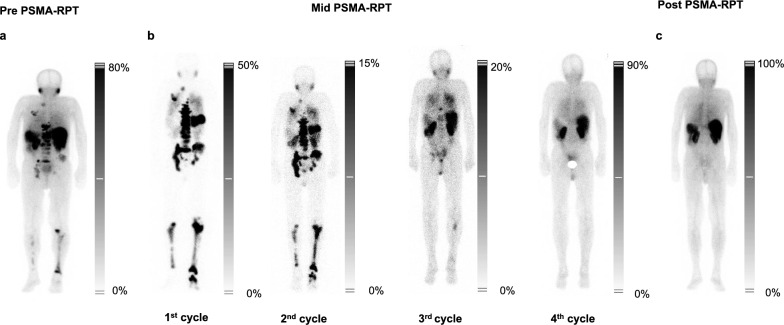 Figure 2
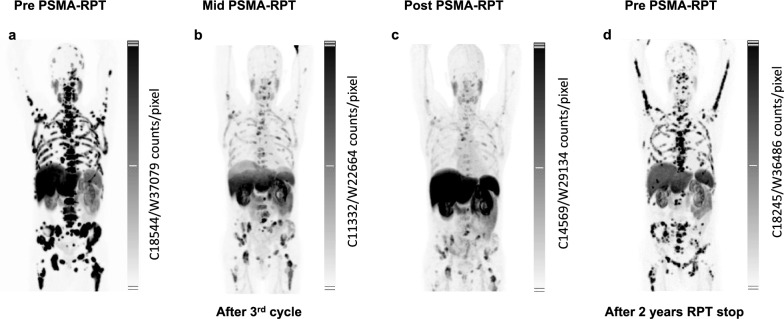 Figure 3
 Figure 4
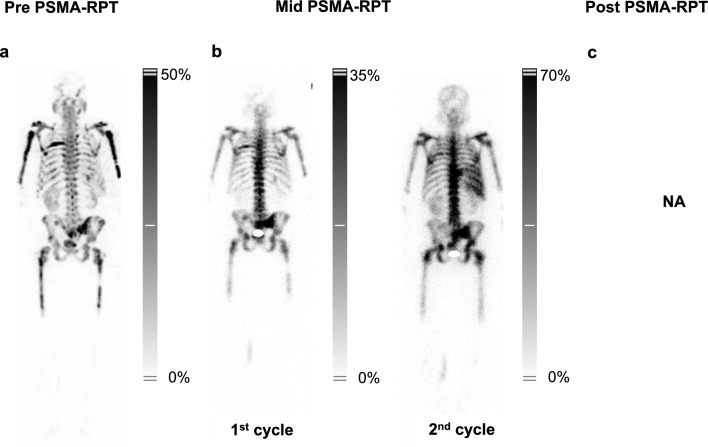 Figure 5
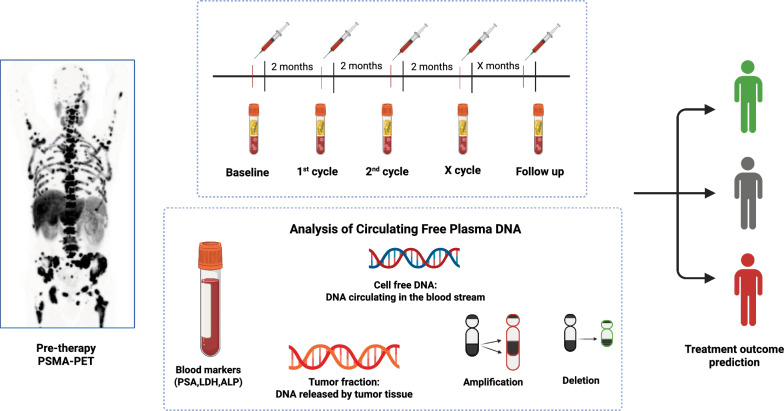 Figure 6
Peer Reviews
No public reviews on file for this paper yet. If you reviewed it on a platform where reviews are public (OpenReview, ICLR, NeurIPS, ICML), you can paste yours below so the community can read it here.
Videos
No videos yet. Explain this paper in a talk, walkthrough, or lecture? Add one.
Taxonomy
TopicsProstate Cancer Treatment and Research · Cancer Genomics and Diagnostics · Radiopharmaceutical Chemistry and Applications