Exploratory observational study with Two-year outcomes of early in-hospital evolocumab in acute coronary syndrome patients undergoing coronary artery bypass grafting
Giuseppe Nasso, Walter Vignaroli, Giuseppe Santarpino, Claudio Larosa, Isabella Rosa, Francesco Bartolomucci, Vincenzo Montemurro, Flavio Fiore, Antongiulio Valenzano, Giacomo Errico, Giacomo Schinco, Mario Siro Brigiani, Gaetano Contegiacomo, Vito Margari, Michele Covelli

TL;DR
Starting evolocumab early in hospital for high-risk heart patients undergoing surgery helps lower cholesterol and reduce cardiovascular events over two years.
Contribution
Demonstrates early in-hospital evolocumab use improves cholesterol and outcomes in ACS patients undergoing CABG.
Findings
Evolocumab achieved 73.3% LDL-C <55 mg/dL vs 29.3% with standard therapy at 24 months.
MACE occurred in 10.0% of evolocumab patients vs 24.4% with standard therapy.
Evolocumab was well tolerated with no discontinuations due to adverse events.
Abstract
Patients with acute coronary syndrome (ACS) who require coronary artery bypass grafting (CABG) remain at very high ischemic risk due to diffuse native disease and vein graft vulnerability. This study aimed to assess whether very early in-hospital initiation of evolocumab, a Proprotein Convertase Subtilisin/Kexin Type 9 (PCSK9) inhibitor, on top of statins improves cholesterol control and mid-term cardiovascular outcomes in this high-risk population. We performed a single-center, retrospective cohort study of 74 ACS patients undergoing isolated CABG (January 2022–July 2023) at Anthea Hospital GVM Care & Research, Bari, Italy. All received high-intensity statin therapy ± ezetimibe (STANDARD, n = 43), while 31 also received evolocumab 140 mg every two weeks (EVOLOCUMAB), initiated pre-angiography, preoperatively, or within 72 h post-CABG. The primary endpoints were LDL cholesterol (LDL-C)…
Genes, proteins, chemicals, diseases, species, mutations and cell lines named across the full text — each resolved to its canonical identifier and authoritative record.
Click any figure to enlarge with its caption.
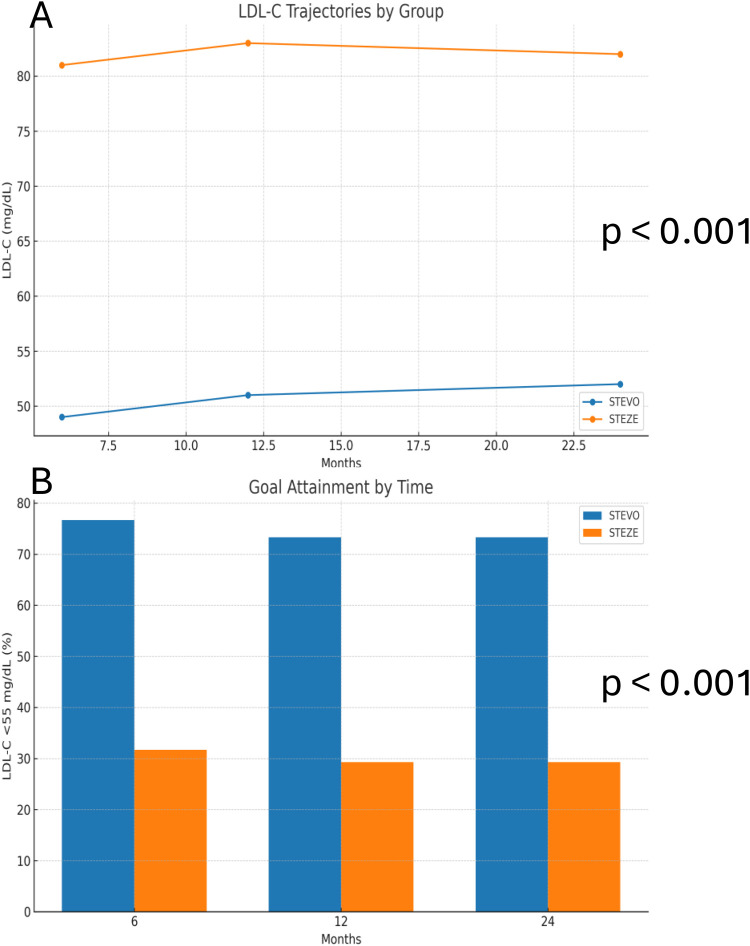 Figure 1
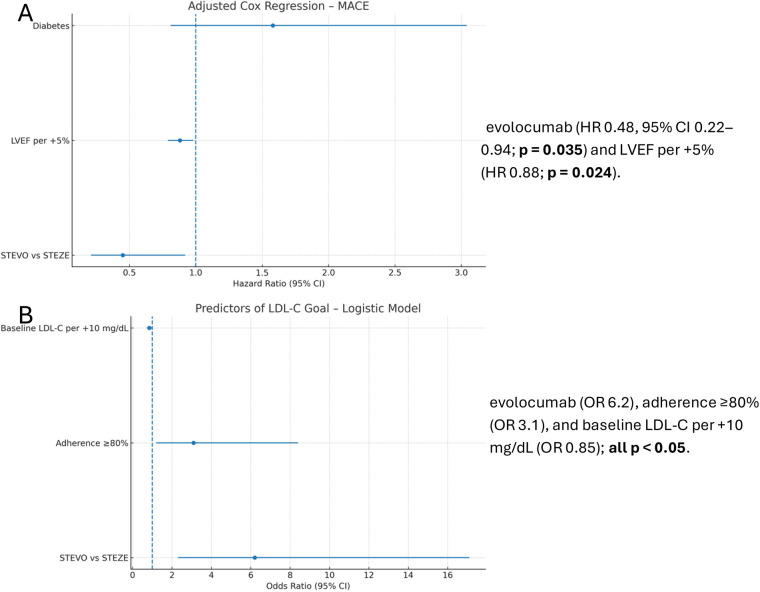 Figure 2
Peer Reviews
No public reviews on file for this paper yet. If you reviewed it on a platform where reviews are public (OpenReview, ICLR, NeurIPS, ICML), you can paste yours below so the community can read it here.
Videos
No videos yet. Explain this paper in a talk, walkthrough, or lecture? Add one.
Taxonomy
TopicsLipoproteins and Cardiovascular Health · Coronary Interventions and Diagnostics · Cardiac Imaging and Diagnostics