Case Report: Stage-by-stage fueling, glucose dynamics, and next-day metabolism and biomarker responses after baseline testing in an 18.5-hour Swedish classic tetrathlon
Jonny Trinh, Fredrik Edin, Ulrika Andersson-Hall, Stefan Pettersson

TL;DR
This case study tracks an amateur ultra-endurance athlete's fueling and glucose levels during a long multi-sport event, showing how nutrition and glucose stability change over time.
Contribution
The study integrates detailed real-world data on fueling, glucose monitoring, and metabolism in a condensed ultra-endurance event, offering insights for better fueling strategies.
Findings
Stable glucose levels were observed during most stages, with hypoglycemia only during the final run.
Next-day glucose tolerance showed an earlier peak and nadir, with reduced carbohydrate oxidation and increased fat oxidation.
Fueling strategies based on discipline-specific timing may improve glucose stability in ultra-endurance events.
Abstract
Amateur ultra-endurance (UE) athletes often exhibit suboptimal fueling, particularly inadequate carbohydrate (CHO) intake, during competition. Integrated real-world datasets that combine weighed-back, stage-specific fueling with blinded continuous glucose monitoring (CGM) and next-day oral glucose tolerance test (OGTT) including indirect calorimetry in a condensed multi-discipline UE setting are scarce. A 37-year-old amateur athlete completed a tightly timed “Swedish Classic” on official race courses within 18:30 h:min (18.5 h)—316 km road cycling, 3 km open-water swimming, 84 km roller-skiing, and 30 km trail running—with helicopter transfers between stages [433 km total; 15:01 h:min (15.0 h) active exercise]. Fasting laboratory tests were performed at 07:30 on the mornings before and after the attempt, including venous blood sampling, dual-energy x-ray absorptiometry (DXA), and a…
Genes, proteins, chemicals, diseases, species, mutations and cell lines named across the full text — each resolved to its canonical identifier and authoritative record.
Click any figure to enlarge with its caption.
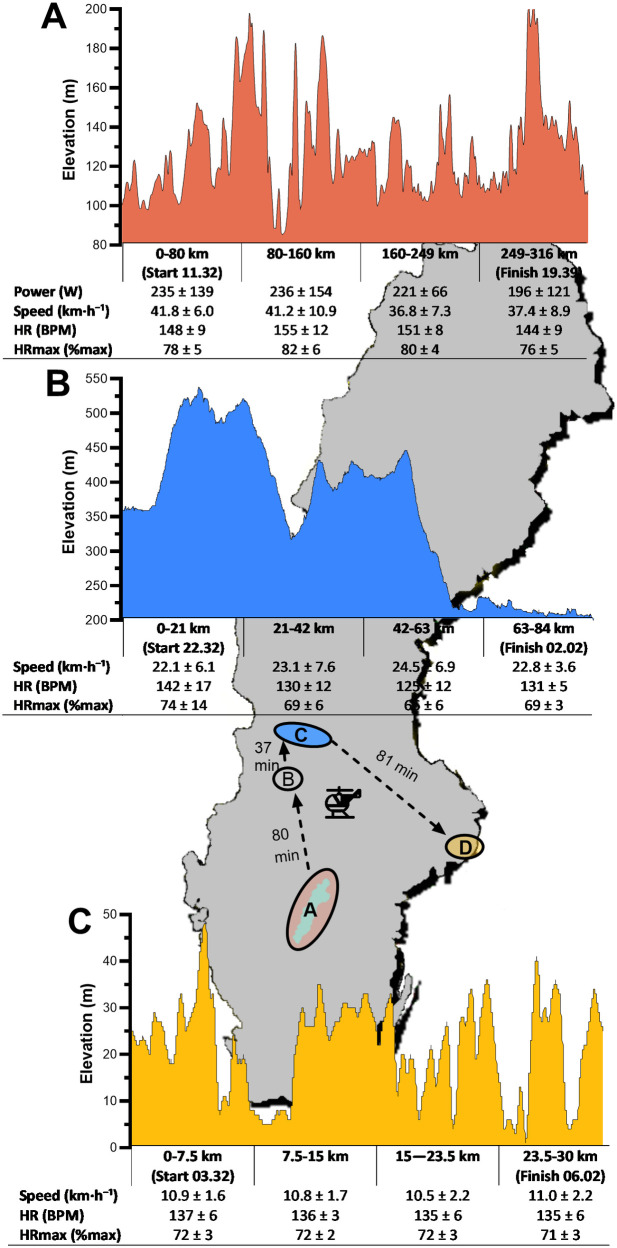 Figure 1
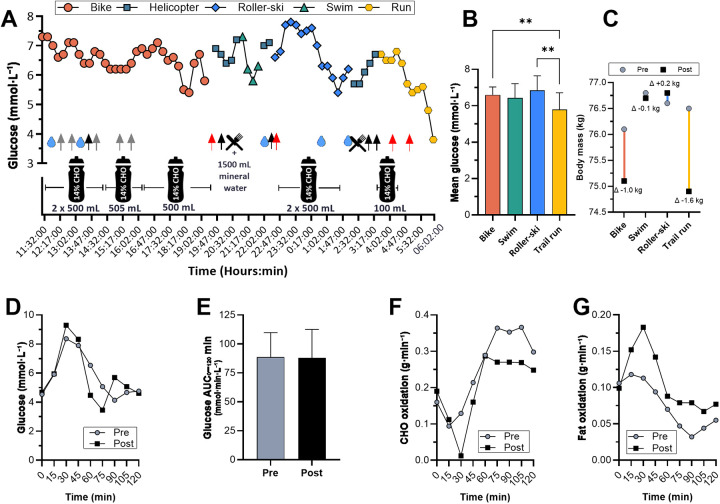 Figure 2
 Figure 3
 Figure 4
Peer Reviews
No public reviews on file for this paper yet. If you reviewed it on a platform where reviews are public (OpenReview, ICLR, NeurIPS, ICML), you can paste yours below so the community can read it here.
Videos
No videos yet. Explain this paper in a talk, walkthrough, or lecture? Add one.
Taxonomy
TopicsMuscle metabolism and nutrition · Adipose Tissue and Metabolism · Diet and metabolism studies