More optimistic treatment expectations are associated with better outcomes through stronger group cohesion, but not dyadic alliance: results from a naturalistic day clinic study in complex depression
Catherine Irniger, Johannes Vetter, Steffi Weidt, Erich Seifritz, Martin Grosse Holtforth, Rainer Krähenmann

TL;DR
Optimistic expectations about treatment improve depression outcomes mainly through stronger group relationships, not just the patient-therapist bond.
Contribution
This study is the first to show that group cohesion, not dyadic alliance, mediates the effect of treatment expectations on depression outcomes in group therapy.
Findings
Optimistic treatment expectations correlate with stronger group cohesion but not dyadic alliance.
Group cohesion, but not dyadic alliance, is significantly linked to better depression outcomes.
The direct link between treatment expectations and outcomes is not significant.
Abstract
More optimistic treatment expectations are typically associated with better psychotherapy outcomes, including in depression. Meta-analytic findings suggest that this relationship is mediated by the dyadic alliance. In settings including group formats, however, patients also interact and build relationships with one another. Thus, group relationship may represent an important mediator, particularly given that depression is often accompanied by interpersonal difficulties. Therefore, we aimed to investigate the potential mediating role of group relationship above and beyond the dyadic alliance, as, to the best of our knowledge, this has not yet been examined. We hypothesized that more optimistic treatment expectations would be both, directly and indirectly associated with better outcomes through a stronger dyadic alliance and better group relationship. Data were drawn from a naturalistic…
Genes, proteins, chemicals, diseases, species, mutations and cell lines named across the full text — each resolved to its canonical identifier and authoritative record.
Click any figure to enlarge with its caption.
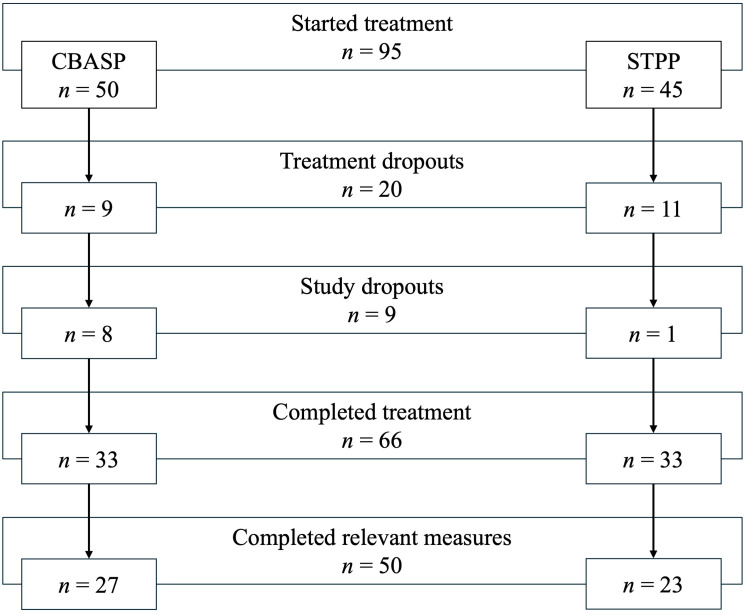 Figure 1
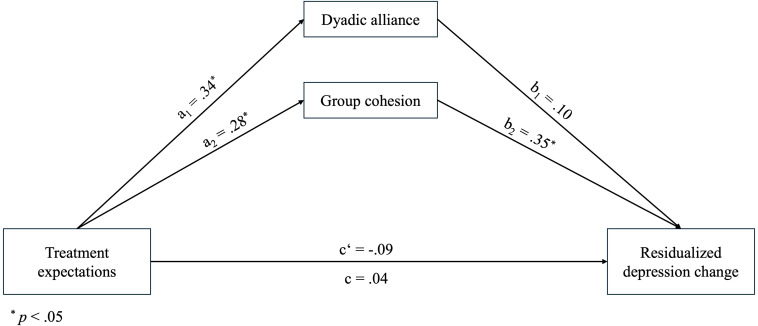 Figure 2
Peer Reviews
No public reviews on file for this paper yet. If you reviewed it on a platform where reviews are public (OpenReview, ICLR, NeurIPS, ICML), you can paste yours below so the community can read it here.
Videos
No videos yet. Explain this paper in a talk, walkthrough, or lecture? Add one.
Taxonomy
TopicsPsychotherapy Techniques and Applications · Digital Mental Health Interventions · Anxiety, Depression, Psychometrics, Treatment, Cognitive Processes