Identifying subtypes of suicidality: a second larger consensus study in emergency clinical psychiatric practice
Remco F.P. de Winter, Damien S.E. Broekharst, Connie M. Meijer, Nienke Kool-Goudzwaard, Anne T. van den Bos, John H. Enterman, Manuela Gemen, Chani Nuij, Mirjam C. Hazewinkel, Danielle Steentjes, Gabrielle E. van Son, Jonas G. Weijers, Derek P. de Beurs, Marieke H. de Groot

TL;DR
This study tests a model to identify four subtypes of suicidality in emergency psychiatric patients, showing strong agreement among professionals using a new tool.
Contribution
The study validates the usability of the (h)4ME model and SUICIDI-3 tool in a larger clinical sample.
Findings
Excellent agreement was found for Perceptual Disintegration and Primary Depressive Cognition subtypes.
The SUICIDI-3 tool showed good feasibility for assigning patients to subtypes.
Replication in diverse populations is needed to confirm the model's consistency.
Abstract
A model has been developed to distinguish subtypes of pathways to entrapment leading to suicidality in clinical mental health practice. The (hypothetical) 4-type Model of Entrapment ((h)4ME) delineates four subtypes of suicidality: I) Perceptual Disintegration (PD), II) Primary Depressive Cognition (PDC), III) Psychosocial Turmoil (PT) and IV) Inadequate Coping/Communication (IC). To examine the model’s usability and feasibility in a larger cohort of suicidal patients (n= 75) following a pilot study. Consultation reports to general practitioners of 75 suicidal emergency patients were independently allocated to subtypes by three psychiatrists and three nurses using the SUICIDI-3 tool. This tool describes the proposed subtypes. Interrater agreement was assessed by calculating Intraclass Correlation Coefficients (ICCs). Absolute and dimensional type agreement was established to assess…
Genes, proteins, chemicals, diseases, species, mutations and cell lines named across the full text — each resolved to its canonical identifier and authoritative record.
Click any figure to enlarge with its caption.
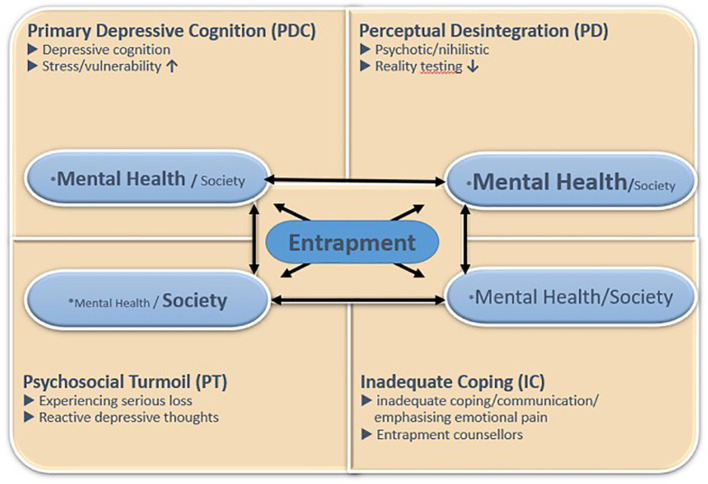 Figure 1
Peer Reviews
No public reviews on file for this paper yet. If you reviewed it on a platform where reviews are public (OpenReview, ICLR, NeurIPS, ICML), you can paste yours below so the community can read it here.
Videos
No videos yet. Explain this paper in a talk, walkthrough, or lecture? Add one.
Taxonomy
TopicsSuicide and Self-Harm Studies · Mental Health Research Topics · Treatment of Major Depression