Longitudinal associations between generative artificial intelligence adoption and university PE teachers’ professional competence
Gang Zhou, Qishun Yang, Xiao Chen

TL;DR
This study explores how using generative AI over time affects the professional skills of university physical education teachers.
Contribution
The study provides longitudinal evidence on how GenAI adoption influences professional competence through self-regulated learning.
Findings
GenAI adoption is positively linked to professional competence over time.
Self-regulated learning mediates the relationship between GenAI adoption and competence.
Teaching experience weakens the indirect effect of GenAI on competence.
Abstract
Generative artificial intelligence (GenAI) is increasingly integrated into educational practice, yet longitudinal evidence regarding its role in teachers’ professional development remains limited, particularly in physical education contexts characterized by embodied teaching. This study employed a three-wave longitudinal design over 1 year to examine the dynamic associations between GenAI adoption and professional competence among 558 university physical education teachers in China. Cross-lagged panel modeling was used to test the longitudinal mediating role of self-regulated learning and the moderating effect of teaching experience. The results showed that GenAI adoption exhibited a significant and sustained positive association with teachers’ professional competence across time. Self-regulated learning functioned as a longitudinal mediator linking GenAI adoption to professional…
Click any figure to enlarge with its caption.
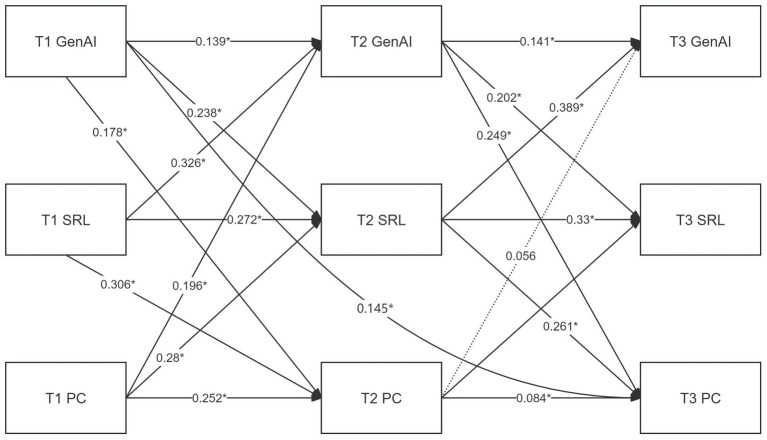 Figure 1
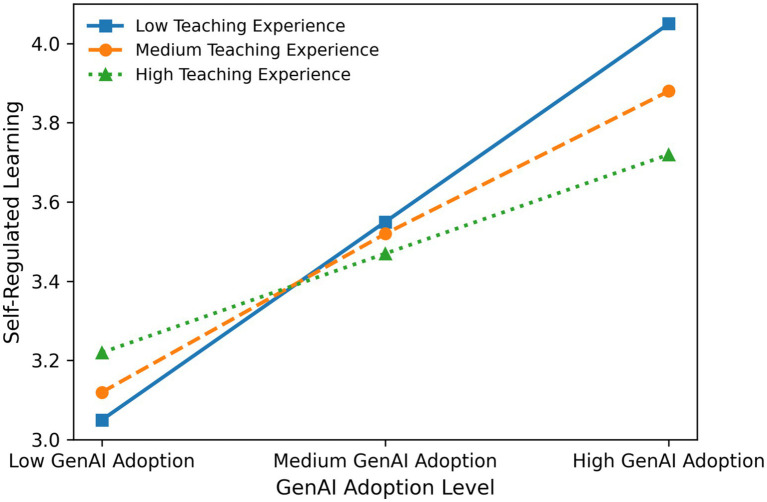 Figure 2
Peer Reviews
No public reviews on file for this paper yet. If you reviewed it on a platform where reviews are public (OpenReview, ICLR, NeurIPS, ICML), you can paste yours below so the community can read it here.
Videos
No videos yet. Explain this paper in a talk, walkthrough, or lecture? Add one.
Taxonomy
TopicsPhysical Education and Pedagogy · Educational Games and Gamification · Educational Theory and Curriculum Studies