The puzzle of profitless pre-cues
Julie M. Bugg, Christopher O. Nuño, Changrun Huang, Tobias Egner

TL;DR
This paper investigates why warnings to pay attention often fail to reduce distractions in cognitive tasks, proposing a new framework to understand and improve proactive control.
Contribution
The paper introduces the TEPID framework, a novel theoretical model explaining how pre-cues influence proactive cognitive control.
Findings
Empirical evidence for the effectiveness of pre-cues in reducing distraction is limited.
The TEPID framework identifies task-related and person-related factors that influence the use of pre-cues.
Recommendations are provided for future research on proactive control and real-life applications.
Abstract
Despite the intuition that attention can be willfully heightened on demand in response to warnings that alert people to impending distraction (e.g., “Pay attention!”), the empirical evidence for this notion from studies employing congruency pre-cues is surprisingly weak, posing a challenge to some theoretical accounts. Here, we examine this puzzle of profitless pre-cues via the first systematic review of the literature on pre-cues in conflict tasks (e.g., the Stroop task)—a classic instance of proactive cognitive control. We first outline important conceptual and methodological considerations to delineate the process of greatest theoretical and practical importance, namely, the volitional attenuation of distraction when the precise target and distractor features are not known in advance. This is followed by a comprehensive literature review, revealing limited evidence for the effective…
Genes, proteins, chemicals, diseases, species, mutations and cell lines named across the full text — each resolved to its canonical identifier and authoritative record.
Click any figure to enlarge with its caption.
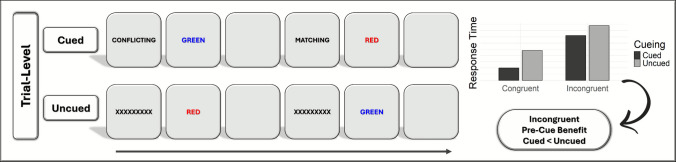 Figure 1
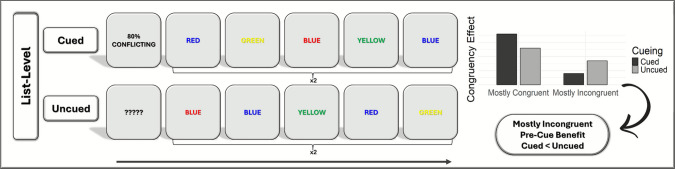 Figure 2
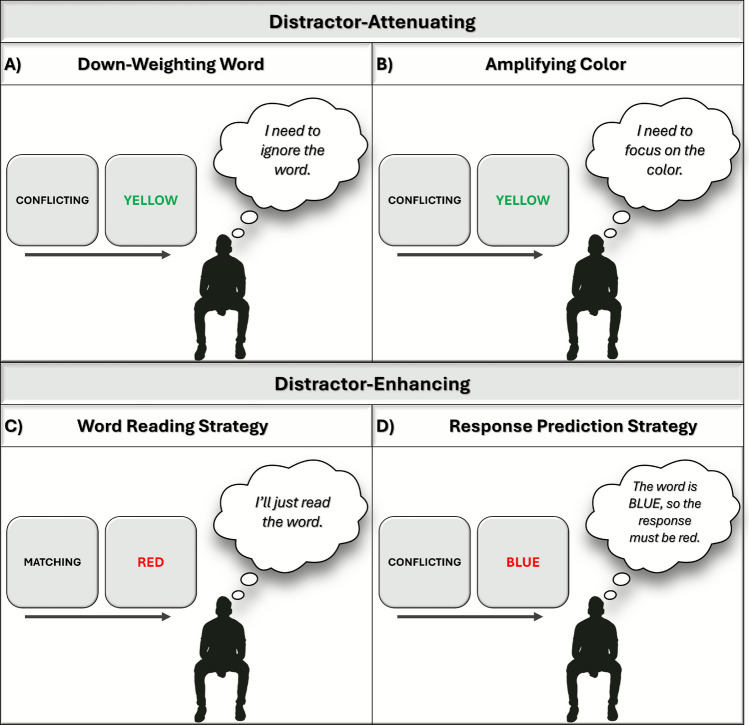 Figure 3
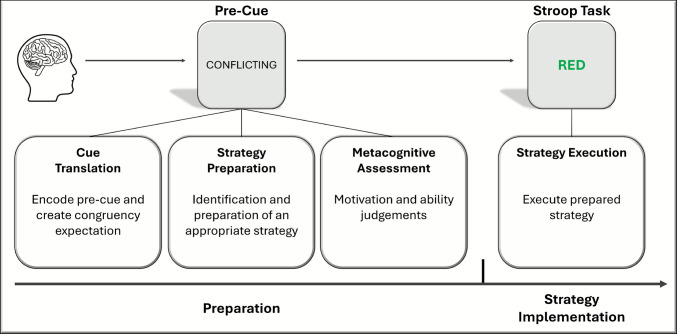 Figure 4
Peer Reviews
No public reviews on file for this paper yet. If you reviewed it on a platform where reviews are public (OpenReview, ICLR, NeurIPS, ICML), you can paste yours below so the community can read it here.
Videos
No videos yet. Explain this paper in a talk, walkthrough, or lecture? Add one.
Taxonomy
TopicsHuman-Automation Interaction and Safety · Neural and Behavioral Psychology Studies · Mind wandering and attention