Deep learning for FDG-PET classification in patients with Alzheimer’s disease, dementia with Lewy bodies and their mixed pathology: a solution for diagnostic heterogeneity
Seonggyu Kim, Seun Jeon, Kwonhwi Cho, Sungwoo Kang, Sungkyu Bang, Byoung Seok Ye, Jong-Min Lee

TL;DR
This study uses deep learning on FDG-PET scans to improve diagnosis of Alzheimer’s, dementia with Lewy bodies, and mixed cases, which are often hard to distinguish.
Contribution
A novel deep learning model is proposed to classify AD, DLB, mixed pathology, and healthy controls using FDG-PET data.
Findings
The model achieved an AUROC of 0.90 for DLB classification.
FDG-PET was shown to be a useful biomarker for differentiating AD, DLB, mixed, and healthy groups.
The model outperforms existing methods in classifying these complex neurological conditions.
Abstract
Mixed pathology of Alzheimer’s disease (AD) and dementia with Lewy bodies (DLB) are frequently observed in patients with cognitive impairment, and complicate clinical diagnosis. We aimed to develop a classification model using 18F-fluorodeoxyglucose (FDG) positron emission tomography (PET) to improve diagnostic accuracy for these challenging cases. We analyzed FDG-PET images from 277 participants who were categorized into AD, DLB, mixed disease, and healthy control (HC) groups. Deep learning-based classification models were trained on seven binary classification tasks and one multiclass classification task and subsequently integrated into an ensemble model to predict AD, DLB, mixed disease or HC groups. The model achieved an AUROC of 0.73 (95% CI, 0.69–0.78) for AD, 0.90 (95% CI, 0.89–0.91) for DLB, 0.71 (95% CI, 0.66–0.75) for Mixed, and 0.87 (95% CI, 0.84–0.89) for HC. The model…
Genes, proteins, chemicals, diseases, species, mutations and cell lines named across the full text — each resolved to its canonical identifier and authoritative record.
Click any figure to enlarge with its caption.
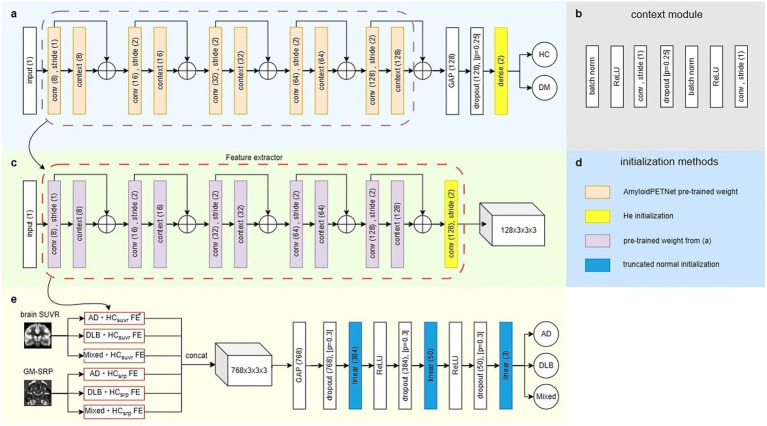 Figure 1
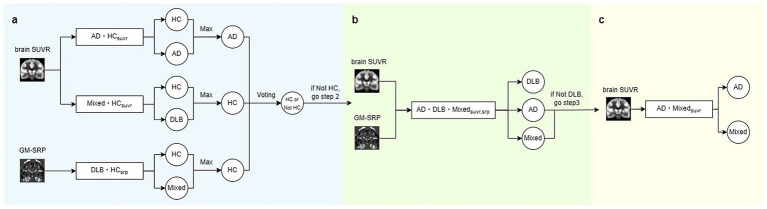 Figure 2
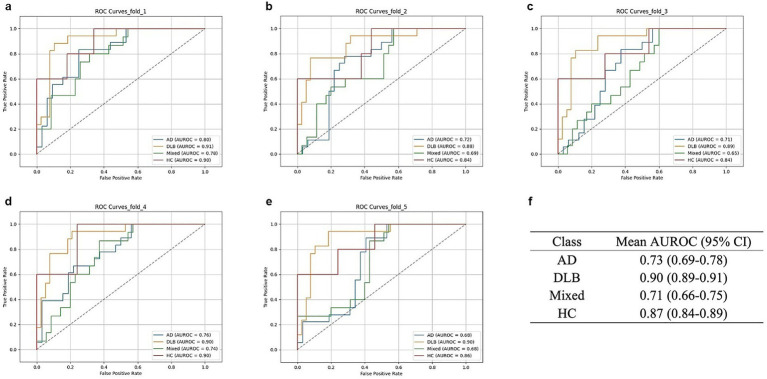 Figure 3
 Figure 4
Peer Reviews
No public reviews on file for this paper yet. If you reviewed it on a platform where reviews are public (OpenReview, ICLR, NeurIPS, ICML), you can paste yours below so the community can read it here.
Videos
No videos yet. Explain this paper in a talk, walkthrough, or lecture? Add one.
Taxonomy
TopicsDementia and Cognitive Impairment Research · AI in cancer detection · COVID-19 diagnosis using AI