Vitamin D and Health Outcomes: State-of-the-Art Review of Triangulated Evidence and Ongoing Controversies
Maria Dalamaga, Rodopi Emfietzoglou, Dimitra Petropoulou, Maria Kypraiou, Dimitris C. Kounatidis, Natalia G. Vallianou, Spyridon Karras, Faidon Magkos, Irene Karampela

TL;DR
This review clarifies vitamin D's role in health by combining evidence from different study types, showing it's important for bones and some other conditions but not a universal solution.
Contribution
The paper introduces a triangulated model reconciling conflicting evidence on vitamin D's health effects across study designs.
Findings
Vitamin D strongly supports skeletal health and reduces fracture risk in deficient or older populations.
Modest benefits are seen in cancer mortality, autoimmune disorders, and respiratory infections in those with low vitamin D.
Cardiovascular and neuropsychiatric outcomes lack consistent evidence, suggesting limited or non-causal effects.
Abstract
Vitamin D is a pleiotropic hormone with an established role in skeletal integrity and broader actions in immune regulation, inflammation, cellular proliferation, and energy homeostasis. Despite decades of research, its extra-skeletal effects remain controversial, largely due to discordant findings across observational studies, Mendelian randomization studies (MRS), and randomized controlled trials (RCTs). Unlike many prior reviews, this state-of-the-art review synthesizes triangulated evidence across these study designs to clarify outcome-specific causal relationships and ongoing controversies. Triangulated evidence provides strong and consistent support for a causal role of vitamin D in skeletal health, particularly in the prevention and treatment of rickets and osteomalacia, and in fracture risk reduction among vitamin D–deficient and older populations. For selected extra-skeletal…
Genes, proteins, chemicals, diseases, species, mutations and cell lines named across the full text — each resolved to its canonical identifier and authoritative record.
Click any figure to enlarge with its caption.
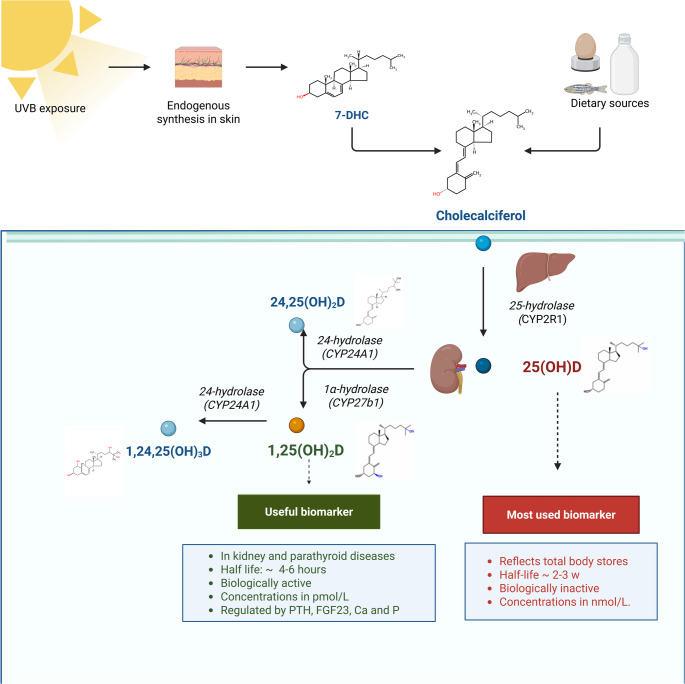 Figure 1
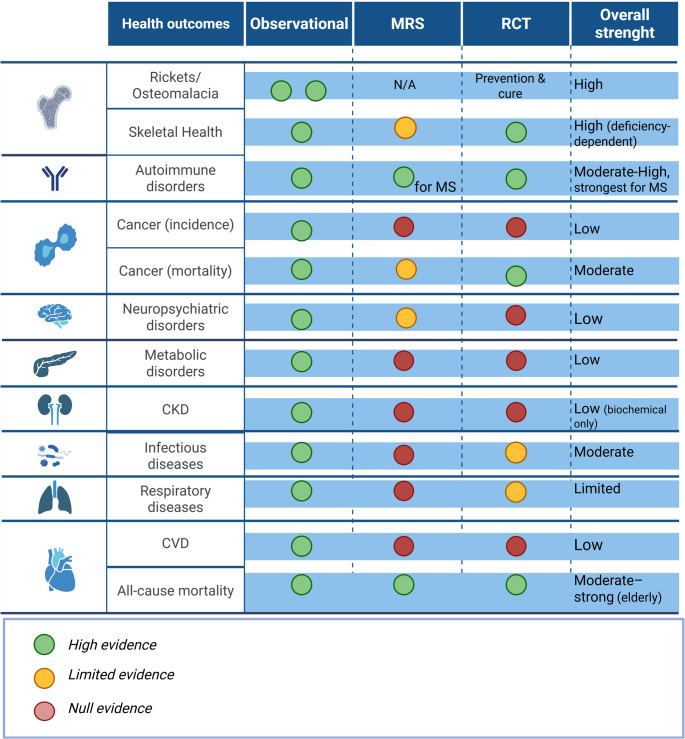 Figure 2
Peer Reviews
No public reviews on file for this paper yet. If you reviewed it on a platform where reviews are public (OpenReview, ICLR, NeurIPS, ICML), you can paste yours below so the community can read it here.
Videos
No videos yet. Explain this paper in a talk, walkthrough, or lecture? Add one.
Taxonomy
TopicsVitamin D Research Studies · Vitamin C and Antioxidants Research · Vitamin K Research Studies