Cationic Gold on Heteroatom Doped Carbon Supports for Vinyl Chloride Production
Joseph Cartwright, Hannaneh Hosseini, Alexander Gunnarson, Anna Lazaridou, Jonathan M. Mauß, Ben Davies, Samuel Pattisson, Angeles Lopez-Martin, David J. Morgan, Nicholas F. Dummer, Ferdi Schüth, Graham J. Hutchings

TL;DR
This paper explores using cationic gold on sulfur-doped carbon to produce vinyl chloride, offering a more eco-friendly alternative to mercury-based catalysts.
Contribution
The study introduces sulfur-doped carbon supports that enhance the stability and activity of cationic gold catalysts for vinyl chloride production.
Findings
S-doped carbon supports increased acetylene conversion by 1.6 times compared to undoped carbon spheres.
S-doped activated carbon (Norit) showed a 2 times higher conversion rate than its undoped counterpart.
Sulfur and nitrogen doping improved gold catalyst stability and activity under reaction conditions.
Abstract
Replacement of mercuric chloride catalysts to produce vinyl chloride monomer from acetylene, the precursor to PVC, is needed due to widespread environmental damage of leached mercury. Cationic gold catalysts, which have been recently commercialised, represent a more environmentally benign alternative. However, new catalysts are required to limit the atomically dispersed cationic Au from agglomeration due to reduction under reaction conditions. Several strategies are available to stabilise the Au active sites such as the use of sulphur containing ligands or to use heteroatom doped carbon as the support. Here we prepared two types of doped carbon supports; spheres derived via a hard template methodology and secondly, doped commercial activated carbon. In both cases the Au supported on S-doped carbon was superior in comparison to the undoped analogue; the acetylene conversion was enhanced…
Genes, proteins, chemicals, diseases, species, mutations and cell lines named across the full text — each resolved to its canonical identifier and authoritative record.
Click any figure to enlarge with its caption.
 Figure 1
 Figure 2
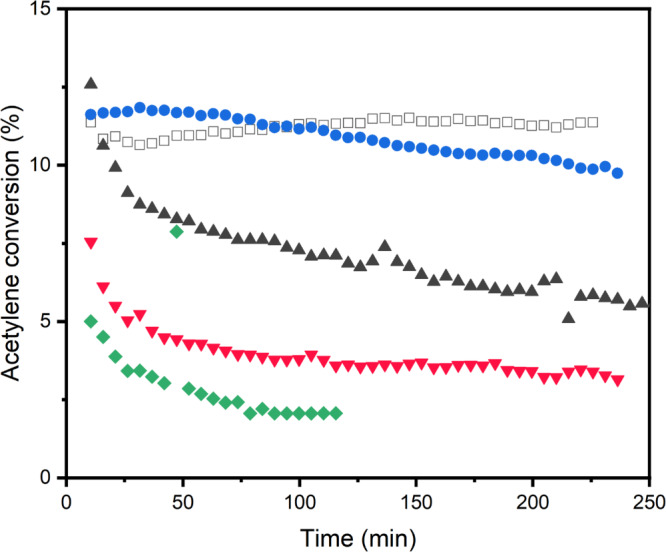 Figure 3
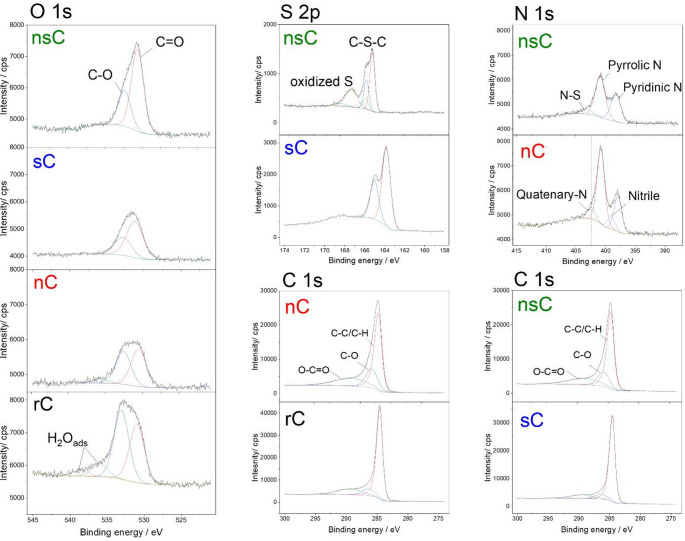 Figure 4
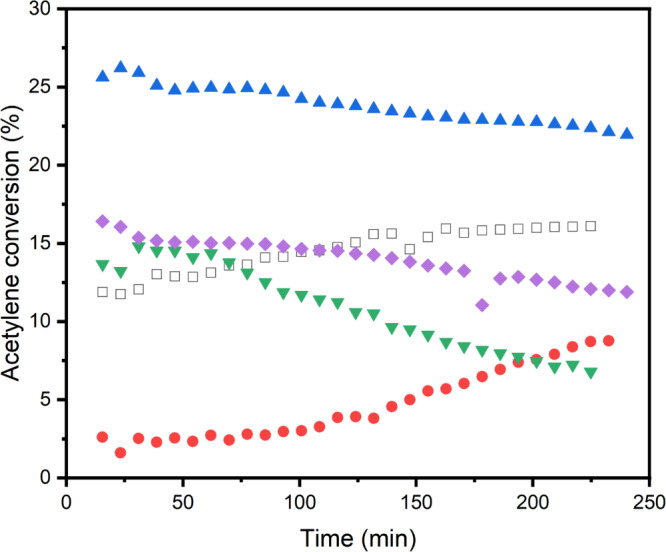 Figure 5
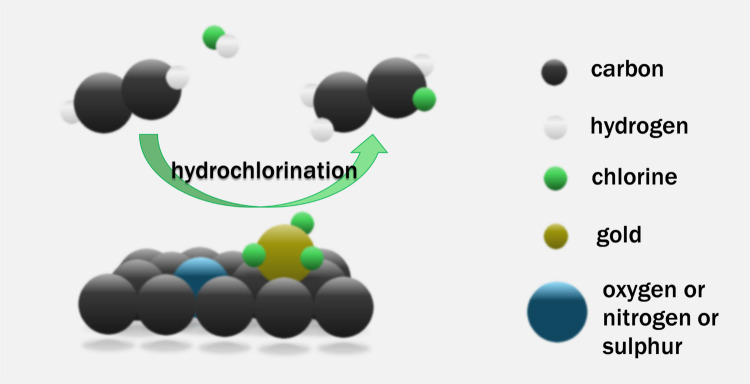 Figure 6
Peer Reviews
No public reviews on file for this paper yet. If you reviewed it on a platform where reviews are public (OpenReview, ICLR, NeurIPS, ICML), you can paste yours below so the community can read it here.
Videos
No videos yet. Explain this paper in a talk, walkthrough, or lecture? Add one.
Taxonomy
TopicsCatalytic Processes in Materials Science · Catalytic Alkyne Reactions · Sulfur-Based Synthesis Techniques