Cerebral vasospasm following arteriovenous malformation rupture: a population-based longitudinal study
Isaac B. Thorman, Eris Spirollari, Tamer Mubarak, Eman Elbayoumi, Aryan Malhotra, Ariel Sacknovitz, Ankita Jain, Michael C. Schubert, Uchenna Okafo, Gurmeen Kaur, Andrew Bauerschmidt, Jon Rosenberg, Stephan A. Mayer, Chirag D. Gandhi, Fawaz Al-Mufti

TL;DR
This study finds that cerebral vasospasm after ruptured brain malformations is rare but strongly linked to higher mortality and specific risk factors like subarachnoid hemorrhage and hydrocephalus.
Contribution
The study is the first longitudinal analysis identifying risk factors for vasospasm and mortality after ruptured arteriovenous malformations using a large population-based dataset.
Findings
Vasospasm occurred in 3% of ruptured AVM cases and was associated with more than double the mortality at 30 days and one year.
Subarachnoid hemorrhage, hydrocephalus, and male sex were significant risk factors for vasospasm.
Coma, hydrocephalus, and chronic kidney disease were the strongest predictors of 30-day mortality.
Abstract
Vasospasm is a devastating sequelae of ruptured arteriovenous malformations (AVMs) in adults. Comorbidities and presenting factors have been suggested as risks, but only in cross-sectional studies. The objective of this study was to characterize risk factors associated with vasospasm and mortality in ruptured AVM. Adult patients from the TriNetX Research Network were included, based on the ICD-10 codes, over a period of 20 years. Cox proportional hazard models assessed the hazards of vasospasm (I67.84) and mortality separately, adjusting for age, sex, comorbidities, substance use history, presenting factors (e.g., hypernatremia, hypokalemia), criteria of the National Inpatient Sample-Subarachnoid Hemorrhage Severity Score, and location of hemorrhage. Outcomes were assessed in the first 30 days following rupture. Among 10,375 patients with ruptured AVMs, 523 (5.3%) died and 297 (3.0%)…
Genes, proteins, chemicals, diseases, species, mutations and cell lines named across the full text — each resolved to its canonical identifier and authoritative record.
Click any figure to enlarge with its caption.
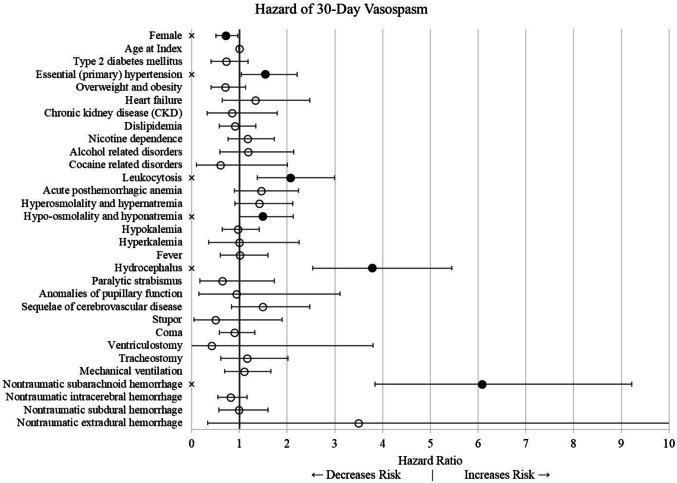 Figure 1
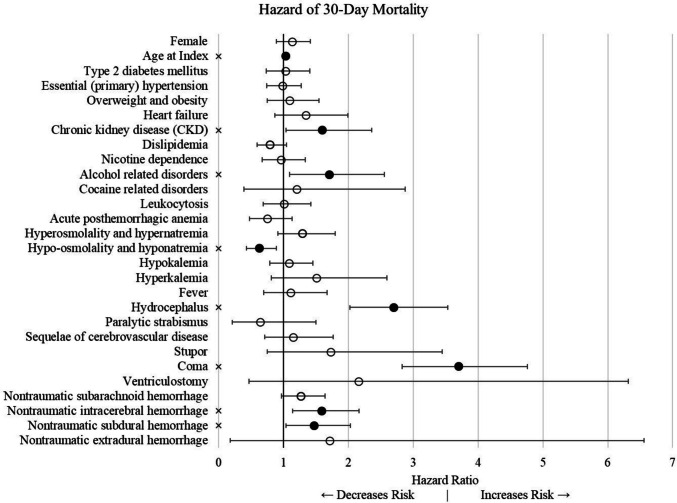 Figure 2
Peer Reviews
No public reviews on file for this paper yet. If you reviewed it on a platform where reviews are public (OpenReview, ICLR, NeurIPS, ICML), you can paste yours below so the community can read it here.
Videos
No videos yet. Explain this paper in a talk, walkthrough, or lecture? Add one.
Taxonomy
TopicsVascular Malformations Diagnosis and Treatment · Vascular Anomalies and Treatments · Vascular Malformations and Hemangiomas