Opioid detection and quantification in plasma and oral fluid by LC–MS/MS
Luana M. Rosendo, Suzel Costa, Susana Simões, João M. Franco, Noelia Serrano Gadea, Mónica Escorial, Francisco Javier Toboso Ortega, Segundo Jiménez-García, Ana M. Peiró, Isabel Duque, Tiago Rosado, Mário Barroso, Eugenia Gallardo

TL;DR
A new LC–MS/MS method was developed to detect and measure opioids in blood and saliva with high accuracy, offering a non-invasive alternative for drug monitoring.
Contribution
A validated LC–MS/MS method for simultaneous detection and quantification of multiple opioids in plasma and oral fluid with high sensitivity and precision.
Findings
The method achieved LLOQs as low as 0.1 ng/mL for fentanyl and showed excellent precision and accuracy.
Extraction efficiencies exceeded 90% for most opioids, and matrix effects were within acceptable limits.
Oral fluid was confirmed as a viable non-invasive matrix for opioid detection, with detectable concentrations across all target compounds.
Abstract
The opioid crisis remains a significant public health concern, necessitating the development of sensitive and reliable analytical methods for drug detection. This study aimed to develop and validate a liquid chromatography–tandem mass spectrometry (LC–MS/MS) method for the simultaneous detection and quantification of fentanyl, buprenorphine, oxycodone, morphine, tramadol, and tapentadol in plasma and oral fluid. The method was validated according to FDA guidelines, assessing selectivity, linearity, precision, accuracy, matrix effect, extraction efficiency, stability, carryover, and dilution integrity. The lower limits of quantification (LLOQs) were established at 0.1 ng/mL for fentanyl, 1.2 ng/mL for tramadol, and 0.6 ng/mL for the remaining opioids, demonstrating high sensitivity. The method exhibited excellent precision and accuracy, with coefficients of variation below 15% for…
Genes, proteins, chemicals, diseases, species, mutations and cell lines named across the full text — each resolved to its canonical identifier and authoritative record.
Click any figure to enlarge with its caption.
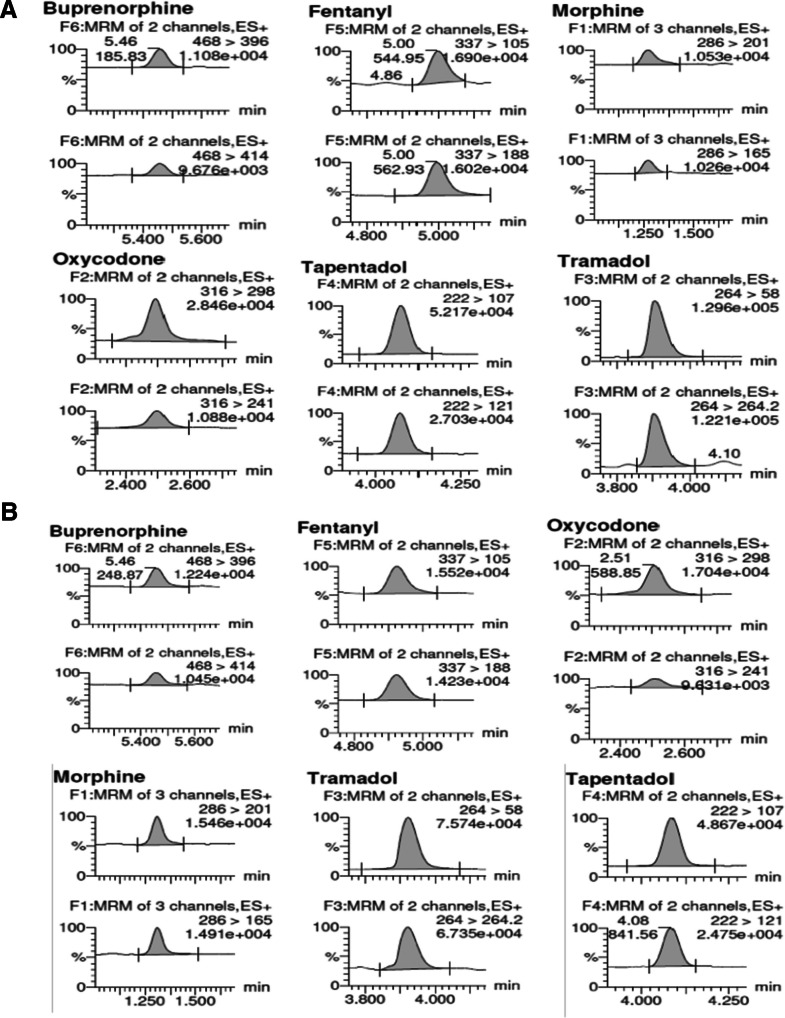 Figure 1
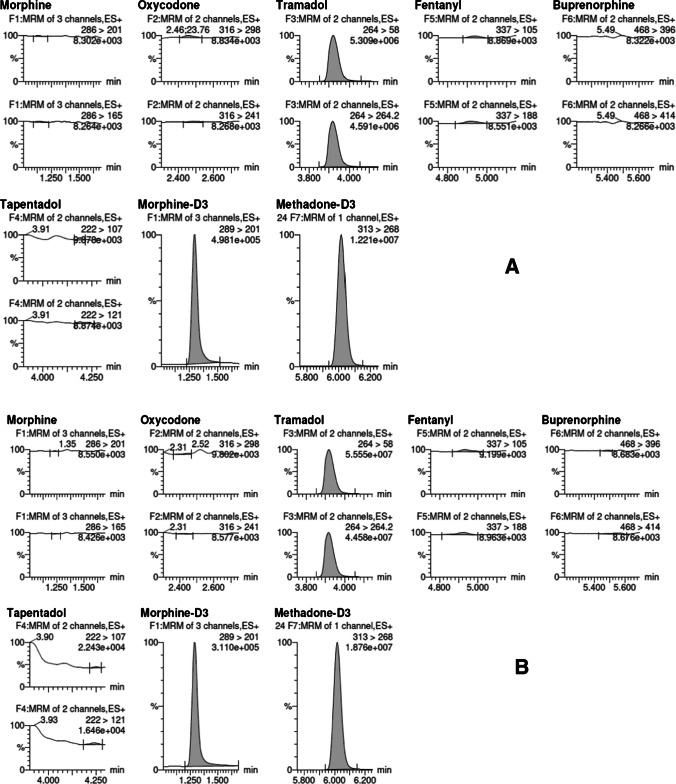 Figure 2
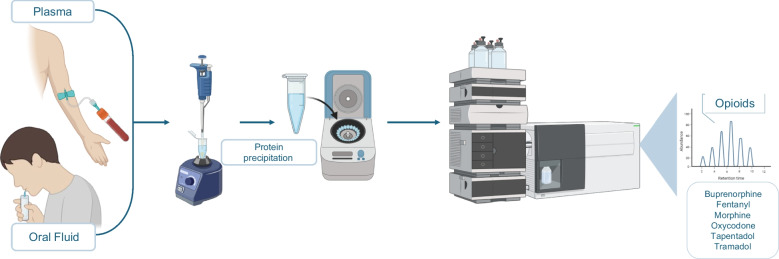 Figure 3
Peer Reviews
No public reviews on file for this paper yet. If you reviewed it on a platform where reviews are public (OpenReview, ICLR, NeurIPS, ICML), you can paste yours below so the community can read it here.
Videos
No videos yet. Explain this paper in a talk, walkthrough, or lecture? Add one.
Taxonomy
TopicsForensic Toxicology and Drug Analysis · Analytical chemistry methods development · Opioid Use Disorder Treatment