A multilevel perspective of developmental feedback and employee creativity
Xiaolu Li, Gang Liu, Lin Sun

TL;DR
This paper explores how feedback from supervisors and teams can boost employee creativity by aligning developmental cues and improving problem identification.
Contribution
The study introduces a multilevel perspective on developmental feedback, linking it to creativity through individual and team mechanisms.
Findings
Supervisor and team developmental feedback both positively relate to employee creativity.
Problem identification mediates the link between supervisor feedback and creativity.
Team reflexivity mediates the relationship between supervisor feedback and problem identification.
Abstract
Drawing from the broader feedback literature and the creativity literature, we offer a multilevel perspective to examine how receiving developmental feedback could positively influence one’s creativity. We resolve a key puzzle in the feedback–creativity literature—why feedback sometimes predicts creativity and sometimes does not—by theorizing developmental feedback as a multilevel system rather than a single-source input. Integrating supervisor and team developmental feedback shows that creativity emerges when developmental cues align across levels to facilitate early-stage problem identification, thereby advancing creativity theory from outcome explanations to process-based accounts. We identified both individual-level and team-level mediating mechanisms linking developmental feedback to creativity. We collected data from a large telecommunication company in China. Hierarchical linear…
Click any figure to enlarge with its caption.
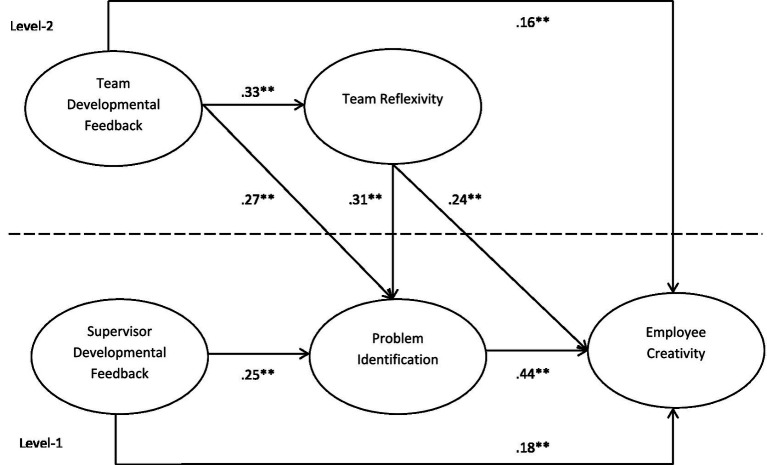 Figure 1
Peer Reviews
No public reviews on file for this paper yet. If you reviewed it on a platform where reviews are public (OpenReview, ICLR, NeurIPS, ICML), you can paste yours below so the community can read it here.
Videos
No videos yet. Explain this paper in a talk, walkthrough, or lecture? Add one.
Taxonomy
TopicsCreativity in Education and Neuroscience · Job Satisfaction and Organizational Behavior · Team Dynamics and Performance