Predictive and prospective control strategies of elite batters during interception tasks: coupling of perception and action
Dukchan Jang

TL;DR
This study explores how elite baseball batters intercept moving objects by combining visual perception and motor control when parts of the visual input are blocked.
Contribution
The study reveals how predictive and prospective control mechanisms interact during interception tasks under partial visual occlusion.
Findings
Temporal efficiency is maintained through compensatory strategies when visual input is partially occluded.
Spatial accuracy declines significantly when early predictive visual information is unavailable.
Internal timing models regulate hand timing independently of immediate visual feedback.
Abstract
Intercepting fast-moving objects, such as during baseball batting, requires the seamless integration of visual perception and motor execution under severe temporal constraints. Although the critical role of visual information in visuomotor coordination is well established, it remains unclear how predictive and prospective control interact when certain phases of visual input are unavailable. This study aimed to elucidate their distinct contributions by examining visuomotor coupling under selectively occluded early and/or late visual information during a time-constrained interception task. Fifteen skilled collegiate baseball players performed a computerized touchscreen interception task, intercepting a fast-moving stimulus (0.5, 0.67, and 1.0 m/s) at a target area. Stimulus visibility was manipulated across four occlusion conditions (full vision, early occlusion, late occlusion, and both…
Click any figure to enlarge with its caption.
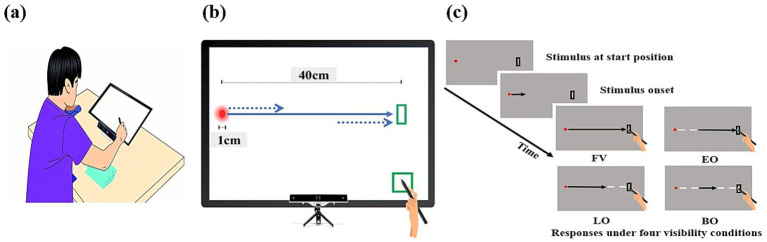 Figure 1
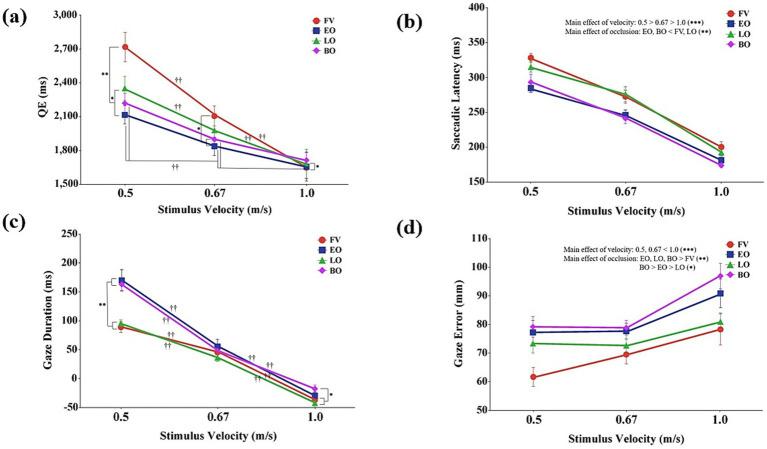 Figure 2
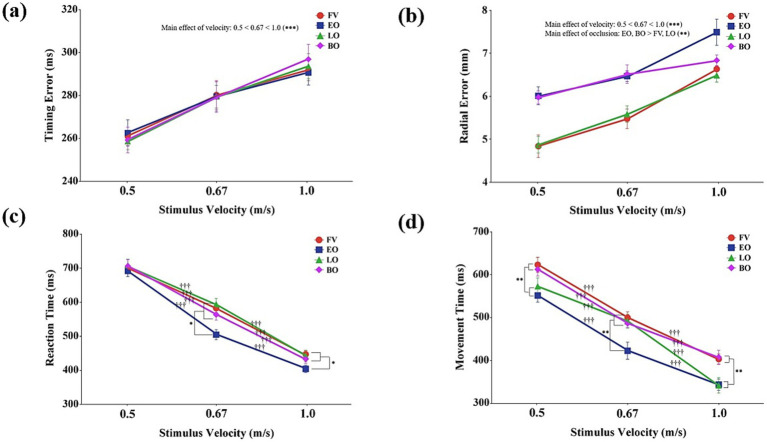 Figure 3
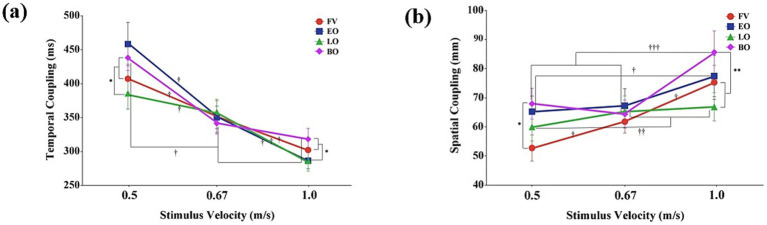 Figure 4
Peer Reviews
No public reviews on file for this paper yet. If you reviewed it on a platform where reviews are public (OpenReview, ICLR, NeurIPS, ICML), you can paste yours below so the community can read it here.
Videos
No videos yet. Explain this paper in a talk, walkthrough, or lecture? Add one.
Taxonomy
TopicsMotor Control and Adaptation · Sport Psychology and Performance · Visual perception and processing mechanisms