ESPLSM: An Efficient and Interpretable Mediation Analysis Framework Using Sparse Envelopes
Yeonhee Park, Zhihua Su

TL;DR
This paper introduces ESPLSM, a new method for mediation analysis that improves accuracy and interpretability in high-dimensional biomedical studies.
Contribution
ESPLSM integrates sparse envelopes with mediation analysis to enhance estimation and interpretation of causal effects.
Findings
ESPLSM outperforms existing methods in estimation accuracy and statistical power.
The method provides new insights into molecular mechanisms of targeted cancer therapies.
Theoretical guarantees for asymptotic efficiency and selection consistency are established.
Abstract
Mediation analysis is a fundamental tool for understanding biological mechanisms through which an exposure exerts its effect on an outcome via intermediate variables, or mediators. However, modern biomedical studies often involve multiple exposures and mediators with complex correlation structures, and may also involve multiple outcomes, as in multi‐omics or imaging studies, where existing mediation analyses can suffer from instability and limited interpretability. In this work, we propose Envelope‐Based Sparse Partial Least Squares for Mediation Analysis (ESPLSM), which integrates dimension reduction and sparsity enforcement via the sparse envelope model to improve estimation and interpretation of causal effects. We embed the envelope model within the causal mediation framework based on potential outcomes, which allows us to formally define and identify direct and indirect effects and…
Genes, proteins, chemicals, diseases, species, mutations and cell lines named across the full text — each resolved to its canonical identifier and authoritative record.
Click any figure to enlarge with its caption.
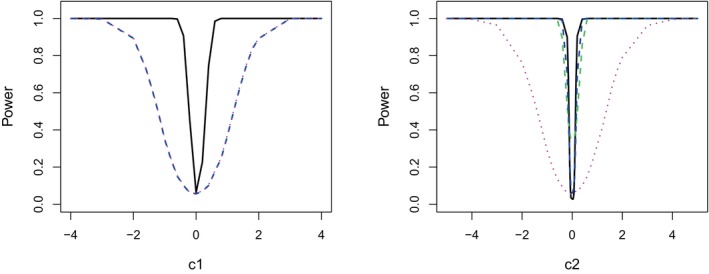 Figure 1
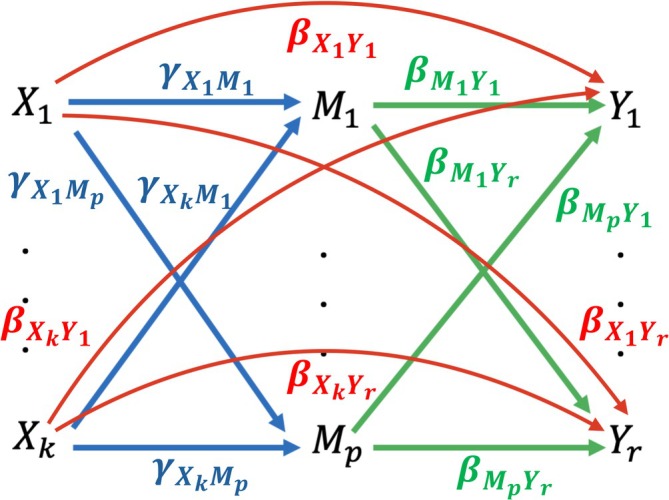 Figure 2
Peer Reviews
No public reviews on file for this paper yet. If you reviewed it on a platform where reviews are public (OpenReview, ICLR, NeurIPS, ICML), you can paste yours below so the community can read it here.
Videos
No videos yet. Explain this paper in a talk, walkthrough, or lecture? Add one.
Taxonomy
TopicsAdvanced Causal Inference Techniques · Statistical Methods and Inference · Genetic Associations and Epidemiology