Personalised Long‐Term Albumin Treatment Based on Three‐Month Ascites Response in Patients With Decompensated Cirrhosis
Enrico Pompili, Giulia Iannone, Salvatore Piano, Pierluigi Toniutto, Antonio Lombardo, Stefania Gioia, Marta Tonon, Roberta Gagliardi, Daniele Carrello, Greta Tedesco, Vito Di Marco, Giacomo Zaccherini, Lorenzo Lani, Maurizio Baldassarre, Silvia Nardelli, Davide Bitetto

TL;DR
This study shows that how patients with cirrhosis respond to albumin treatment after 3 months can help doctors personalize their long-term care and improve outcomes.
Contribution
A new method for personalizing long-term albumin treatment based on early ascites response in decompensated cirrhosis patients.
Findings
36% of patients were responders with better outcomes and higher chances of treatment discontinuation or transplantation.
Non-responders and partial responders had higher mortality and lower transplantation rates.
Stratifying patients by 3-month response helps guide individualized treatment and integrate other management options.
Abstract
Long‐term albumin (LTA) is effective for treating ascites in decompensated cirrhosis. This study aims to analyse the clinical courses of patients receiving LTA and provide a 3 month stratification to personalise management integrating LTA with other options. Patients receiving LTA included in the multicentre, retrospective, observational Real‐ANSWER study were stratified into three categories according to the response of ascites after 3 months of treatment: ‘responders’ (grade 0–1 ascites), ‘partial responders’ (at least grade 2 ascites not receiving therapeutic paracentesis) and ‘non‐responders’ (at least grade 2 ascites receiving therapeutic paracentesis). Clinical trajectories and outcomes of the different categories were compared. Of the 252 patients included (median Child‐Pugh 9, MELDNa 18), 36% were responders, 29% partial responders and 35% non‐responders. Responders differed…
Genes, proteins, chemicals, diseases, species, mutations and cell lines named across the full text — each resolved to its canonical identifier and authoritative record.
Click any figure to enlarge with its caption.
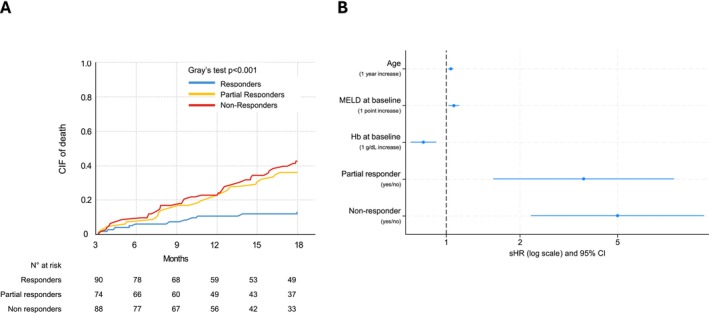 Figure 1
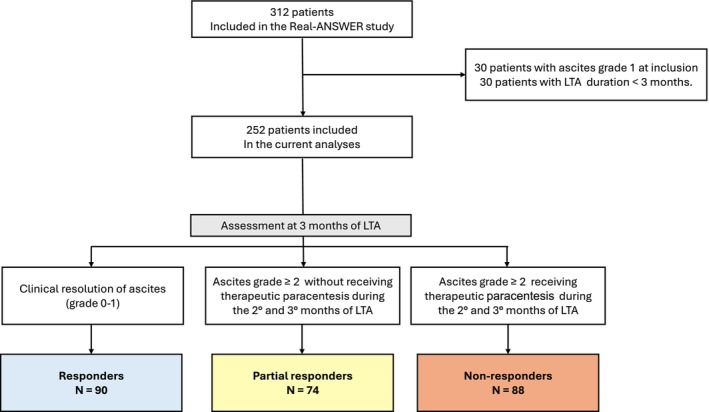 Figure 2
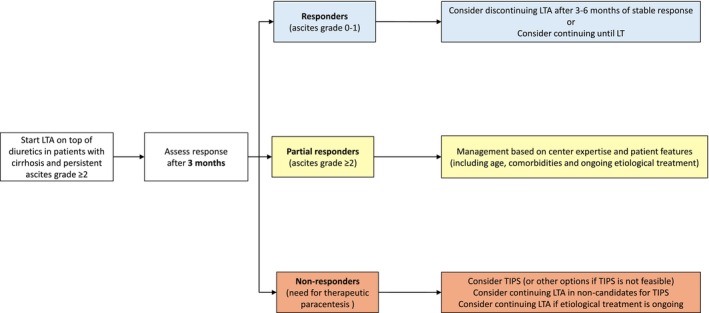 Figure 3
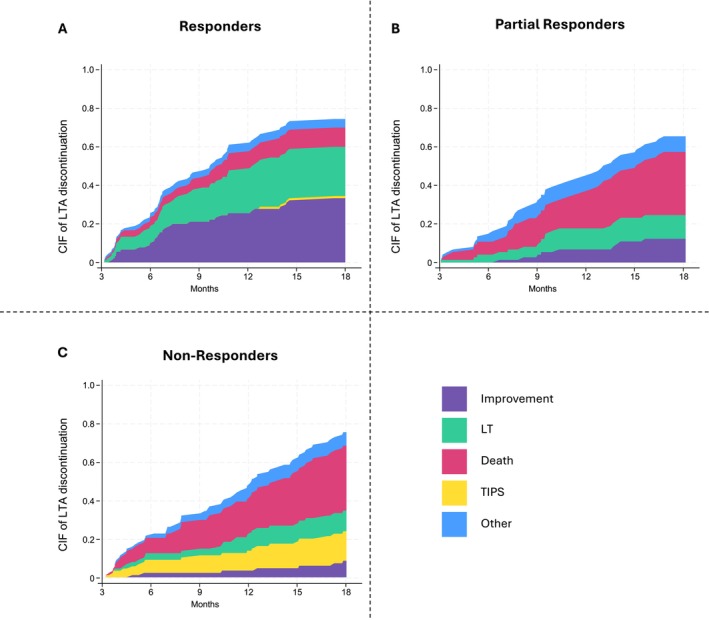 Figure 4
Peer Reviews
No public reviews on file for this paper yet. If you reviewed it on a platform where reviews are public (OpenReview, ICLR, NeurIPS, ICML), you can paste yours below so the community can read it here.
Videos
No videos yet. Explain this paper in a talk, walkthrough, or lecture? Add one.
Taxonomy
TopicsLiver Disease and Transplantation · Viral gastroenteritis research and epidemiology · Clinical Nutrition and Gastroenterology