Investigating the disturbance in cortical glutamate and GABA function in psychosis and its origins and consequences
Bill Deakin, Elizabeth Liddle, Mohanbabu Rathnaiah, Catherine C. Gregory, Mohammad Z. Katshu, Gemma Williams, Silke Conen, Richard Smallman, Loes C. Koelewijn, Adriana Anton, Jyothika Kumar, Lauren E. Gascoyne, Chen Chen, Naghmeh Nikkheslat, John Evans, Bernard Lanz

TL;DR
This study explores how changes in brain chemicals like glutamate and GABA may contribute to psychosis in schizophrenia, finding that GABA levels are lower in patients and linked to symptom severity.
Contribution
The study provides new evidence that GABA reduction in the dACC is associated with symptom severity in schizophrenia, independent of inflammation or oxidative stress.
Findings
Established schizophrenia patients show a greater glutamate deficit in the dACC compared to recently diagnosed patients.
GABA levels in the dACC correlate with symptom severity across both recent and established schizophrenia groups.
Glutamate deficits in established illness are not explained by inflammation, oxidative stress, or antipsychotic exposure.
Abstract
We investigated the longstanding idea that the onset of psychotic symptoms in schizophrenia arises from an early phase of glutamate neurotoxicity, possibly related to loss of GABA restraint, oxidative stress or inflammation, that cumulatively results in a later phase of synaptic loss in keeping with magnetic resonance spectroscopy (MRS) evidence of reduced glutamate in schizophrenia, especially in older patients. We evaluated this hypothesis in a 3-centre MRS study to determine whether abnormalities in glutamate in dorsal anterior cingulate cortex (dACC) differed between people with minimally treated ‘Recent’ onset schizophrenia and an ‘Established’ group with > 10 years of illness. We tested the hypothesised mechanisms of reduced GABA in either or both dACC and occipital cortex, and depletion of dACC glutathione, a measure of central inflammation. We explored predicted associations…
Genes, proteins, chemicals, diseases, species, mutations and cell lines named across the full text — each resolved to its canonical identifier and authoritative record.
Click any figure to enlarge with its caption.
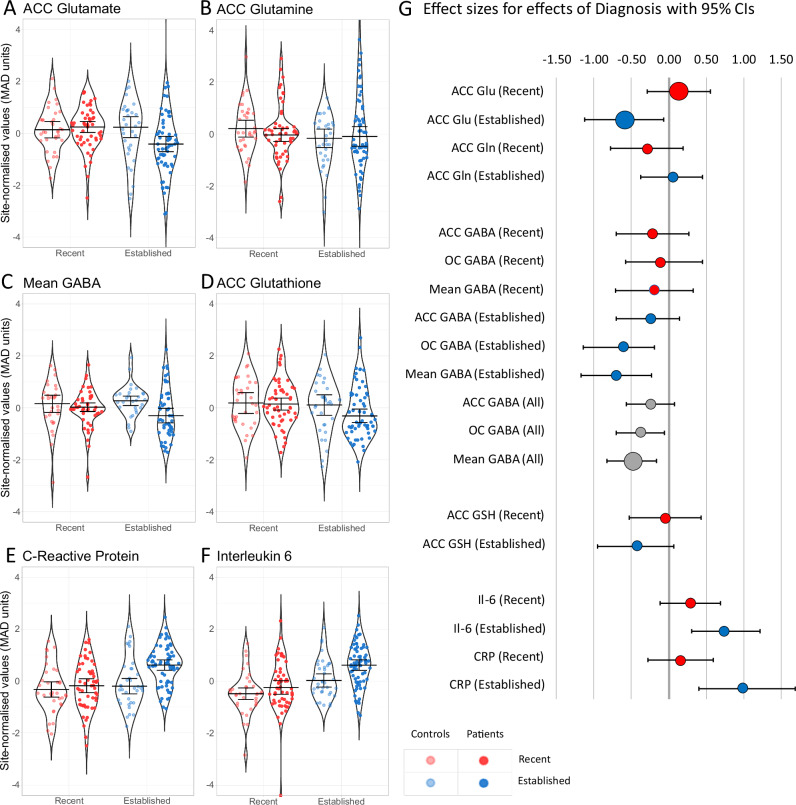 Figure 1
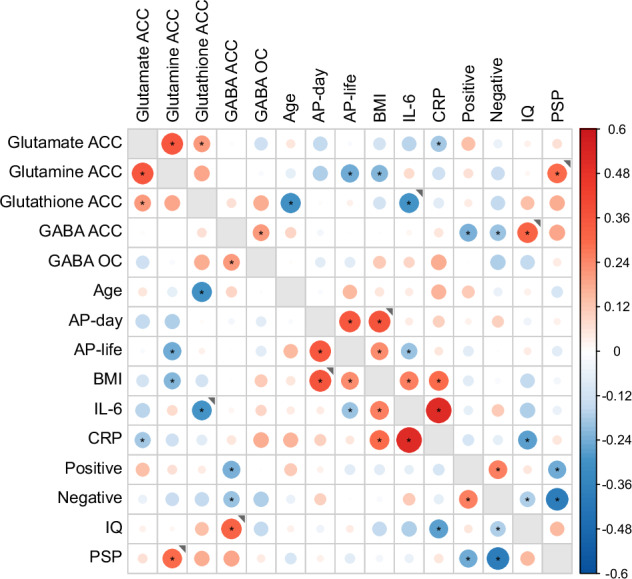 Figure 2
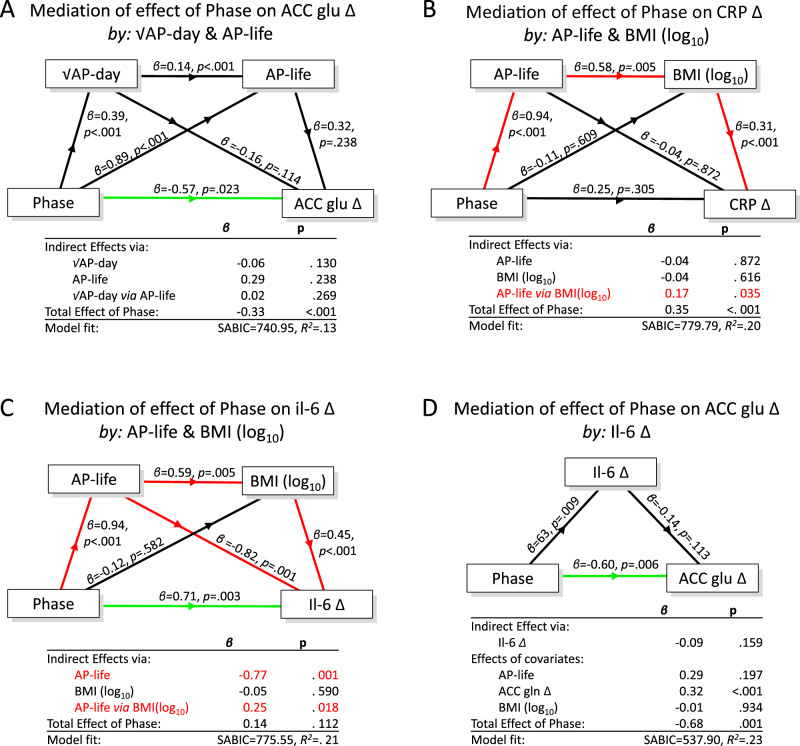 Figure 3
Peer Reviews
No public reviews on file for this paper yet. If you reviewed it on a platform where reviews are public (OpenReview, ICLR, NeurIPS, ICML), you can paste yours below so the community can read it here.
Videos
No videos yet. Explain this paper in a talk, walkthrough, or lecture? Add one.
Taxonomy
TopicsTryptophan and brain disorders · Neuroscience and Neuropharmacology Research · Schizophrenia research and treatment