3D imaging and anisotropy mapping of the lamb disc for biomechanical and regenerative insights
Ana Prates Soares, Andreia Sousa da Silveira, Jussi-Petteri Suuronen, Paul Helmerking, Timm Weitkamp, Bernhard Hesse, Katharina Schmidt-Bleek, Carsten Rendenbach

TL;DR
This study uses 3D imaging to map collagen fiber structure in a lamb's jaw joint disc, revealing how its organization affects mechanics and offering insights for designing better joint implants.
Contribution
The first full-volume, plane-resolved 3D description of collagen anisotropy in the ovine TMJ disc is presented.
Findings
The lamb TMJ disc has a heterogeneous but highly ordered collagen network with distinct fiber orientations in different anatomical planes.
Anisotropy is highest in peripheral regions and lowest in the central zone, indicating functional specialization.
Subchondral bone beneath the disc has a fine, anisotropic trabecular lattice that complements disc organization.
Abstract
The temporomandibular joint (TMJ) relies on a fibrocartilaginous disc for stabilization and load distribution. When the disc degenerates, current replacement options fail to restore native biomechanics. Developing effective implants requires detailed knowledge of the disc’s structure. The present work provides a full-volume, three-dimensional characterization of collagen fiber architecture and anisotropy in a large animal model with anatomical and functional similarities to the human joint. A multimodal 3D imaging workflow was implemented, combining cone-beam CT for anatomical context and synchrotron phase-contrast micro-CT for high-resolution visualization of the ovine temporomandibular joint disc, cartilage, ligament, and subchondral bone. Deep-learning segmentation enabled full-volume tissue segmentation. Fiber orientation and anisotropy were quantified using mean intercept length…
Genes, proteins, chemicals, diseases, species, mutations and cell lines named across the full text — each resolved to its canonical identifier and authoritative record.
Click any figure to enlarge with its caption.
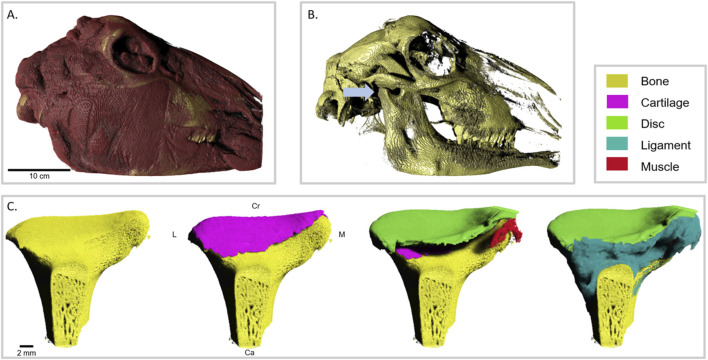 Figure 1
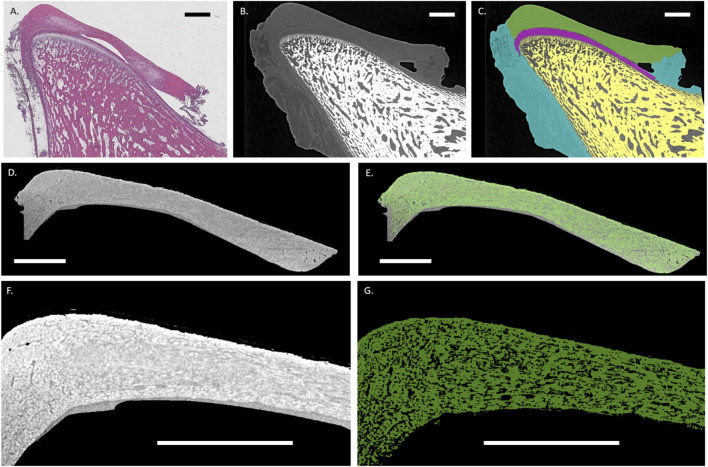 Figure 2
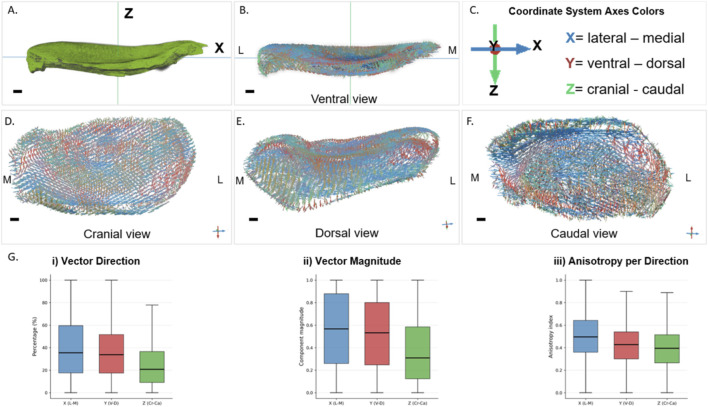 Figure 3
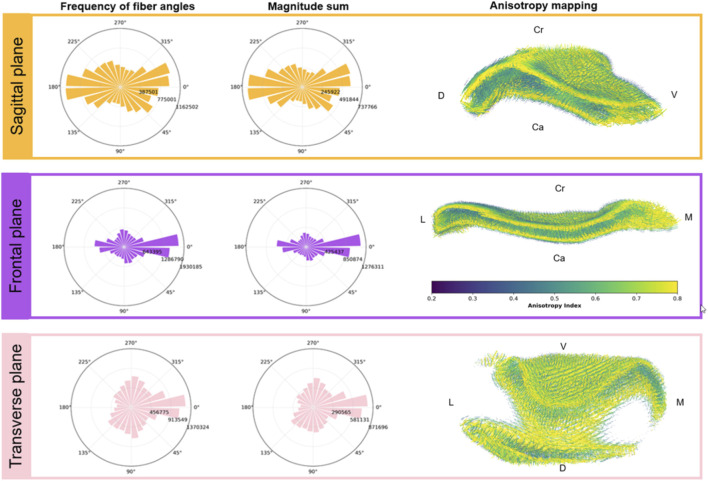 Figure 4
Peer Reviews
No public reviews on file for this paper yet. If you reviewed it on a platform where reviews are public (OpenReview, ICLR, NeurIPS, ICML), you can paste yours below so the community can read it here.
Videos
No videos yet. Explain this paper in a talk, walkthrough, or lecture? Add one.
Taxonomy
TopicsTemporomandibular Joint Disorders · Orthodontics and Dentofacial Orthopedics · Adhesion, Friction, and Surface Interactions