The self-reinforcing cycle under dual constraints—a study of the behavioral logic of urban empty-nest older adults substituting self-medication for formal medical treatment
Ji Wu, Yuanyuan Liu, Siwen Li

TL;DR
This study explores how urban empty-nest older adults in China cope with health issues by substituting self-medication for formal treatment due to structural and social challenges.
Contribution
The paper introduces a theoretical model explaining the self-reinforcing cycle of health behaviors in empty-nest older adults under dual constraints.
Findings
Empty-nest older adults face dual constraints of inadequate support and health vulnerability, influencing their health behaviors.
Self-medication is used as a survival strategy to maintain autonomy and achieve social adaptation through peer support.
A self-reinforcing cycle of health behaviors is driven by illness experience and health anxiety, leading to recurring health issues.
Abstract
Against the stark backdrop of China’s rapidly aging population and the high prevalence of chronic diseases among the older adults, urban empty-nesters face a dual challenge stemming from inadequate intergenerational support and heightened health vulnerability. A deeper understanding of their illness coping behavior is therefore critically needed. This study employs grounded theory methodology, conducting in-depth interviews with 25 empty-nest older adults in H City. A total of 290,000 words of interview texts were collected to generate a theoretical model, systematically revealing the individual cognitive framework and dynamic mechanisms of health behaviors within this group. The study reveals a “dual constraints–trigger mechanism–self-reinforcing cycle” logic underpinning the health coping strategies of empty-nest elders: (1) At the precondition level, insufficient intergenerational…
Genes, proteins, chemicals, diseases, species, mutations and cell lines named across the full text — each resolved to its canonical identifier and authoritative record.
Click any figure to enlarge with its caption.
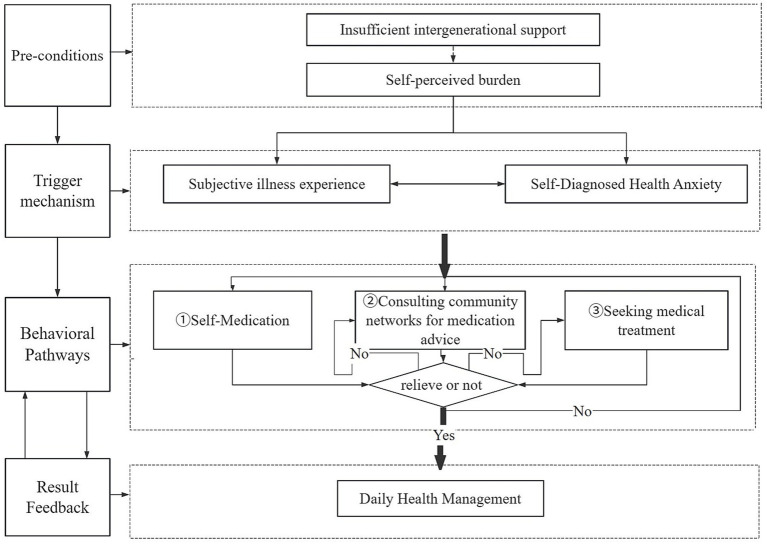 Figure 1
Peer Reviews
No public reviews on file for this paper yet. If you reviewed it on a platform where reviews are public (OpenReview, ICLR, NeurIPS, ICML), you can paste yours below so the community can read it here.
Videos
No videos yet. Explain this paper in a talk, walkthrough, or lecture? Add one.
Taxonomy
TopicsIntergenerational Family Dynamics and Caregiving · Chronic Disease Management Strategies · Health disparities and outcomes